
AI Ad Copy A/B Testing: A Step-by-Step Workflow for Paid Media Managers
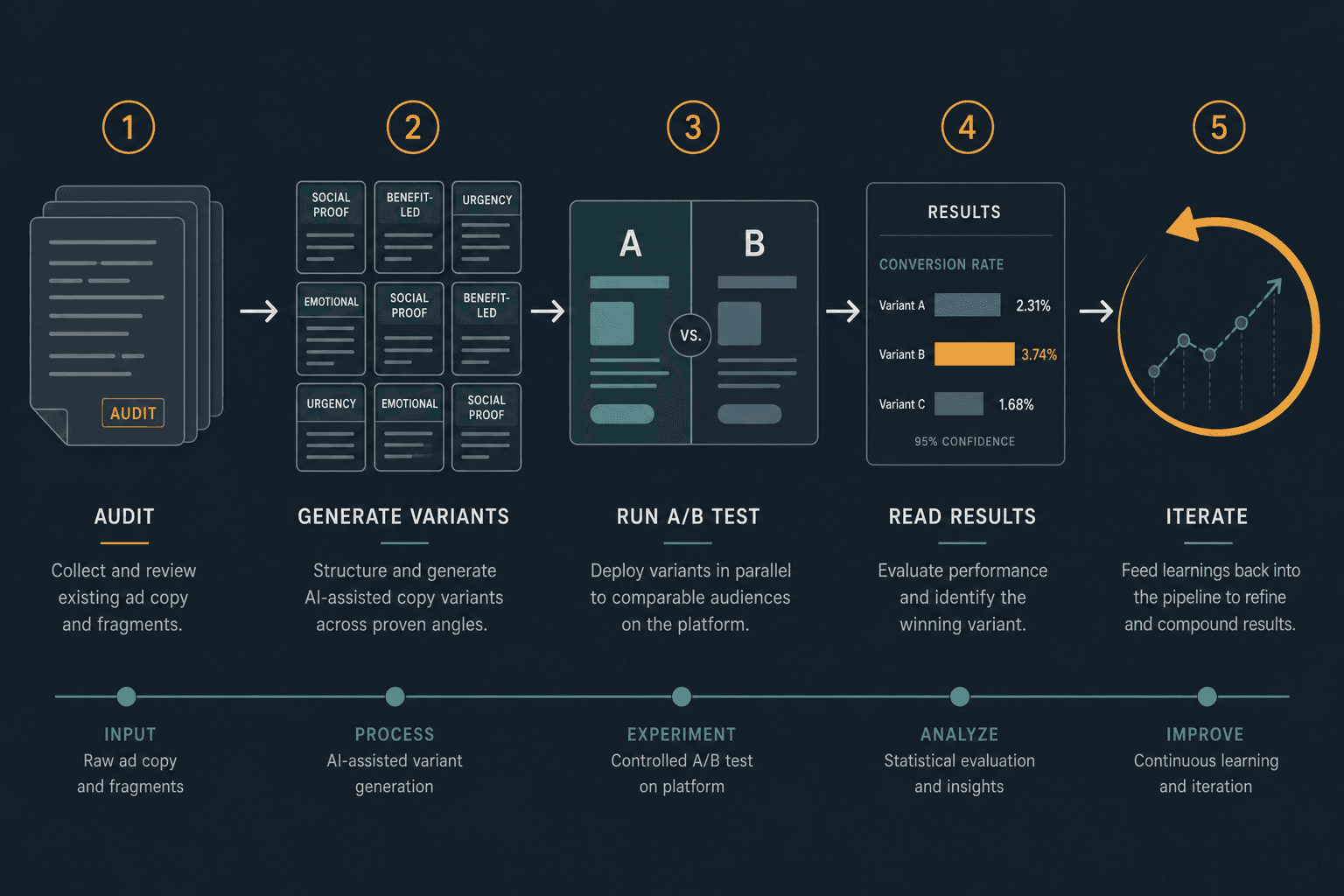
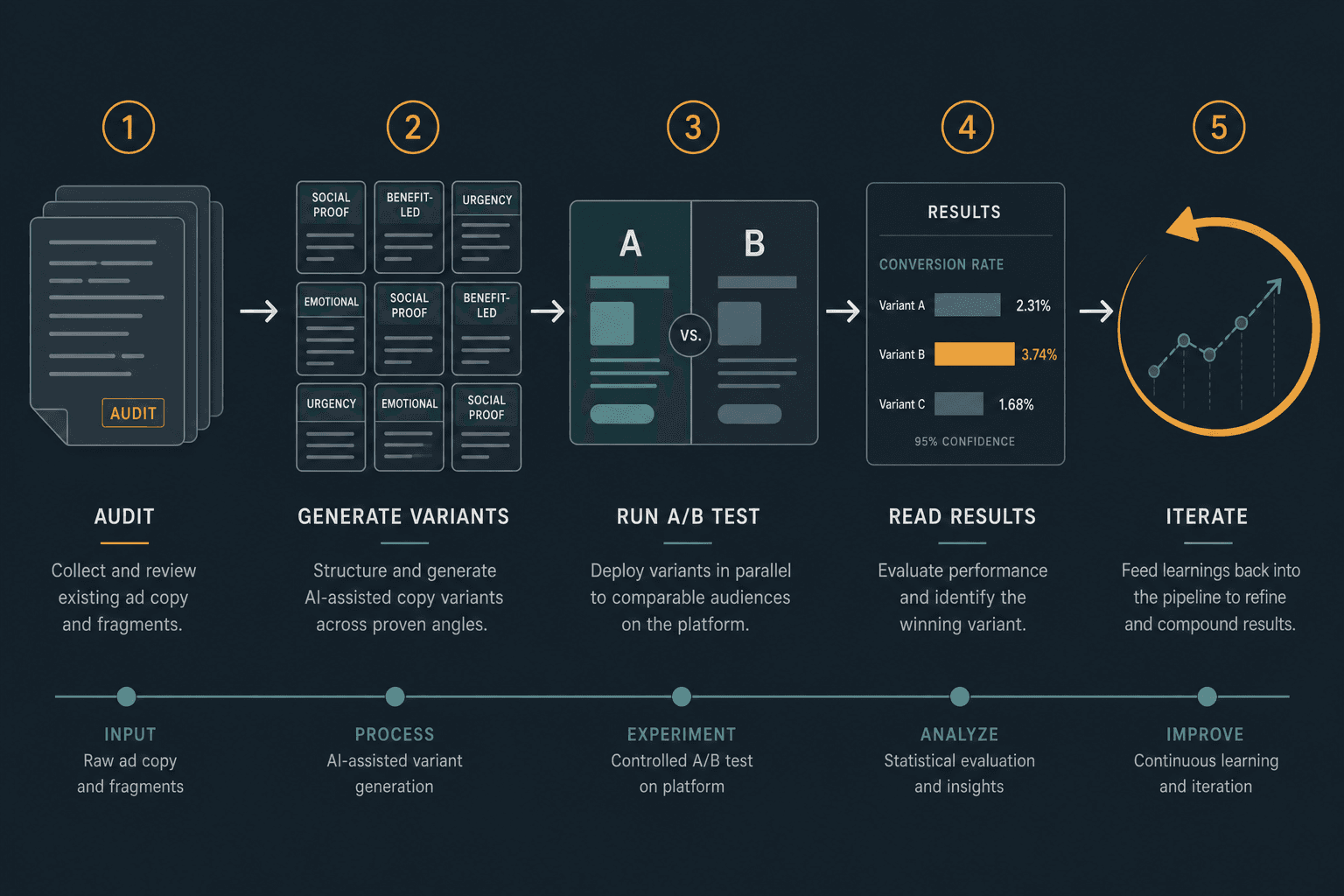
Most ad copy tests fail before the first impression because weak, undifferentiated variants enter the test — not because the test mechanics are broken. This guide walks paid media managers through a repeatable five-step AI-assisted loop: auditing existing copy, generating hypothesis-driven variants with an LLM, setting up platform-native tests on Meta and Google, reading results correctly, and feeding winners back into the next cycle.
Why Most Ad Copy Tests Fail Before They Start
The standard diagnosis for a failed ad copy test is that the test mechanics broke down — wrong duration, insufficient budget, platform interference. That diagnosis is usually wrong. Most copy tests fail before the first impression is served because the variants entering the test are weak, undifferentiated, and untethered from any hypothesis.
When two variants say essentially the same thing in slightly different words, the test cannot produce a learning. You get noise, not signal. The correct response is not to run the test longer or spend more — it is to go back upstream and generate variants that are actually distinct.
The scale of this problem is visible in creative performance data. An analysis of 550,000+ ads and $1.3B in spend attributed to Motion's 2026 benchmarks — cited in Alex Neiman's breakdown of Meta creative testing — found that only around 5% of ad creatives become meaningful winners, and roughly 50% receive no significant spend at all. Most of that waste is not a bidding problem or a targeting problem. It is a creative input problem.
The urgency of fixing this has increased since Meta's Andromeda retrieval system rolled out globally in October 2025. Andromeda increased the complexity of Meta's ad retrieval model by an order of magnitude, with one consequence that directly affects copy testing: ads scoring above 60% on Meta's Creative Similarity Score now trigger retrieval suppression. Five ads with the same layout and slightly different headlines will cannibalize each other's reach rather than compete for the same audience.
On Google, the shift to AI Max campaigns — available across North American accounts from early 2026 — removes keyword targeting as an advertiser lever. Gemini handles query matching, copy assembly, and bidding. The primary advertiser input becomes the landing page and the copy angle. In both environments, creative testing and audience testing are now effectively the same activity.
The workflow in this guide addresses the upstream failure point directly. It starts with a performance data audit, moves through hypothesis-driven LLM variant generation, covers platform-native test setup on both Meta and Google, and closes with a weekly iteration cadence that compounds over time. No enterprise automation platform required.
The Testing Hierarchy: Test the Big Levers First
Before touching any tool, you need a sequencing principle. Not all copy variables produce equal performance swings, and testing in the wrong order is one of the most common and costly mistakes in paid media.
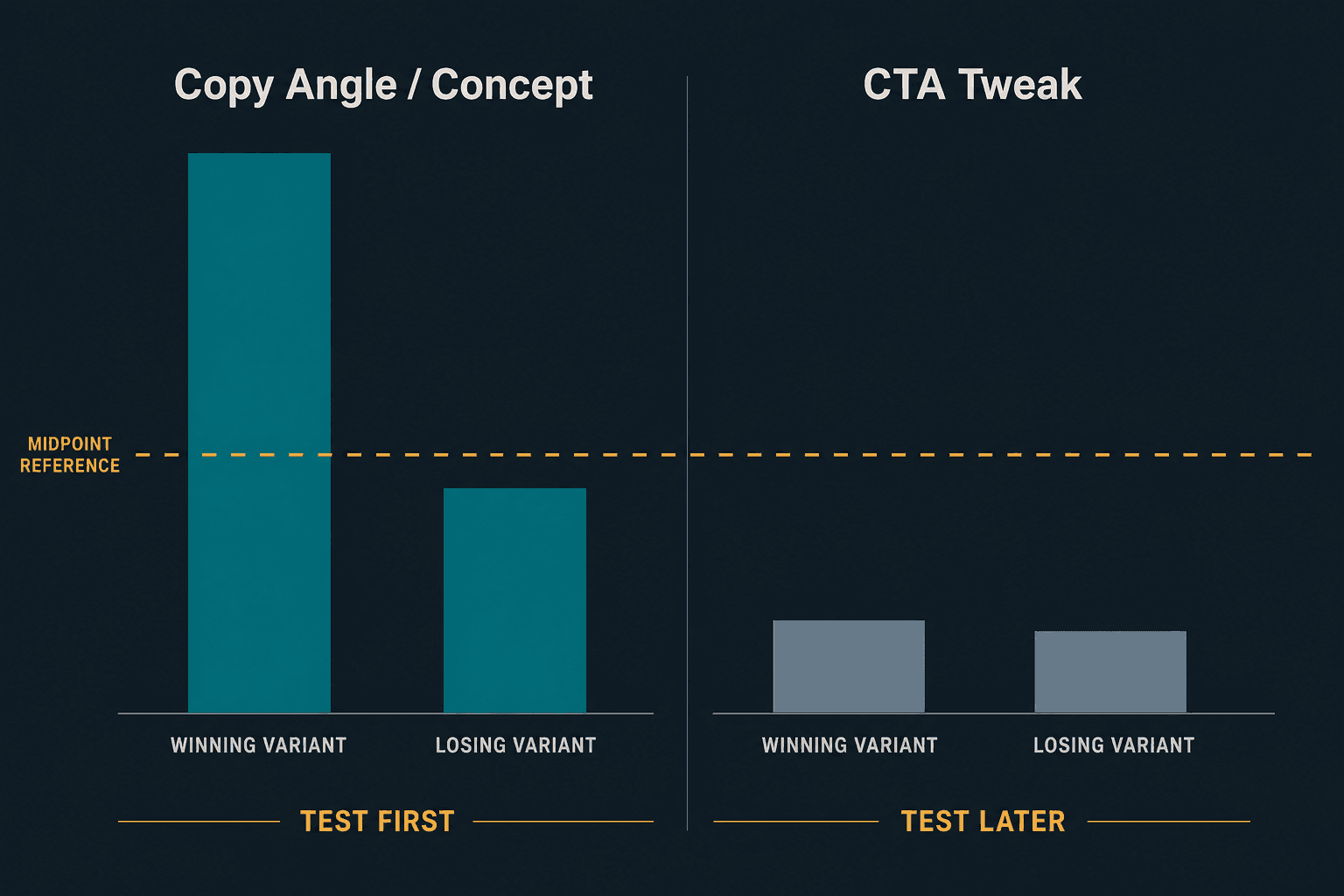
Alex Neiman's analysis of DTC account data provides directional performance swing ranges by variable type. These are benchmarks from specific account data, not universal guarantees — but the ordering holds across most accounts:
| Variable | Typical performance swing | Test priority |
|---|---|---|
| Concept / copy angle | 2x–5x CPA difference | First |
| Format (video vs. static, story vs. feed) | 50–200% CPA difference | Second |
| Hook (opening line or frame) | 30–100% CTR difference | Third |
| Visual style | 20–50% CTR difference | Fourth |
| CTA / copy length | 10–25% conversion difference | Last |
The implication is direct: if you are running a test that swaps "Shop Now" for "Get Started" before you have tested whether a fear-based angle outperforms a benefit-led angle, you are optimizing the wrong layer. A CTA change that produces a 12% lift on a weak copy angle is smaller than the gain from finding an angle that halves CPA.
Start with concept and angle. When you have a winning angle, move to format. When you have a winning format, optimize the hook. Work your way down the hierarchy, not up from it.
Step 1: Audit Your Existing Copy and Extract Winning Patterns
The most common mistake in AI-assisted copy generation is starting with a blank prompt. A blank prompt produces generic output because the model has no account-specific signal to work with. The audit in this step produces that signal.
What to pull from each platform
- Meta Ads Manager: Export the last 90 days of ad-level data. Include primary text, headline, CTR, CPA, conversion rate, and frequency. Filter to ads with at least 1,000 impressions so you are not reading noise.
- Google Ads (RSA): Navigate to Campaigns > Assets > Performance tab. Filter asset type to Headline. Export the headline-level data including performance ratings (Best, Good, Low), click-through data, and conversion data where available. Pull descriptions separately.
- Flag your top 20% and bottom 20% by CPA. You are looking for the structural difference between what works and what does not — not just the performance number.
How to prompt an LLM for pattern analysis
Paste the winning and losing copy into your LLM with a structured analysis prompt. You are not asking it to write new copy yet — you are asking it to identify what distinguishes the performers from the non-performers.
I'm going to give you two sets of ad copy from my Meta campaigns. Set A are my top performers by CPA over the last 90 days. Set B are my worst performers by CPA over the same period.

Set A (Winners):
[paste winning headlines and primary text here]

Set B (Losers):
[paste losing headlines and primary text here]

Analyze the structural and messaging differences between the two sets. Specifically:
1. What opening hooks, sentence structures, or framing patterns appear in Set A but not Set B?
2. What benefit types or emotional tones appear more often in Set A?
3. What patterns in Set B seem to correlate with poor performance?
4. What copy angle categories would you assign to each ad (e.g., social proof, urgency, benefit-led, problem agitation)?

Do not generate new copy yet. Output your analysis as a structured list.
The output becomes your grounding document for Step 2. Save it. If you skip this step and prompt for variants directly, you will get output that could have been written for any advertiser in your category.
Step 2: Generate Hypothesis-Driven Variants with an LLM
With the audit output from Step 1 in hand, you can now generate variants that isolate a single variable — which is what makes a test learnable. Each method below changes one thing and holds everything else constant.
Either Claude or ChatGPT works for this task. The choice depends on your existing workflow and which model handles your brand voice better — see the ChatGPT vs. Claude comparison for paid media teams if you want guidance on routing specific tasks to each model.
Method 1: Hook angle testing
Same offer, same CTA, same benefit. Only the opening hook varies. This is the highest-leverage test you can run because hook angle determines whether the ad earns the next second of attention.
Based on this audit finding: [paste relevant pattern from Step 1 output]

Generate 5 headline variants for this ad. Each variant should use a different opening hook type. Keep the core offer and CTA identical across all variants. Hook types to use:
- Problem agitation (lead with the pain state)
- Social proof (lead with a result or customer signal)
- Curiosity gap (lead with an incomplete information frame)
- Benefit promise (lead with the primary outcome)
- Urgency / scarcity (lead with a time or availability constraint)

Product/offer: [describe your product and offer]
Target audience: [describe your audience]
Current best-performing headline for reference: [paste it]

Output each variant on its own line, labeled by hook type.
Method 2: Benefit priority testing
Each variant leads with a different primary benefit while keeping secondary benefits and the CTA consistent. This tests which benefit your audience cares most about — not whether they care about the product.
My product has these benefits: [list 4–6 distinct benefits from your product or landing page]

Generate 4 ad primary text variants. In each variant, a different benefit from the list above should appear in the first sentence. Secondary benefits can appear later in the copy but should stay consistent across variants. CTA should be identical across all variants: [your CTA].

Audience: [describe]
Tone: [e.g., direct and factual / conversational / aspirational]
Character limit per variant: [e.g., 125 characters for headline / 500 characters for primary text]
Method 3: Emotional tone testing
Same core message, different emotional register. This is useful when your audit shows that your current copy clusters heavily in one tone — typically either very rational or very urgent — and you have not tested the other end of the spectrum.
Rewrite this ad copy in 3 different emotional tones. Keep the core message and offer identical. Only the tone and emotional intensity should change.

Original copy: [paste your current best-performing ad copy]

Tone variants to produce:
1. Rational / factual — data-forward, no emotional language
2. Empathetic / conversational — acknowledges the audience's situation before presenting the offer
3. High urgency — creates a sense of immediate consequence for not acting

Output each variant labeled by tone.
Method 4: Format and length testing
Tests whether the structural format of the copy — not its message — affects performance. Run this after you have a winning angle and tone, not before.
Take this winning ad copy and reformat it into 4 structural variants. The core message and angle must stay the same. Only the format should change.

Winning copy: [paste]

Format variants:
1. Ultra-short — single punchy sentence, 10 words or fewer
2. Bullet list — 3 benefit bullets, no narrative prose
3. Story narrative — brief before/after or problem/solution arc
4. FAQ structure — opens with a question the audience is likely asking, then answers it

Target platform: [Meta feed / Google RSA headline]
Character limits: [specify]Step 3: Set Up Tests on Platform — Meta and Google Separately
Meta and Google have structurally different testing mechanics. Treating them the same way is a setup error that produces either invalid results or no results at all. Cover each platform separately before running anything.
Meta Ads: Use Meta Experiments for controlled tests
Meta offers three testing modes with different tradeoffs. For copy angle tests — which is what this workflow produces — Meta Experiments A/B Test is the right tool:
- Meta Experiments A/B Test: The most controlled option. Supports 2–5 variations, tests one variable, splits traffic cleanly, and produces statistically meaningful results. Use this for high-stakes decisions about copy angle.
- Creative Testing Feature (rolled out October 2025): Prevents uneven delivery optimization across ads. A controlled creative comparison without the full Experiments setup. Useful for mid-stakes creative comparisons.
- Directional testing (Advantage+ or multiple creatives in one ad set): Fast but not a clean experiment. Useful for early exploration before committing to a formal test. Not appropriate for drawing confident conclusions.
For budget sizing: plan for approximately 50 optimized conversion events per variant to reach a statistically meaningful result. At a $40 CPA, a two-variant test requires roughly $4,000 in total spend. Adjust for your actual CPA.
Test duration: 4–7 days minimum, 30 days maximum. Beyond 30 days, seasonal shifts and market changes begin to contaminate the results. Do not use the "end early if winner found" setting for high-stakes decisions — it inflates false positives. Set a fixed duration and hold it.
Google Ads RSA: There is no native A/B toggle
This is the structural fact that most copy testing guides gloss over: Google Responsive Search Ads do not have a native A/B testing switch. Google assembles headline combinations dynamically from up to 15 headlines, which means you cannot isolate a single headline variant the way Meta Experiments isolates a creative.
There are two correct workarounds, each suited to a different testing goal:
| Goal | Tool | How it works | Best for |
|---|---|---|---|
| Test a fundamentally different copy angle | Google Campaign Experiments | Duplicates the campaign, splits traffic between original and experiment, produces statistically significant results at the campaign level | Angle-level hypothesis tests — e.g., benefit-led vs. problem agitation |
| Monitor individual headline performance over time | Campaigns > Assets > Performance tab | Shows per-headline click and conversion data; filter to Headline asset type; performance ratings (Best / Good / Low) update continuously | Ongoing headline pruning and signal gathering |
| Find-and-replace copy changes at scale | Google Ad Variations | Applies text changes across many ads at once; not a controlled experiment | Bulk copy updates, not hypothesis testing |
For per-headline asset data, use a pinning strategy to get cleaner signals: pin your hypothesis headline to position 1 and leave positions 2 and 3 open. This forces Google to serve your test headline consistently while still allowing the system to optimize the remaining positions. Cut headlines rated Low with high impressions — they are actively dragging performance.
Step 4: Read Results Without Drawing Wrong Conclusions
Result misreading is where well-structured tests produce bad decisions. There are three distinct failure modes here, and each leads to a different type of error.
Statistical significance vs. practical significance
A result can be statistically significant — unlikely to be random — and still be practically irrelevant. If variant A beats variant B by 4% CPA at 95% confidence, but the margin is smaller than your normal week-to-week CPA variance, you have not found a winner worth scaling. Ask whether the performance difference would meaningfully change your campaign economics before declaring a winner.
Underpowered tests
Tests with fewer than 50 conversion events per variant are underpowered. The result could go either way on the next 50 conversions. If you call a winner at 20 conversions per variant, you are making a decision based on noise. Either wait for more data or acknowledge that the test result is directional only.
What inconclusive actually means
An inconclusive result is not a failed test. It is information: the variable you tested did not matter at the margin you tested it. The correct operational response is not to run the test again with the same variants. It is to go back to Step 2 and generate variants that are more structurally distinct — a bigger angle change, not a smaller copy tweak.
Fatigue signals and kill thresholds
Creative fatigue has accelerated. Liftoff 2026 data cited by Alex Neiman shows video ads now fatigue in 9.2 days on average, down from 14 days in 2024. Static copy fatigues more slowly, but the compression is real across formats.
| Signal | Kill threshold | Action |
|---|---|---|
| Frequency | > 3.5 | Pause the ad and rotate in a new variant |
| CTR trend | > 20% decline from launch baseline | Flag for review; pause if decline continues |
| CPA trend | > 40% increase from launch baseline | Pause immediately |
| CPM trend | > 25% increase from launch baseline | Monitor; may indicate audience saturation |
Step 5: The Iteration Loop — Feeding Winners Back In
The compounding value of this workflow comes from what happens after a test concludes. Winning elements — the specific hooks, angles, and benefit framings that outperformed — replace the original audit data as the grounding material for the next generation cycle in Step 2.
Each cycle, your LLM prompts become more specific because they are built on a growing record of what works in your account, for your audience, in your category. This is the mechanism that makes the loop compound over time. Without it, every generation cycle starts from scratch and produces generic output.
The weekly cadence that makes this operational:
- Monday: Pull performance data from the prior week. Tag winners and losers. Update your grounding document with new winning hooks, angles, and framings.
- Tuesday: Run LLM generation using winning elements as inputs. Generate 15–20 variants across the four methods in Step 2. Aim for structural diversity — not variations on the same angle.
- Wednesday: Human brand review. Check every variant for accuracy, compliance, and brand voice. Cut anything that would not pass a legal or brand review. This step is not optional.
- Thursday: Load approved variants into the test. Pause ads that have hit fatigue thresholds. Do not restructure campaigns during active learning phases.
- Friday: Check learning phase status. Queue the next round of variants for the following week. Archive non-launched variants — do not discard them. They become candidates for the next rotation in 4–6 weeks when the audience has refreshed.
Common Mistakes That Break the Loop
- Testing CTA before angle. The most expensive sequencing mistake. A 15% CTA lift on a weak angle is smaller than the gain from finding an angle that changes CPA by 2x. Follow the testing hierarchy.
- Running underpowered tests. Calling a winner at 15–20 conversion events per variant is not a result — it is a guess. Wait for 50 events per variant or label the output as directional only.
- Using cold LLM prompts without audit grounding. A prompt that does not reference your historical performance data will produce output that could work for any advertiser in your space. It will not produce variants worth testing.
- Treating inconclusive as failure. An inconclusive result tells you the variable did not matter at the margin you tested. The correct response is a more distinct change, not a smaller tweak or a re-run of the same test.
- Pausing tests early when one variant appears to lead. Early leaders often regress. The "end early if winner found" setting in Meta Experiments inflates false positives. Use a fixed duration.
- Restructuring campaigns during the learning phase. Any significant change — budget, targeting, creative — resets the learning phase and invalidates accumulated data. Make structural changes only after the learning phase completes.
- Skipping the human brand review. AI-generated copy requires human review for accuracy and brand safety before going live. This is not a step you can compress. See the AI hallucination detection guide for specifics on what to check.
Minimal Tool Stack: What You Actually Need
This workflow does not require an enterprise automation platform, a purpose-built creative testing tool, or a paid AI subscription beyond what most teams already have. The baseline is two things: one LLM and the platform-native testing tools built into Meta and Google.
| Tool | Role in workflow | Cost | Required? |
|---|---|---|---|
| Claude or ChatGPT | Copy audit analysis (Step 1) and variant generation (Step 2) | Free tier available; paid plans ~$20/month | Yes — one of these |
| Meta Experiments | Controlled A/B test setup on Meta Ads | No additional cost; native to Meta Ads Manager | Yes for Meta campaigns |
| Google Campaign Experiments | Traffic-split copy angle tests on Google Search | No additional cost; native to Google Ads | Yes for Google angle tests |
| Google Ads Assets report | Per-headline performance data for ongoing RSA optimization | No additional cost; native to Google Ads | Yes for RSA iteration |
| Adalysis | Purpose-built RSA test workflow management | $149/month | No — optional for teams wanting more structure |
| Google Ad Variations | Find-and-replace copy changes at scale | No additional cost; native to Google Ads | No — not for controlled testing |
For the LLM choice: either Claude or ChatGPT handles the prompts in this workflow. If you want to understand the current capability differences between them before committing to one, see the ChatGPT vs. Claude comparison for marketing teams. For readers who want to understand what has changed in ChatGPT since GPT-4o, the ChatGPT 2026 changelog for marketers covers the practical capability shifts from GPT-4o through GPT-5.5.
Comments
Join the discussion with an anonymous comment.