

AI Hallucination Detection and Prevention for Marketing Teams
A practitioner-depth playbook for content strategists, demand-gen managers, and SEO leads who use AI writing tools daily and need a systematic, team-deployable process to stop fabricated statistics, fake citations, and invented claims from reaching published content. Covers seven marketing-specific hallucination types, four prevention layers to apply during generation, a five-pass pre-publish verification checklist, and a ready-to-use team SOP with named accountable roles.

Why Marketing Content Is Uniquely High-Risk for AI Hallucinations
Picture this: your content team ships a thought-leadership post citing a Gartner statistic — "67% of B2B buyers now complete two-thirds of the purchase journey before contacting sales" — with no link because the AI generated it as a plausible-sounding fact. Three months later, a prospect's procurement team can't verify the number. Your credibility takes the hit, not the model that invented it.
This isn't a hypothetical edge case. It's a systematic production risk. The specific claim types that AI models hallucinate most often — statistics, competitor data, case study outcomes, regulatory requirements — are precisely the claims that carry the most weight in marketing content. They're the evidence layer that makes a blog post persuasive, a landing page credible, or a sales enablement piece trustworthy.
The scale of the problem is documented. McKinsey's 2025 Global Survey on AI found that 88% of organizations report regular AI use — and 51% of those using AI saw at least one negative consequence. Nearly one-third specifically cited AI inaccuracy as the source of that consequence. These aren't developers running experimental pipelines. These are marketing teams publishing content.
The compounding problem is citation-laundering. A fabricated statistic published in one blog post gets cited by a second post, then a third. Within months, the invented number has multiple apparent sources and looks thoroughly verified. Each citation makes it harder to retract and silently erodes the E-E-A-T signals that search engines use to assess content quality.
Seven Hallucination Types That Hurt Marketing Teams
Not all hallucinations create equal damage. A wrong date in a historical timeline is annoying. A fabricated competitor pricing table or an invented customer quote is a liability. These seven types, drawn from documented marketing incidents, represent the failure modes most likely to reach publication and cause real harm.
| Hallucination Type | What It Looks Like | Marketing Damage |
|---|---|---|
| Fabricated statistics | "Studies show 73% of marketers report…" with no source link | Citation-laundering propagation; E-E-A-T damage; public fact-checks |
| Fake citations | Real organization name, invented study title or publication year | Credibility collapse when readers verify; mirrors Mata v. Avianca pattern |
| Invented case studies | "Brand X achieved 3x ROI using this approach" — brand never ran the campaign | Brand defamation risk; factual correction demands from named company |
| Wrong competitor pricing | Discontinued pricing tiers or incorrect feature tiers listed as current | Competitor screenshots the error publicly; sales team undermined mid-deal |
| Hallucinated customer quotes | Attributed testimonial from a real customer who never said it | Potential FTC Endorsement Guide exposure; immediate trust collapse if customer sees it |
| False product claims | "Integrates with Salesforce, HubSpot, and Zoho" when only HubSpot is supported | Customer support escalations; compliance issues if claims touch regulated features |
| Fake regulation references | "Per GDPR Article 17(3)(b)…" with invented sub-clause language | Legal liability; compliance teams flagging published content; reader distrust |
One practical detection signal cuts across several of these types: round numbers. Real research data is messy. Survey results land at 43%, 67%, 81% — not at 50%, 70%, or 80%. When AI generates a statistic that's a clean multiple of five or ten, treat it as a hallucination signal until you locate the primary source.
How Bad Is the Problem? What 2025–2026 Benchmarks Actually Show
The most common assumption in marketing teams is that newer, more capable models are safer to trust. The benchmark data says otherwise.
Vectara's hallucination leaderboard — the most rigorous public benchmark available, covering 7,700+ articles across law, medicine, finance, technology, and business — was last updated May 11, 2026. On the harder dataset, which uses longer documents and more demanding summarization tasks, the results for the models most commonly used in marketing workflows are sobering:
| Model | Hallucination Rate (Hard Dataset) | Tier |
|---|---|---|
| antgroup/finix_s1_32b | 1.8% | Specialist |
| openai/gpt-5.4-nano | 3.1% | Specialist |
| google/gemini-2.5-flash-lite | 3.3% | Specialist |
| mistral-large | 4.5% | Mid-tier |
| claude-sonnet-4 | 10.3% | Frontier reasoning |
| claude-opus-4 | 12.0% | Frontier reasoning |
| gemini-3-pro-preview | 13.6% | Frontier reasoning |
| grok-4-fast-reasoning | 20.2% | Frontier reasoning |
| o3-pro | 23.3% | Frontier reasoning |
The pattern that should concern marketing teams most is the reasoning model gap. GPT-5, Claude Sonnet 4.5, Grok-4, and Gemini-3-Pro — the most capable models available in 2026 — all exceed 10% hallucination rates on the harder benchmark. The hypothesis from researchers is that reasoning models invest more computation in "thinking through" answers, which can cause them to drift from source material rather than staying grounded in it.
A finding from MIT researchers in January 2025 adds another dimension to this: AI models use 34% more confident language when hallucinating than when stating correct facts. The wronger the model is, the more certain it sounds. That's the core reason why deadline-pressured reviewers miss hallucinations — the fabricated statistic reads with exactly the same confidence as the verified one.
Four Prevention Layers to Build Into Your Content Workflow
Prevention is more efficient than detection. Catching a fabricated statistic before it enters the draft costs thirty seconds. Retracting it after publication costs your team hours and your brand credibility. These four layers work at the generation stage, before content reaches the review queue.
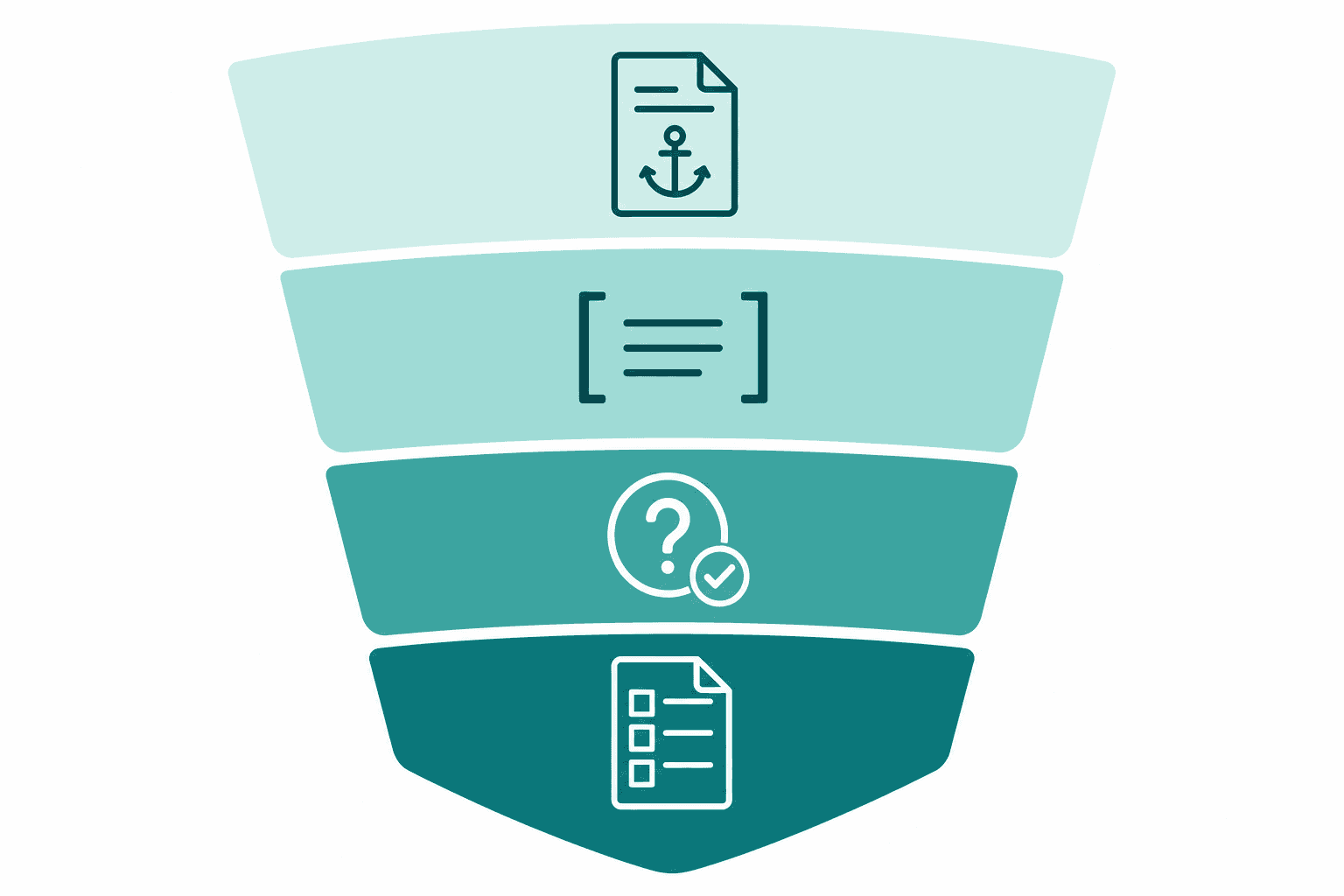
Layer 1: Source-Grounded Prompting
The single most effective structural intervention is giving the model a document to work from rather than asking it to recall facts from training data. Paste your primary sources — research reports, product documentation, approved stats — directly into the prompt context. Instruct the model to use only the provided material for factual claims.
This approach — often called retrieval-augmented generation (RAG) when automated — reduces hallucination rates by up to 71%. The caveat matters: that reduction only holds if the source documents you provide are themselves accurate and current. Pasting a two-year-old industry report as your source document doesn't reduce hallucination — it redirects it toward outdated facts.
Layer 2: Citation-Required Instructions
This is the highest-ROI intervention in the stack and requires zero new tools or budget. Add a single instruction to every factual content prompt: if the model cannot attribute a claim to a specific source in the provided context, it must write [VERIFY] or [SOURCE NEEDED] as a placeholder instead of generating a plausible-sounding fact.
The result is a draft with clearly flagged gaps rather than a draft with confidently stated fabrications. A reviewer scanning for [VERIFY] can address each gap in minutes. A reviewer scanning for hallucinations they don't know exist is working blind.
CITATION INSTRUCTION (add to any factual content prompt):

For every statistic, study finding, competitor claim, customer quote, or regulatory reference you include:
- If you have a specific source in the provided documents, cite it inline: [Source: Document Name, page/section]
- If you do not have a specific source, write [VERIFY] immediately after the claim
- Do not generate plausible-sounding statistics, citations, or quotes without a source in the provided context
- It is always better to write [VERIFY] than to invent a fact
Layer 3: Explicit Uncertainty Permission
Language models are trained on human-generated text, and humans rarely write "I don't know" in formal contexts. The model has learned to suppress uncertainty and produce a confident answer even when it has no reliable basis for one. You can partially override this by explicitly giving the model permission — and a direct instruction — to express uncertainty.
UNCERTAINTY PERMISSION (add to research and factual drafting prompts):

If you are uncertain about a fact, date, statistic, or attribution, say so explicitly rather than generating a best guess. Use phrases like:
- "I'm not certain of the exact figure — [VERIFY]"
- "The source for this claim is unclear — [SOURCE NEEDED]"
- "This may have changed — please verify against current documentation"

Do not present uncertain information with the same confidence as verified information.
Layer 4: Section-by-Section Generation with Verification Gates
Generating a full 1,500-word draft in a single prompt creates compounding accuracy risk. An unverified claim in paragraph two becomes the assumed context for paragraphs three through ten. Each subsequent section builds on potentially fabricated foundations.
Instead, generate one section at a time and run a quick verification pass before moving to the next. This adds five to seven minutes to the generation phase but prevents a single hallucination from propagating through an entire piece. It also makes the final pre-publish review faster because each section arrives pre-checked rather than buried in a full draft.
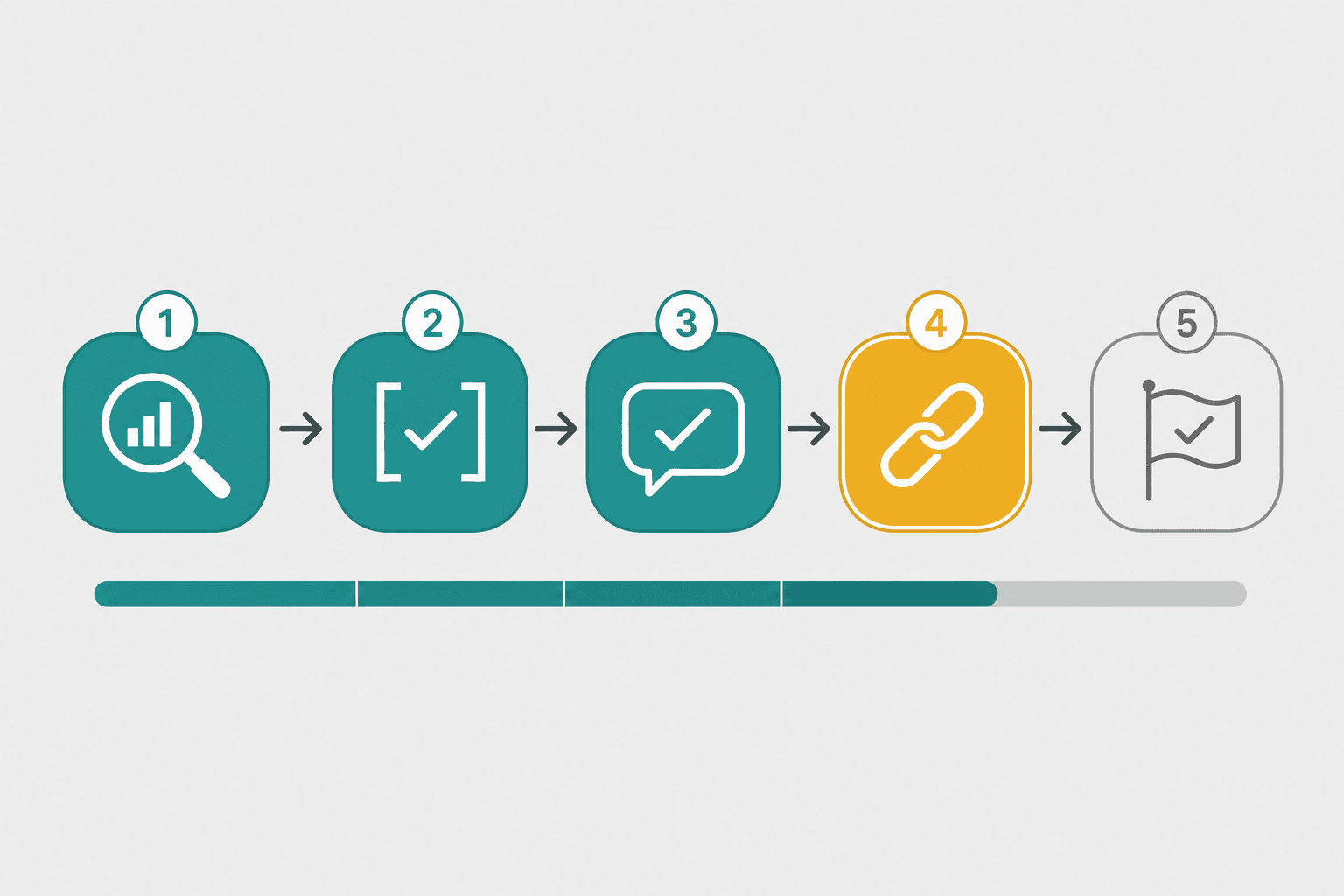
The Five-Pass Pre-Publish Verification Checklist
Even with all four prevention layers active, a structured pre-publish review is non-negotiable. The five passes below take 15–25 minutes on a 1,500-word piece — less time than most teams spend on formatting and style edits. Each pass has a specific scope, a common failure mode, and a clear pass/fail criterion.
| Pass | What to Check | Common Failure Mode | Pass Criterion |
|---|---|---|---|
| 1. Stat scan | Every percentage, number, dollar figure, or quantified claim | Round numbers (50%, 70%, 3x) with no source link — strong hallucination signal | Every stat has a named source OR is marked [VERIFY] |
| 2. Citation check | Every named study, report, survey, or publication | Real organization name attached to a study that doesn't exist, or wrong publication year | Each citation locatable via search in under 60 seconds |
| 3. Quote verification | Every direct quote attributed to a person, customer, or company | Plausible-sounding quotes from real people who never said them — FTC exposure risk | Each quote traced to a primary source or removed; no AI-generated testimonials |
| 4. Link click-through | Every hyperlink in the draft | URL resolves to a 404, a homepage, or an unrelated page — not the claimed source | Each link resolves to the specific page or section claimed |
| 5. Specific-claim sweep | Competitor pricing, product features, integrations, regulatory references | Outdated pricing tiers, wrong feature availability, invented regulation sub-clauses | Each specific claim verified against current primary source (vendor site, official regulation text) |
Tool Options by Team Size and Budget
You do not need new software to implement a functional hallucination defense. The minimum viable approach is workflow and prompt discipline. Tools add leverage at higher volumes or complexity, but they do not replace the workflow.
| Tier | Tools | Best For | Key Limitation |
|---|---|---|---|
| Minimum viable (no new tools) | Citation-required prompting + manual five-pass checklist in your existing workflow | Teams with low-to-moderate AI content volume; any budget | Depends entirely on reviewer discipline; doesn't scale to high-volume production |
| Mid-tier | Perplexity for real-time sourced research; Claude Projects or ChatGPT Projects for document-grounded generation against uploaded source files | Teams producing 10–30 AI-assisted pieces per month; need source grounding without custom infrastructure | Perplexity's citations require click-through verification — it can still misattribute. Projects context windows have limits. |
| Enterprise | Patronus AI, Guardrails AI, or Vectara HHEM for automated pipeline-level hallucination detection integrated into content systems | High-volume content operations; teams with technical resources to integrate APIs into CMS or content workflow | Requires engineering time to integrate; adds cost per query; does not eliminate hallucinations, only flags them for review |
Ready-to-Use Team SOP: Prompt Templates and Accountable Roles
Individual vigilance fails under deadline pressure. Hallucinations look identical to verified facts in a draft. A team-level SOP with named accountable roles is the only reliable defense at production scale — it removes the assumption that whoever is fastest to hit publish is also the person who caught the fabricated statistic.
Copy-Paste Prompt Templates by Content Type
Use these as the base instruction block for your most common content types. Append your specific brief, audience, and tone instructions after.
BLOG POST / LONG-FORM ARTICLE

You are drafting a [topic] blog post for [audience]. Use only the source documents I have provided for all statistics, study findings, case study outcomes, and regulatory references.

Rules:
- For every factual claim with a source in the provided documents, cite it inline: [Source: Document Name]
- For every factual claim you cannot source from the provided documents, write [VERIFY] immediately after the claim
- Do not generate statistics, percentages, or research findings from memory
- Do not attribute quotes to named individuals unless the quote appears in the provided documents
- Round numbers (50%, 3x, $1 million) are a hallucination signal — flag them with [VERIFY] unless sourced
- It is always better to write [VERIFY] than to invent a fact

Generate the [section name] section only. I will review before requesting the next section.
LANDING PAGE / PRODUCT COPY
You are writing [page type] copy for [product/service]. Use only the product documentation, approved claims, and source materials I have provided.
Rules:
- Do not claim integrations, certifications, or compliance standards unless explicitly listed in the provided materials
- Do not generate customer testimonials, case study outcomes, or social proof — these must come from approved sources
- For any performance claim ("reduces X by Y%"), write [VERIFY — needs approved source] if not in provided materials
- Do not reference competitor pricing, features, or positioning unless provided in the brief
Generate [section] only.CASE STUDY
You are drafting a case study about [company/outcome]. The factual record for this case study is contained entirely in the provided interview notes and source documents.
Rules:
- All outcome figures (percentages, dollar amounts, time savings) must come from the provided documents
- Do not generate or paraphrase customer quotes — use only verbatim quotes from the provided interview transcript
- Do not add context, background statistics, or industry benchmarks unless provided in the brief
- If a section requires a fact not in the provided materials, write [MISSING — need source from client]
- Do not infer results that are not explicitly statedTeam SOP: Named Accountable Roles
Adapt the role definitions below to your team's existing structure. The goal is not to add headcount — it's to ensure that no AI-drafted content reaches publication without a named person having completed the five-pass checklist.
- AI Drafter — The person or role that prompts the model and assembles the initial draft. Responsible for: using the citation-required prompt template, applying source grounding (pasting source documents into context), generating section-by-section with verification gates, and flagging all [VERIFY] placeholders before handing off. Does not publish directly.
- Content Reviewer — The person who runs the five-pass verification checklist. Responsible for: resolving every [VERIFY] placeholder (either sourcing the claim or removing it), clicking through every link, verifying every named citation, confirming every attributed quote against a primary source, and checking all specific claims (competitor pricing, product features, regulatory references) against current primary sources. Signs off with initials and date before the piece moves to final approval.
- Final Approver — The person who authorizes publication. Responsible for: confirming that the Content Reviewer sign-off is present and dated, spot-checking two to three high-stakes claims in the piece, and holding final accountability for published accuracy. For high-stakes content (regulatory, competitive, customer-facing case studies), this role should not be the same person as the Content Reviewer.
The teams that ship the fewest hallucinations are not the ones with the most sophisticated tools. They're the ones that have made verification a named, accountable step with a specific person responsible for completing it before every piece goes live. That's a process decision, not a technology decision — and it's available to every team, at any budget, starting today.
Comments
Join the discussion with an anonymous comment.