
EU AI Act Implications for Marketing Practitioners in 2026: Deployer Obligations, Article 50 Rules, and What to Do Before August 2
Marketing teams using AI tools are deployers under the EU AI Act and face real, enforceable compliance obligations — including Article 50 transparency rules taking effect August 2, 2026 — regardless of where their company is headquartered. This article maps the Act's requirements to specific marketing use cases and gives practitioners a concrete checklist to act on before the deadline.
August 2, 2026: Why Marketing Teams Are in Scope Right Now
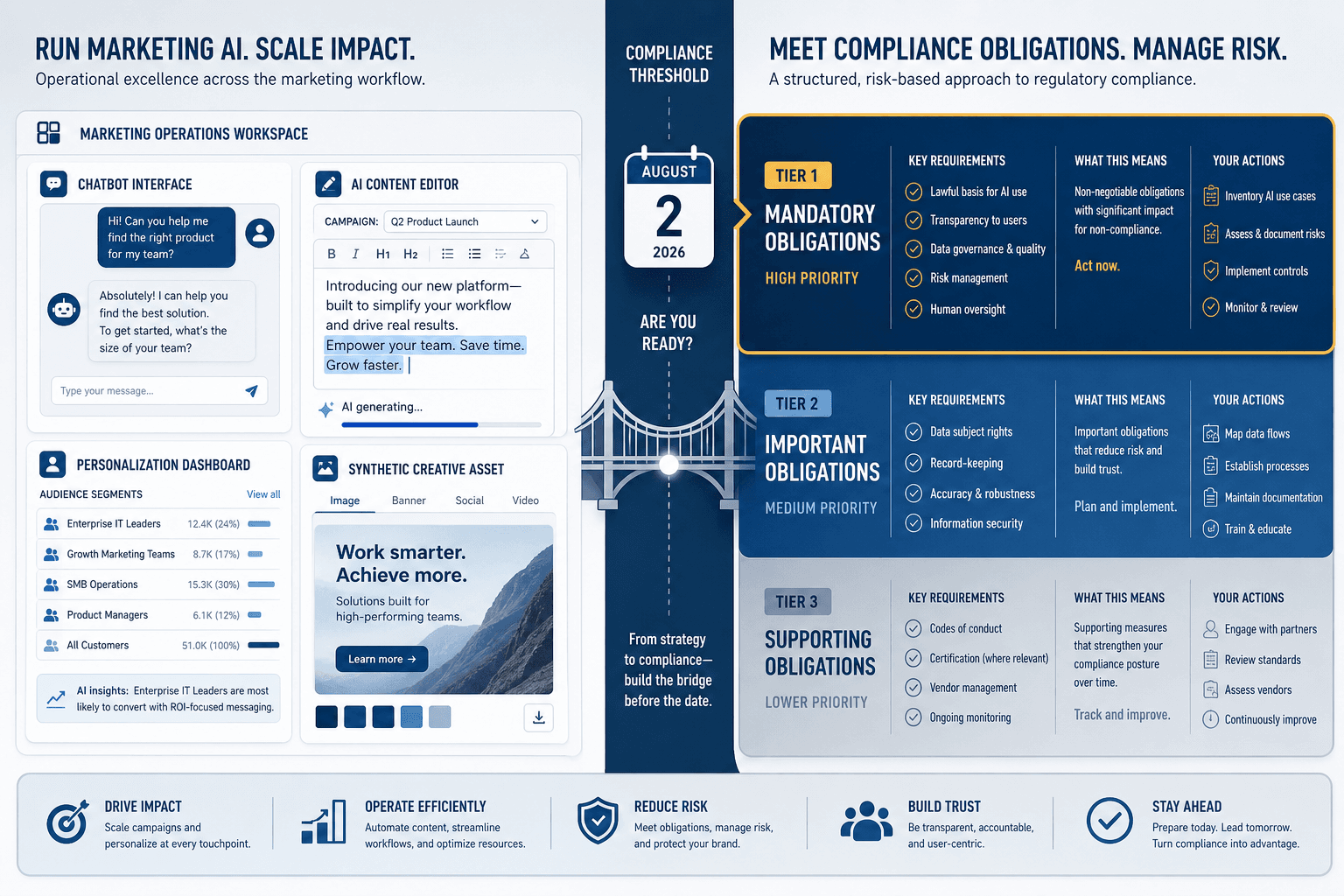
August 2, 2026 is the date most of the EU AI Act's obligations become enforceable. For marketing teams, that deadline is not abstract. If your team selects, configures, or relies on an AI tool to do its work — and that work reaches audiences in the EU — you are almost certainly a deployer under the Act, and specific obligations apply to you right now.
The distinction between a provider and a deployer is the conceptual foundation of everything that follows. Under Article 3 of the Act, a deployer is any natural or legal person using an AI system under its authority. You do not need to have built the system. You do not need to have trained the model. If you are using an AI chatbot on your website, running AI-generated ad creative, publishing AI-assisted content, or using a personalization tool to serve dynamic experiences — you are a deployer.
The vendors who built those tools — OpenAI, Adobe, Salesforce, and others — are providers. Their compliance obligations are separate from yours. A vendor meeting its provider obligations does not discharge your deployer obligations. This matters because many marketing teams have assumed their tool vendor's compliance documentation covers them. It does not.
For a broader map of where AI tools are currently used across marketing functions before working through the compliance layer, see the AI in Digital Marketing function-by-function guide for 2026.
How the EU AI Act Classifies AI Systems — and Where Marketing Tools Typically Land
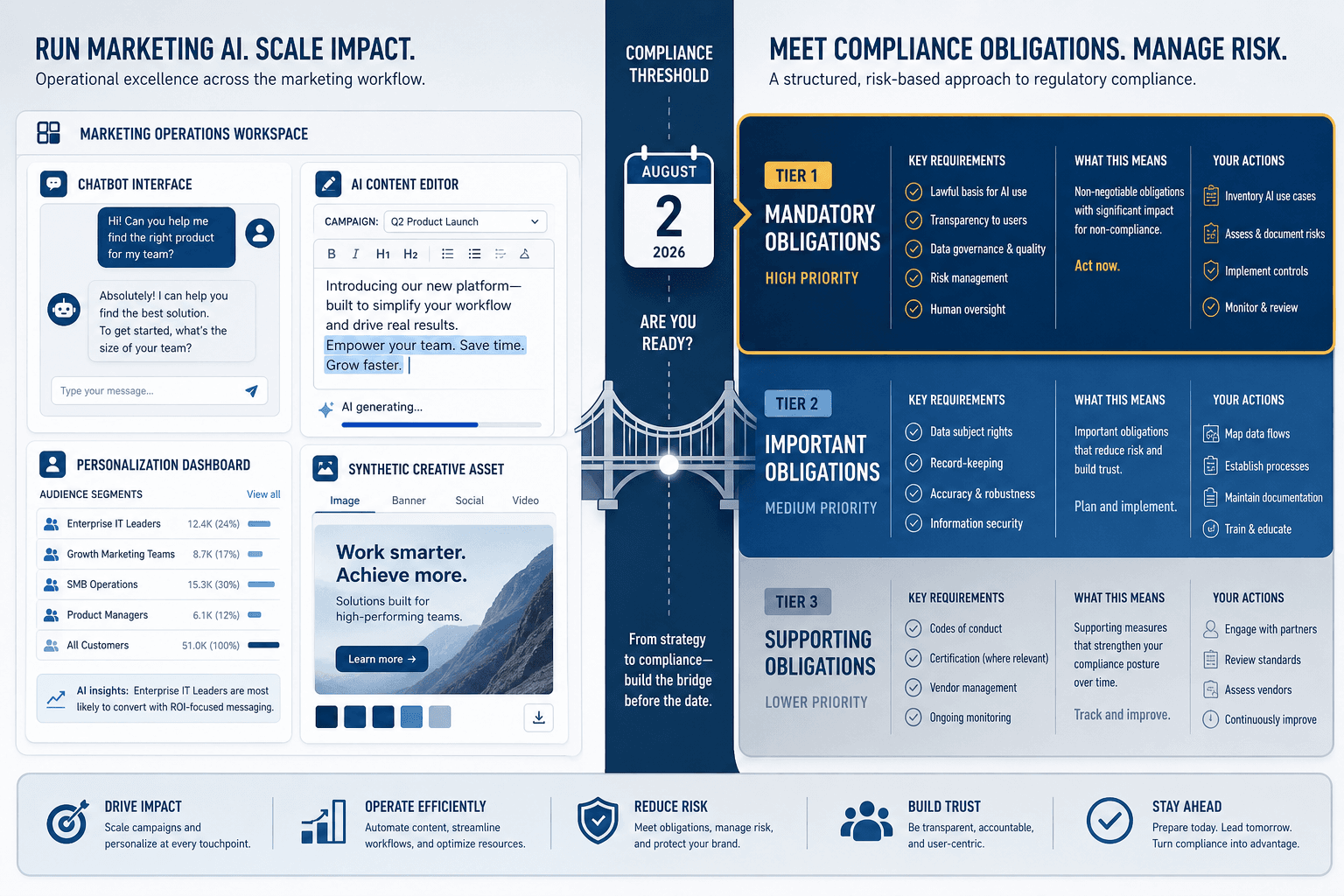
The Act organizes AI systems into four risk tiers. Understanding which tier your tools fall into determines which obligations apply.
| Risk Tier | What It Covers | Marketing Relevance |
|---|---|---|
| Prohibited | AI systems banned outright — subliminal manipulation causing significant harm, social scoring, real-time biometric surveillance in public spaces | Narrow but real exposure for aggressive behavioral-nudging tools; see Article 5 section below |
| High-risk (Annex III) | AI used in employment, credit, education, critical infrastructure, and certain profiling applications | Legal gray area for some personalization and profiling tools; requires case-by-case legal assessment |
| Limited-risk / Transparency (Article 50) | AI interacting with people, generating synthetic content, performing emotion recognition or biometric categorization, creating deepfakes | Where most marketing AI tools land — chatbots, generative content tools, synthetic creative, some targeting tools |
| Minimal risk | Spam filters, AI in games, basic recommendation systems with no profiling dimension | Many standard marketing tools; no specific obligations beyond general good practice |
Most marketing AI tools sit in the limited-risk transparency tier. This means Article 50 obligations — not the full high-risk compliance regime — are the primary concern for most marketing teams. High-risk obligations (conformity assessments, technical documentation, mandatory logging, bias testing) apply to a different category of AI system and are not the focus of this article.
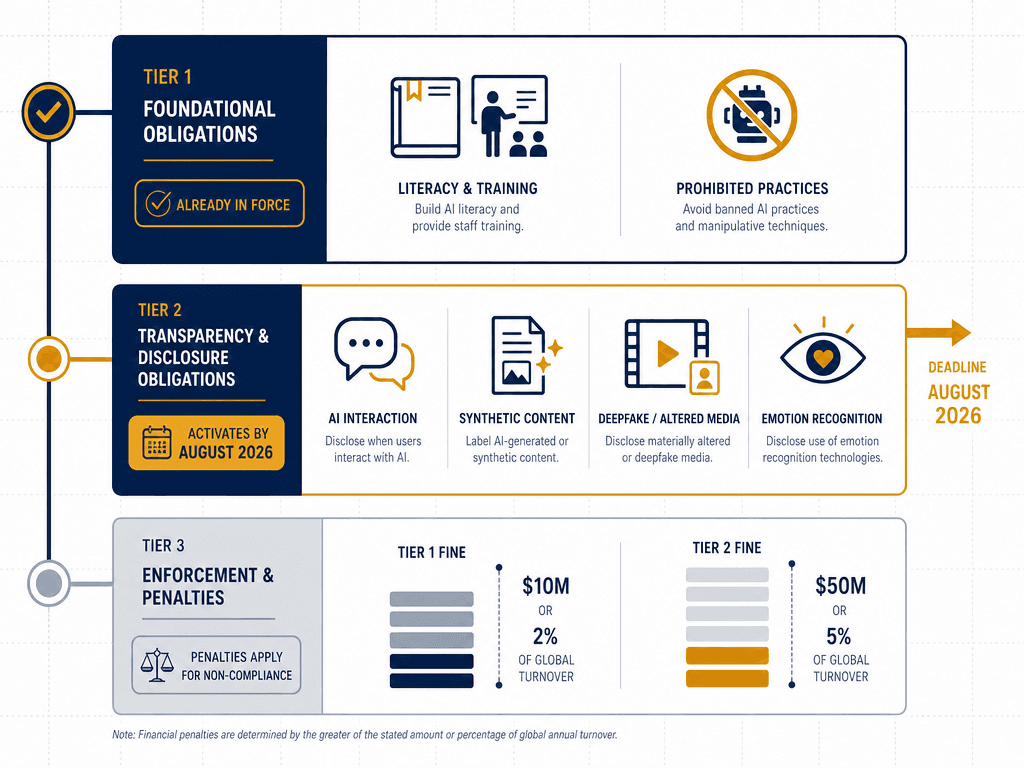
Already in Force: Article 4 (AI Literacy) and Article 5 (Prohibited Practices)
These two obligation sets have been enforceable since February 2, 2025. If your team has not addressed them, you are already behind.
Article 4: AI Literacy
Article 4 requires deployers to ensure staff operating AI tools have a sufficient level of AI literacy, taking into account their technical knowledge, experience, education, and the context in which the AI systems are used. The obligation is to their best extent — but it is real, and it must be documented.
In marketing terms, this means:
- Content managers using AI writing tools need to understand how those tools generate output, what their failure modes are, and how to review output critically — not just how to use the interface.
- Performance marketers using AI bidding or targeting systems need to understand what the system is optimizing for and what signals it uses.
- Marketing managers overseeing AI-assisted workflows need documented evidence that their team has received appropriate training — not just an assumption that vendor onboarding counts.
- The literacy standard is context-appropriate, not uniform. A junior social media coordinator and a marketing director using the same AI tool may need different levels of documented training.
Article 5: Prohibited Practices
Article 5 prohibits specific categories of AI use outright. The two provisions most relevant to marketing are:
- Subliminal or manipulative techniques: AI systems that deploy subliminal techniques beyond a person's consciousness, or purposefully manipulative or deceptive techniques, with the objective or effect of materially distorting behavior by impairing the ability to make an informed decision, causing a decision that would not otherwise have been taken and that causes or is likely to cause significant harm.
- Exploiting vulnerabilities: AI systems that exploit vulnerabilities related to age, disability, or specific social or economic situation to materially distort behavior in a way that causes significant harm.
The harm threshold in both provisions is meaningful. Standard ad personalization — serving relevant ads based on browsing behavior, demographic targeting, interest-based segmentation — is almost certainly not in scope. The prohibition targets AI that actively circumvents a person's rational decision-making in a way that causes them real harm.
Where marketing teams should pay closer attention: AI-driven dark-pattern tools that use behavioral triggers, manufactured urgency, or psychological pressure tactics to push users toward decisions against their interests. If a tool's explicit purpose is to override rational deliberation rather than to inform it, that tool warrants legal review against Article 5.
What Activates August 2, 2026: Article 50 Transparency Obligations by Marketing Use Case
Article 50 is the section of the Act that most directly governs how marketing teams must communicate about their AI use to the people those tools interact with or affect. It applies to four distinct situations. Each has different requirements for deployers.
Use Case 1: Chatbots and Virtual Assistants
Under Article 50(1), providers must design AI systems that interact directly with people so that users are informed they are interacting with AI. As a deployer, your obligation is to ensure that disclosure is actually present when you deploy the system.
There is an exception: if it is obvious to a reasonably well-informed, observant person that they are interacting with an AI system, the disclosure requirement does not apply. This exception exists, but it should not be over-relied on. An AI chat interface that mimics human conversational patterns, uses a human name, or is designed to be indistinguishable from a human agent does not qualify for the exception simply because the user could theoretically infer it is AI. The standard is what a reasonably observant person would conclude — not what a suspicious or technically sophisticated person might suspect.
The disclosure must be provided at the time of first interaction, in a clear and distinguishable manner, per Article 50(5). A small note buried in the footer of a chat widget does not satisfy this standard.
Use Case 2: AI-Generated Content and Synthetic Creative
Article 50(2) requires providers of generative AI systems to ensure their outputs are marked in a machine-readable format detectable as artificially generated. This is a provider obligation — it falls on the tool vendor, not on the marketing team directly.
Article 50(4) creates a separate deployer obligation: if you publish AI-generated text with the purpose of informing the public on matters of public interest, you must disclose that the content is AI-generated — unless the content has undergone substantive human review with documented editorial responsibility.
The editorial review carve-out is real but narrow. The review must be substantive and must involve documented editorial responsibility held by a natural or legal person. A cursory proofread, a quick scan for obvious errors, or a light copy-edit does not satisfy the standard. The editorial responsibility must be genuine — the kind of review where a human editor is accountable for the published content, not just the AI output that preceded it.
For marketing teams working through what content types trigger disclosure obligations and how a content taxonomy and QC workflow helps determine what needs disclosure versus what qualifies for the editorial review exception, the AI-generated marketing content type taxonomy and quality-control framework is a practical companion resource. For concrete examples of why superficial review is insufficient, the documented cases in AI hallucination in marketing content illustrate exactly the scenarios where a cursory proofread would fail.
One important timing note: a provisional political agreement reached in May 2026 — referred to as the AI Omnibus — would give generative AI systems already on the market before August 2, 2026 until December 2, 2026 to meet the machine-readable marking requirement under Article 50(2). This is a provisional agreement that has not yet passed through Parliament and Council and is not enacted law at the time of writing. It may affect the timeline for that specific sub-obligation only. It does not extend the broader August 2, 2026 deadline.
Use Case 3: Deepfakes and Synthetic Image, Audio, or Video
Article 50(4) also requires deployers using AI to create deepfakes — synthetic or manipulated image, audio, or video that depicts real or realistic people, places, or events — to disclose clearly that the content has been artificially generated or manipulated.
The disclosure must be provided at the time of first exposure, in a clear and distinguishable manner. The sources are explicit about what does not qualify: a very small snippet of text hidden in a footer, a faint label on an image, or a brief label flashing for only an instant on a video clip.
Artistic and satirical works have a reduced disclosure requirement under the Act, but marketing creative does not typically qualify for this exception. If your team is producing AI-generated or AI-manipulated video content featuring synthetic presenters, AI voice-overs, or digitally altered real individuals for campaigns that reach EU audiences, a clear disclosure at the point of first exposure is required from August 2.
Use Case 4: Emotion Recognition and Biometric Categorization
Article 50(3) requires deployers using emotion recognition or biometric categorization systems to inform the people exposed to those systems. Any personal data processing involved must comply with GDPR.
This is a narrower category for most marketing teams, but it is not irrelevant. Some advanced personalization tools, in-store analytics systems, and audience measurement platforms incorporate emotion inference or biometric classification. Before deploying any such tool, the Article 5 prohibited practices must be screened first — emotion recognition tools that exploit vulnerabilities or distort behavior in harmful ways are prohibited outright, not merely subject to disclosure.
| Article 50 Use Case | Who Holds the Obligation | What Is Required | Effective Date |
|---|---|---|---|
| Chatbots / virtual assistants | Provider (design); Deployer (ensure disclosure is present) | Inform users they are interacting with AI at first interaction | August 2, 2026 |
| AI-generated synthetic content (machine-readable marking) | Provider | Mark outputs in machine-readable, detectable format | August 2, 2026 (provisional extension to Dec 2, 2026 for systems already on market — not yet enacted) |
| AI-generated text published to inform public on matters of public interest | Deployer | Disclose AI-generated nature unless substantive human editorial review with documented responsibility | August 2, 2026 |
| Deepfakes (synthetic/manipulated image, audio, video) | Deployer | Clear disclosure at time of first exposure that content is artificially generated or manipulated | August 2, 2026 |
| Emotion recognition / biometric categorization | Deployer | Inform exposed individuals; GDPR compliance for personal data; screen against Article 5 first | August 2, 2026 |
Extraterritorial Scope: Why Non-EU Marketing Teams Are Not Automatically Exempt
The EU AI Act's reach is not limited to companies headquartered in the EU. The relevant test is where the AI system's output is used — not where the deployer is based, where the tool is hosted, or where the marketing team sits.
A US-based marketing team running AI-generated ad campaigns, deploying an AI chatbot, or publishing AI-assisted content that reaches persons in the EU is captured by the Act as a third-country deployer. This is the same extraterritorial logic that made GDPR a global compliance requirement for any organization handling EU residents' data.
Enforcement mechanisms for non-EU deployers are still maturing. National market surveillance authorities in each EU member state are responsible for enforcement, and the practical reach of those authorities to non-EU entities will develop over time. This does not mean non-EU teams should treat the Act as unenforceable — it means the enforcement infrastructure is evolving, and the legal obligations are clear even where enforcement is still developing.
The Vendor Responsibility Gap: Why Your Tool Vendor's Compliance Doesn't Cover You
This is the most common compliance misconception among marketing teams: the belief that if their AI tool vendor is compliant with the EU AI Act, the marketing team's obligations are satisfied. They are not.
Provider obligations and deployer obligations are legally distinct and non-transferable. A vendor meeting its provider obligations — marking outputs in machine-readable format, providing technical documentation, building disclosure mechanisms into the product — does not discharge the deployer's separate obligation to actually use those mechanisms, ensure disclosures reach end users, document staff AI literacy, and assess the tool against Article 5 prohibitions.
The analogy from GDPR is instructive: a data processor's compliance with processor obligations does not satisfy the controller's separate controller obligations. The same structural logic applies here.
What marketing teams should be asking their AI vendors, in writing:
- Does your system's output include machine-readable AI provenance marking as required by Article 50(2), and what format does that marking take?
- For AI chat products: does the system include a disclosure mechanism that informs users they are interacting with AI at first interaction, and can we verify this is active in our deployment?
- What documentation do you provide to support our deployer obligations under the EU AI Act, including for our own compliance records?
- Will you contractually commit to supporting our compliance with deployer obligations, and what happens if a product update changes how disclosure mechanisms work?
- Has your system been assessed against Article 5 prohibited practices? Can you provide documentation of that assessment?
Penalty Framework: What Non-Compliance Actually Costs
The EU AI Act's penalty structure is tiered by violation type. These are the figures that apply to deployers:
| Violation Type | Maximum Fine |
|---|---|
| Deployer non-compliance with high-risk system obligations | EUR 15 million or 3% of global annual turnover, whichever is higher |
| Use of prohibited AI practices (Article 5) | EUR 35 million or 7% of global annual turnover, whichever is higher |
| Providing inaccurate, incomplete, or misleading information to regulators | EUR 7.5 million or 1% of global annual turnover, whichever is higher |
Enforcement runs through national market surveillance authorities in each EU member state, not through a single central EU regulator. This means enforcement approaches, priorities, and timelines may vary across countries. It does not mean the obligations themselves vary — the Act's requirements are uniform across the EU.
The penalty figures apply to the highest-tier violations. Article 50 transparency failures — the most likely area of exposure for marketing teams — are not explicitly assigned a separate fine tier in the Act's current text; they would fall under the general non-compliance provisions. This is an area where regulatory guidance will develop. The prudent approach is to treat Article 50 compliance as a real obligation, not a soft expectation.
Marketing Team Compliance Checklist: Seven Steps Before August 2
These steps are ordered by urgency. Steps 1 through 3 should be completed first because they determine the scope of everything else.
- Map your AI tool stack. Create a complete inventory of every AI tool your marketing team currently uses, including tools embedded in platforms (e.g., AI features within your CRM, ad platform, or CMS). Include tools used by contractors and agency partners operating on your behalf.
- Classify each tool against Article 50 use cases. For each tool in your inventory, determine which Article 50 category applies: does it interact directly with people? Does it generate synthetic content? Does it create deepfakes or synthetic media? Does it perform emotion recognition or biometric categorization? Some tools will fall into multiple categories.
- Assess Article 5 exposure for behavioral targeting tools. Review any AI tools that use behavioral signals to influence user decisions. Flag tools that operate through non-transparent psychological mechanisms or that are designed to exploit emotional states or cognitive biases. These warrant legal review against Article 5 before August 2.
- Document AI literacy training for staff operating AI tools. Create a record of who operates which AI tools and what training they have received. This does not need to be a formal certification — but it must be documented. The Article 4 obligation has been in force since February 2025. If you have not documented this yet, do it now.
- Inventory published AI-generated content and assess disclosure obligations. Audit content your team has published using AI tools. For any content that could fall under Article 50(4) — AI-generated text published to inform the public on matters of public interest — assess whether it underwent substantive human editorial review with documented responsibility. If not, determine whether retroactive disclosure is warranted and establish a forward-looking review process.
- Contact AI vendors with specific compliance questions and review contracts. Use the vendor questions listed in the previous section. Update contracts to require vendor support for your deployer obligations, including notification of product changes that affect disclosure mechanisms.
- Build EU AI Act compliance into ongoing AI governance. Treat this as a repeating operational process, not a one-time legal task. The Act will be enforced and interpreted over time; new tools will be added to your stack; product features will change. Marketing directors scaling AI use need a governance layer that catches compliance implications as they arise.
| Step | Obligation It Addresses | Urgency |
|---|---|---|
| Map AI tool stack | Prerequisite for all other steps | Immediate |
| Classify tools against Article 50 use cases | Article 50 (August 2, 2026) | Immediate |
| Assess Article 5 exposure for behavioral tools | Article 5 (in force since Feb 2025) | Immediate |
| Document AI literacy training | Article 4 (in force since Feb 2025) | This week |
| Inventory published AI-generated content | Article 50(4) (August 2, 2026) | Before August 2 |
| Contact vendors and review contracts | Deployer / provider obligation separation | Before August 2 |
| Build ongoing AI governance process | Ongoing compliance across all obligation tiers | Before August 2, then recurring |
How EU AI Act Obligations Relate to FTC and GDPR Requirements
Marketing teams that are already managing FTC disclosure obligations and GDPR compliance need to understand that the EU AI Act is a distinct legal framework — not an extension of either.
The FTC's AI disclosure requirements for advertising and marketing are grounded in US consumer protection law, enforced by a federal agency, and triggered by different conditions than EU AI Act obligations. Meeting FTC disclosure requirements does not satisfy Article 50 obligations, and vice versa. The legal bases, triggers, enforcement mechanisms, and geographic scope are categorically different.
GDPR has a direct interaction with the EU AI Act in one specific area: Article 50(3) explicitly requires that personal data processing involved in emotion recognition or biometric categorization systems must comply with GDPR. For these tools, GDPR compliance is a floor, not a ceiling — the EU AI Act adds disclosure obligations on top of existing data protection requirements.
The practical implication for marketing teams: a compliance checklist that addresses only FTC requirements leaves EU AI Act exposure unaddressed, and a compliance checklist that addresses only GDPR leaves Article 50 transparency obligations unaddressed. All three frameworks are live, and all three apply to marketing teams with international audience reach.
Comments
Join the discussion with an anonymous comment.