
AI in Digital Marketing: A Function-by-Function Guide for 2026
A practitioner-focused breakdown of how AI actually performs across SEO, content, paid media, email, and analytics — covering distinct use cases, data prerequisites, ROI timelines, and failure modes for each function, so working marketers can prioritize where to start and what to govern.
The Accountability Gap: Where AI Adoption Actually Stands in 2026
The adoption question is settled. 91% of marketers now actively use AI, up from 63% the previous year. The harder question — whether that usage is producing measurable business outcomes — is where the gap opens. Only 41% of AI-using marketing teams can demonstrate ROI, down from 49% in 2025. The tools are not the constraint. The constraint is measurement design, data infrastructure, and governance.
The scaling challenges that dominated 2024 (budget, access, tooling) have been replaced by internal ones: brand, legal, and compliance reviews; output quality control; and data and privacy risks. Nearly two-thirds of organizations have not yet begun scaling AI across the enterprise, despite near-universal adoption at the pilot level. McKinsey's 2025 research finds that AI high performers are nearly three times more likely to fundamentally redesign individual workflows — not just add AI tools on top of existing ones. That distinction explains most of the ROI gap.
What follows is a function-by-function breakdown of where AI actually delivers, what it requires, and what fails when those requirements aren't met. The goal is not a comprehensive tool inventory — it's a practical map for sequencing decisions and governance work across SEO, content, paid media, email, and analytics.
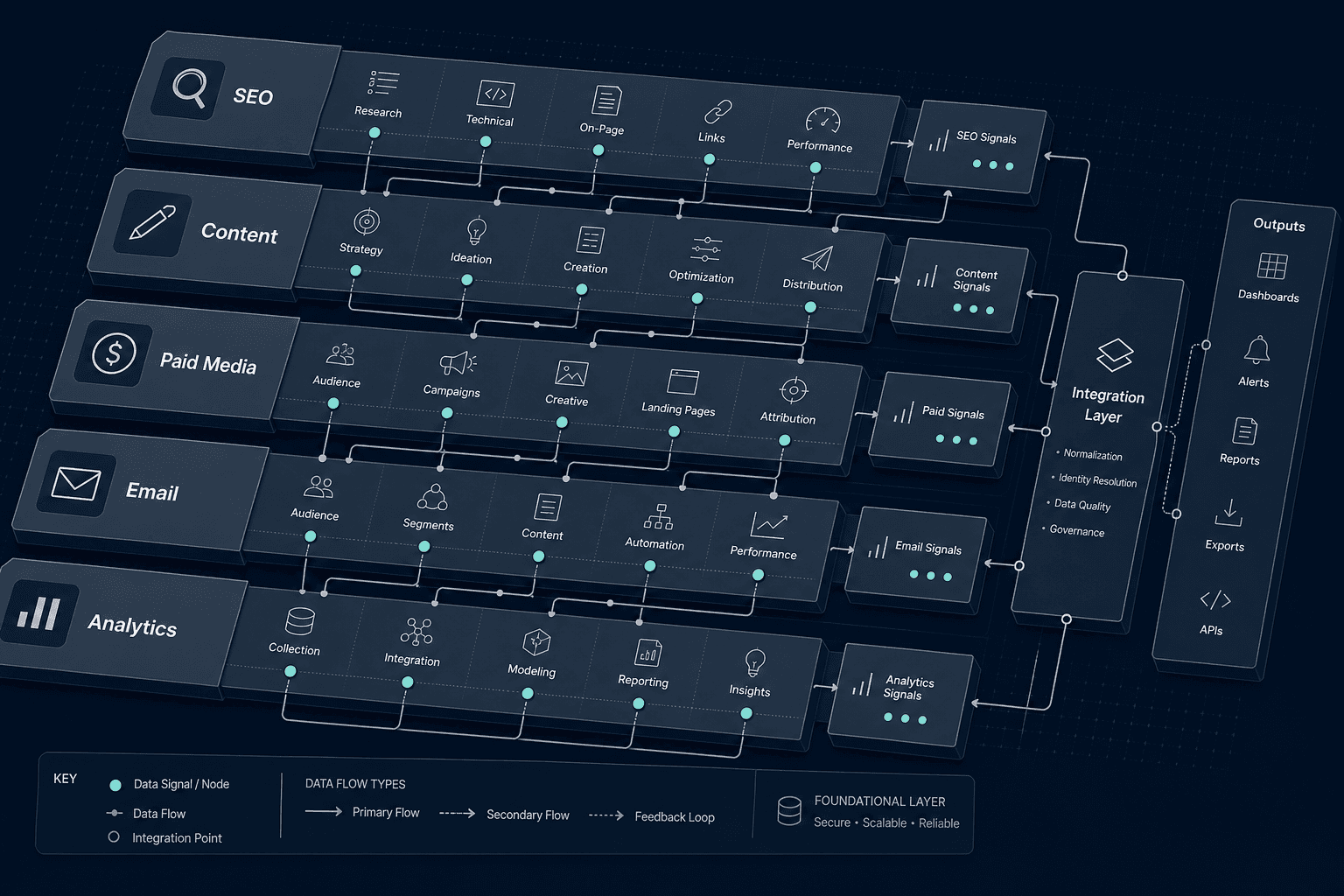
SEO: Two Simultaneous Challenges
AI has changed SEO in two structurally different ways, and conflating them produces bad strategy. The first is AI as a workflow tool. The second is AI search as a new visibility environment. Both require attention, but they require different tactics.
AI as an SEO workflow tool
For day-to-day SEO work, AI reduces time on repeatable tasks: keyword clustering, content brief generation, technical audit triage, and internal link mapping. These are genuine productivity gains. Keyword clustering that previously took hours of manual grouping can be completed in minutes with well-structured prompts. Technical audits can surface patterns across thousands of crawl errors faster than manual review.
The limitation is that AI workflow tools accelerate execution but do not replace judgment. A content brief generated by AI still needs an SEO professional to validate search intent alignment, competitive gap analysis, and topical authority fit. The output quality depends heavily on the quality of the input context — site-specific data, competitor intelligence, and audience understanding that the model doesn't have by default.
AI search as a new visibility battleground
AI Overviews now appear on approximately 48% of Google queries as of April 2026, up from 31% in early 2025, reaching 2 billion monthly users. ChatGPT Search, Perplexity, and Google's AI Mode are adding additional surfaces. These are not the same surface — only 13.7% of citations overlap between AI Overviews and AI Mode, meaning content that gets cited in one does not automatically appear in the other. Optimization must target multiple surfaces with different content structures.
GEO (Generative Engine Optimization) and AEO (Answer Engine Optimization) are not replacements for SEO — they require the same foundational quality signals: E-E-A-T, structured data, and entity authority. What changes is content structure. Content optimized for citation in AI responses needs self-contained, direct answers near the top of the piece. FAQ sections with 40–60 word self-contained openers are cited at three times the rate of non-FAQ sections. Content with statistics sees 28–40% higher visibility in AI search.
- Brand citation rate in AI responses is a new KPI — track how often your brand appears in ChatGPT, Perplexity, and Google AI responses for your target queries.
- Earned media distribution increases AI citations by up to 325% compared to publishing only on your own site — third-party coverage signals authority to AI systems.
- NAP consistency, active reviews, and internal content consistency form a 'reputation graph' that influences which businesses AI recommends when similar options exist.
- 44.2% of all LLM citations come from the first 30% of text — front-loading direct answers is not just a UX decision, it's a citation strategy.
Content Marketing: Production Speed Requires Editorial Governance
Content AI has the fastest ROI timeline of any marketing function — first outputs typically arrive within one to two weeks of implementation. It's also the function where failure is most visible. Brand voice drift is the second-ranked scaling challenge in AI marketing (behind compliance reviews), and it compounds over time when not actively managed.
AI enables companies to publish approximately 42% more content monthly, with output volume increasing 77% within six months of implementation. The production acceleration is real. The quality risk is equally real: thin, high-volume output consistently underperforms fewer, substantive pieces in both search visibility and audience engagement.
The differentiator between teams that capture content AI's upside and those that dilute their brand is editorial governance — specifically, how AI output is reviewed before publication. 73% of teams combining AI with human oversight outperform AI-only approaches. Only 5% of teams relying mostly on AI without human review report strong results.
What editorial governance actually looks like
- Tiered review by content stakes: Low-stakes content (social captions, meta descriptions) gets a single pass. Medium-stakes content (blog posts, email sequences) gets subject-matter and brand voice review. High-stakes content (thought leadership, executive bylines, product pages) gets full editorial treatment with fact-checking.
- Monthly brand voice audits: Compare a sample of AI-assisted outputs to a human-written baseline on tone, vocabulary, and sentence structure. Drift is easier to correct early than after six months of publication.
- Automated tone validators: Tools that flag content deviating from established style guidelines before it reaches human review — not a replacement for review, but a filter that reduces reviewer load.
Paid Media: Governing AI-Default Platforms
Performance Max and Meta Advantage+ have made AI the operational default in paid media. For most advertisers running Google or Meta campaigns in 2026, AI is already making decisions about where ads appear, which creative variants run, and how bids adjust in real time. This is not an adoption question — it's a governance question.
Despite this, only 30% of agencies, brands, and publishers have fully integrated AI across the media campaign lifecycle (IAB State of Data 2025). The gap between 'running AI-default platforms' and 'having integrated AI into campaign strategy, measurement, and governance' is where most performance teams are currently operating.
The practitioner skill that matters in 2026 is not how to activate these platforms — it's how to govern them. That means understanding what inputs the AI is optimizing against and ensuring those inputs are correctly configured.
- Conversion value setup: If the platform is optimizing for conversions, it needs accurate conversion values — not just conversion counts. Mismatched values cause the algorithm to optimize toward the wrong actions.
- Creative feed quality: AI creative systems (including Performance Max asset groups and Advantage+ creative) perform proportionally to the quality and variety of inputs. Thin creative feeds produce narrow, repetitive output.
- Budget guardrails: Autonomous campaigns without explicit budget caps and placement exclusions can allocate spend in ways that are technically 'optimized' but strategically misaligned with brand or margin targets.
- Override logic: Define in advance which campaign decisions require human review before execution — particularly for high-spend, brand-sensitive, or new audience segments.
Email Marketing: Personalization Requires Data Quality Prerequisites
Email is where AI delivers some of the clearest, fastest returns — and where poor data hygiene causes the most visible failures. Before evaluating any AI email capability, audit your list and your data fields. The benefits are conditional on meeting minimum data requirements.
Predictive send-time optimization can increase open rates by 20–30% by delivering emails when individual subscribers are most likely to engage. But this only works when the platform has sufficient behavioral history per subscriber — typically 5,000+ subscribers with at least three months of engagement data. Smaller lists or newer programs do not have the signal density required for reliable predictions.
Personalization at scale has a harder prerequisite: data quality. Lists with more than 15% stale contacts produce personalization errors — wrong names, outdated company references, mismatched product recommendations — that spike unsubscribe rates. AI personalization amplifies the quality of your data, in both directions.
- Audit contact staleness before enabling personalization: flag and suppress records with no engagement in 12+ months, missing required fields, or outdated firmographic data.
- Send-time optimization ROI timeline: 4–8 weeks to measurable lift, assuming list size and history thresholds are met.
- Subject line and copy testing with AI accelerates iteration — but requires a sufficient send volume per variant to produce statistically meaningful results. Small lists should prioritize list hygiene over AI copy testing.
- AI-generated email sequences need the same brand voice governance as other AI content — tiered review based on stakes (transactional vs. nurture vs. re-engagement).
Analytics and Measurement: What AI Requires Before It Can Help
Analytics AI — predictive lead scoring, churn modeling, LTV forecasting, data-driven attribution — has the longest ROI timeline and the strictest data prerequisites of any marketing function. Most teams are not ready for it, and deploying it prematurely produces confidently wrong outputs.
The minimum data requirements for AI-powered predictive models are specific: 10,000+ records with known outcomes, fewer than 5% missing fields, and at least six months of history. Below these thresholds, the model is pattern-matching on noise rather than signal. The garbage-in problem is not eliminated by AI — it is amplified.
The attribution shift from last-click to data-driven is a related challenge. Data-driven attribution uses machine learning to assign credit across touchpoints based on actual conversion paths — which is more accurate, but requires sufficient conversion volume to train the model. Google's data-driven attribution model requires a minimum of 300 conversions per month across the account. Below that threshold, last-click or position-based models are more reliable, not less.
| Capability | Minimum Data Requirement | ROI Timeline | Common Failure Mode |
|---|---|---|---|
| Predictive lead scoring | 10K+ leads with known outcomes, 6+ months history, <5% missing fields | 3–6 months | Training on insufficient records; model scores noise as signal |
| Data-driven attribution | 300+ conversions/month per channel | 2–4 months post-setup | Applying DDA to low-volume accounts; undercounts top-of-funnel |
| Churn modeling | 12+ months customer history, defined churn event | 4–8 months | Undefined churn label; model cannot learn what it's predicting |
| LTV forecasting | 24+ months transaction history, stable cohort sizes | 6–12 months | Sparse transaction data; model overfits to outliers |
| Send-time optimization | 5K+ subscribers, 3+ months engagement history | 4–8 weeks | Small list size; insufficient per-subscriber behavioral signal |
Use-Case Prioritization: Sequencing by Time-to-Value and Data Requirements
Sequencing AI adoption by use-case maturity consistently outperforms random tool adoption. The 74% failure-to-scale rate BCG documents is partly a sequencing problem: teams deploy analytics AI before their data is ready, or activate personalization before auditing list hygiene.
The framework below organizes use cases into three phases based on time-to-value and minimum data requirements. Start with Phase 1 use cases to build organizational confidence and measurement infrastructure before moving to more data-intensive applications.
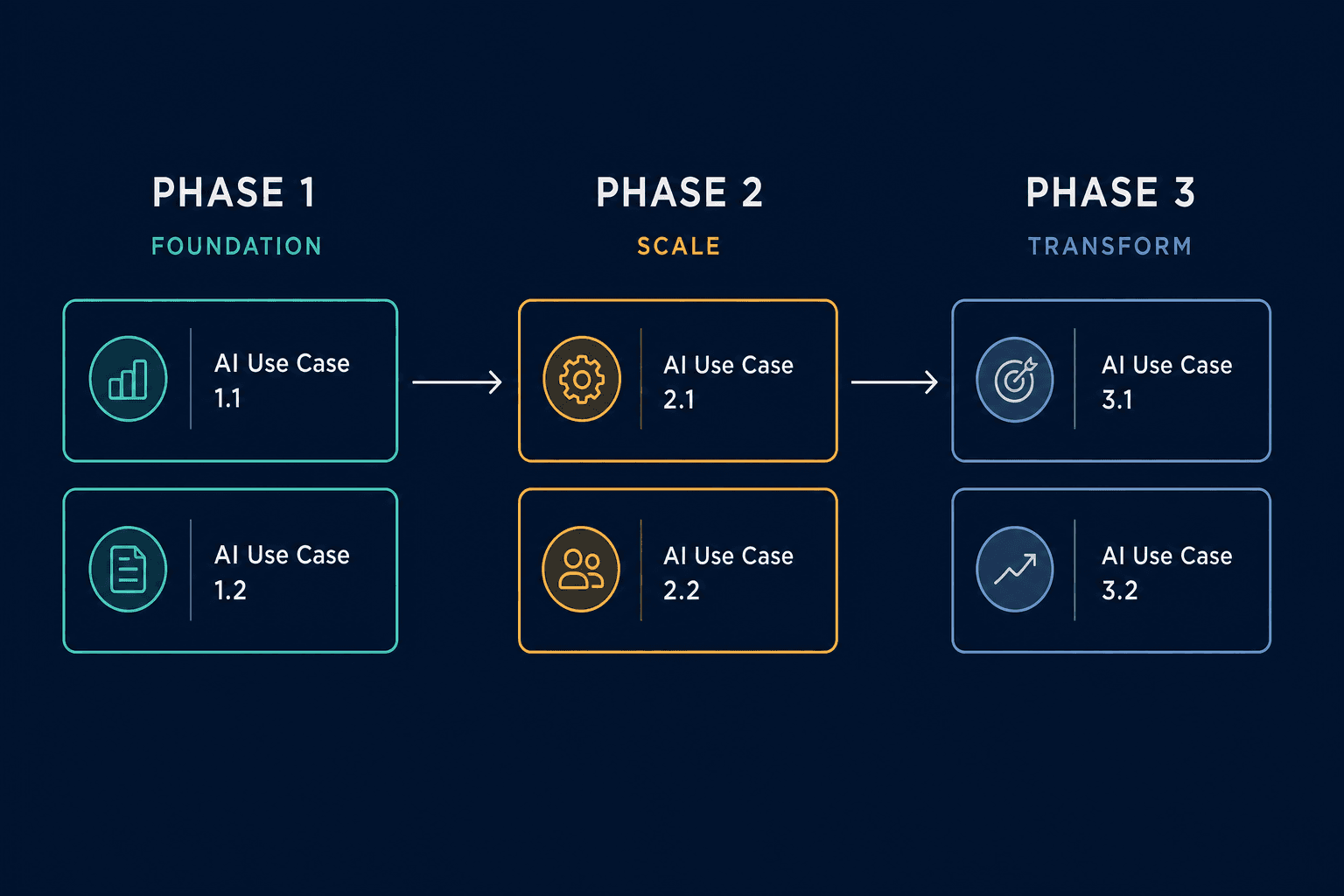
| Phase | Use Case | Minimum Data Requirement | Time-to-Value | Function |
|---|---|---|---|---|
| Phase 1 — Start | AI-assisted content generation | Brand voice guidelines, editorial review process | 1–2 weeks | Content |
| Phase 1 — Start | Email send-time optimization | 5K+ subscribers, 3+ months history | 4–8 weeks | |
| Phase 1 — Start | Keyword clustering and content briefs | Existing keyword list or crawl data | 1–3 weeks | SEO |
| Phase 2 | Ad copy A/B testing with AI | Sufficient send volume per variant (500+ impressions) | 6–10 weeks | Paid Media |
| Phase 2 | Basic lead scoring | 2K+ leads with outcome labels, 6+ months history | 6–12 weeks | Analytics / CRM |
| Phase 2 | AI Overviews and AEO optimization | Published content with structured data, E-E-A-T signals | 8–16 weeks | SEO |
| Phase 3 | Predictive churn modeling | 10K+ customers, 12+ months history, defined churn event | 3–6 months | Analytics |
| Phase 3 | LTV forecasting | 24+ months transaction history, stable cohorts | 4–8 months | Analytics |
| Phase 3 | Full campaign lifecycle AI integration | Mature creative feed, conversion value setup, override logic | Ongoing | Paid Media |
Common Failure Modes and Diagnostic Questions
Most AI marketing failures are predictable. The five patterns below account for the majority of implementations that produce activity without measurable outcomes.
- Stale CRM data powering personalization. Diagnostic: What percentage of your contact records were last updated more than 12 months ago? If it's above 15%, personalization is more likely to produce errors than lift.
- AI content without brand voice validation. Diagnostic: Can you point to a documented brand voice guide that was used to configure AI prompts and review criteria? If not, drift is already happening — it just hasn't been measured yet.
- Predictive models trained on insufficient data. Diagnostic: How many records with known outcomes does your training dataset contain? If it's below 10,000, the model is pattern-matching on noise. Use rules-based scoring until the data threshold is met.
- Autonomous campaigns without budget guardrails. Diagnostic: What is the maximum daily spend any AI-managed campaign can reach without human review? If the answer is 'whatever the platform decides,' you don't have a governance model.
- Measuring activity, not outcomes. Diagnostic: What specific business outcome — revenue, pipeline, qualified leads — can you trace to AI-assisted work this quarter? If the answer is 'we published more content' or 'we ran more tests,' the measurement framework needs to be rebuilt before more AI is deployed.
Where to Start by Role
The right entry point depends on which function you own. The table below gives role-specific first actions — not comprehensive strategies, but the one or two moves most likely to produce early evidence of value.
| Role | First Action | Second Action | What to Measure |
|---|---|---|---|
| SEO Professional | Implement AI keyword clustering on your target topic set — compare cluster quality to manual grouping | Audit top-10 pages for AEO structure: do they have self-contained, direct answers in the first 30% of text? | Brand citation rate in AI Overviews; time saved on brief production |
| Content Marketer | Run one content type (e.g., blog posts) through a tiered AI-assist workflow with explicit brand voice review at each stage | Conduct a before/after brand voice comparison between AI-assisted and human-written pieces from the same period | AI content efficiency rate; editor revision rate; engagement metrics vs. non-AI baseline |
| Performance Marketer | Audit conversion value setup in your Performance Max or Advantage+ campaigns — confirm values reflect actual margin, not just conversion count | Define explicit budget caps and placement exclusions for all AI-managed campaigns | AI-attributed ROAS vs. manually managed campaigns; human override rate |
| Marketing Manager / Director | Identify which AI use cases your team is currently running and map them to the Phase 1/2/3 framework — flag any Phase 3 deployments missing Phase 1 prerequisites | Define the five AI-specific KPIs (below) and assign measurement ownership before the next planning cycle | AI-attributed revenue; ROI proof rate; time-to-value per use case |
Measuring AI Value: A Practical Checklist
The measurement gap — 91% adoption, 41% ROI proof — is not primarily a performance problem. It's a measurement design problem. Teams that have adapted their measurement approach report returns of 2–3x or higher. The five KPIs below give marketing managers and directors the vocabulary to build internal accountability for AI investment.
- AI content efficiency rate: Output volume per person-hour on AI-assisted content vs. fully manual content. Tracks productivity gain without conflating it with quality.
- AI-attributed revenue: Pipeline or closed revenue traceable to AI-assisted campaigns, content, or outreach. Requires attribution setup before deployment — not after.
- Human override rate: Percentage of AI outputs that required significant human revision before use. Healthy range is 10–25%. Below 10% suggests insufficient review; above 25% suggests the AI configuration or prompt design needs improvement.
- AI error rate: Percentage of AI outputs containing factual errors, brand voice violations, or compliance issues. Target is below 2%. Track this per content type and per tool to identify where quality controls are failing.
- Time-to-value per use case: How long from deployment to first measurable outcome. Compare against the expected timelines in the prioritization table above. Significant deviation (in either direction) is a signal to investigate.
Comments
Join the discussion with an anonymous comment.