
Meta Advantage+ Shopping Campaigns in 2026: What Happened, What Replaced Them, and How to Set Up Advantage+ Sales Now
Meta Advantage+ Shopping Campaigns were deprecated in Q1 2026 via a MAPI v25.0 breaking change — this guide explains what ASC was, what the transition to Advantage+ Sales Campaigns means structurally, and how performance marketers and ecommerce advertisers should configure and run Advantage+ Sales correctly today.
What Advantage+ Shopping Campaigns Were — and Why They Grew So Fast
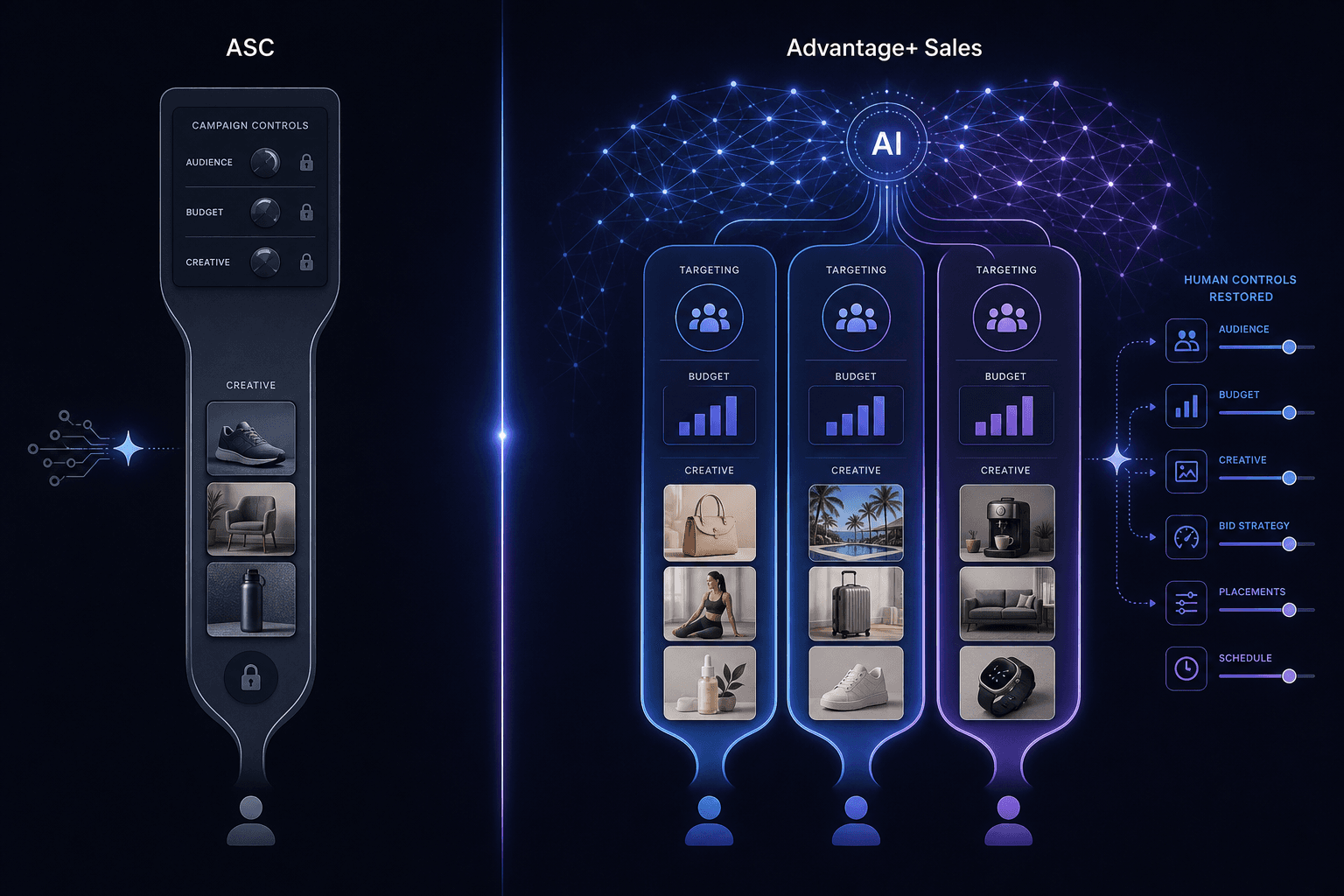
Advantage+ Shopping Campaigns (ASC) launched as Meta's flagship AI-automated format for ecommerce advertisers. The core idea was radical simplification: hand over nearly all campaign decisions to Meta's machine learning system and let it optimize delivery, targeting, and budget allocation without manual audience or placement configuration.
The format had a distinctive structural fingerprint that set it apart from standard Meta campaigns:
- A single ad set — no ability to add additional ad sets within the campaign.
- Algorithmic targeting locked to geography only — no detailed targeting, no custom audiences, no lookalike audiences.
- Advantage+ Placements locked on — Meta controlled where ads appeared across its properties.
- Up to 150 creative combinations within that single ad set.
- An Existing Customer Budget Cap (ECBC) — a field that let advertisers limit what percentage of the campaign budget could be spent reaching existing customers.
- Andromeda-powered delivery — Meta's ML retrieval engine selecting from tens of millions of ad candidates to find the highest-quality matches for each impression.
The combination worked well for direct-response ecommerce advertisers who were comfortable ceding targeting control in exchange for algorithmic efficiency. Meta reported that ASC grew 70% year-over-year in Q4 2024, describing it as one of its most rapidly and consistently growing AI-powered ad products. That growth figure, sourced from Meta's own announcements, explains why the subsequent deprecation was genuinely disruptive for active advertisers — this was not a niche format.
The Deprecation Timeline: MAPI v24 Restriction to v25.0 Breaking Change
The ASC deprecation happened in two stages, both sourced from Meta's official developer documentation. As of this article's publication date (June 2026), both stages are completed events.
| Date | API Version | Change |
|---|---|---|
| September / October 2025 | MAPI v24 | New ASC and Advantage+ App Campaigns (AAC) can no longer be created or updated on API v24. Campaigns on v23.0 continued to function. |
| Q1 2026 | MAPI v25.0 breaking change | No new ASC or AAC campaigns can be created or updated across ALL API versions. The existing_customer_budget_percentage field (ECBC) was deprecated simultaneously. |
The practical implication of the v25.0 breaking change: any MAPI partner or advertiser attempting to create or update an ASC campaign after Q1 2026 receives an error regardless of which API version they are calling. The format is no longer creatable.
Meta's developer documentation also noted that during the transition period (before v25.0), the recommended path was to create standard campaigns using Advantage+ Audience rather than continuing to build on the ASC format.
Advantage+ Sales Campaigns: What's New, What Carried Over, and What's Gone
Advantage+ Sales is not a rename. The underlying campaign structure changed materially, and advertisers who treat it as a direct migration path without rebuilding will end up with campaigns that don't reflect the new format's capabilities or constraints.
The table below maps the structural differences:
| Feature | ASC | Advantage+ Sales |
|---|---|---|
| Ad sets per campaign | 1 (locked) | Unlimited |
| Ads per ad set | 150 total | 50 per ad set (150+ achievable across multiple ad sets) |
| Targeting | Geography only — no custom audiences, no lookalikes | Advantage+ Audience with targeting suggestions and custom audience exclusions |
| Existing Customer Budget Cap | Yes (existing_customer_budget_percentage field) | Removed — must be replicated manually with separate ad sets |
| Placements | Advantage+ Placements locked on | Advantage+ Placements on by default (can be adjusted) |
| AI delivery engine | Andromeda-powered | Andromeda-powered (carried over) |
| Algorithmic budget allocation | Yes | Yes (carried over) |
| Audience Segments reporting | Available via Breakdown menu | Available via Breakdown menu (carried over) |
The two most significant additions are Advantage+ Audience and multiple ad sets. The most significant removal is the Existing Customer Budget Cap. These three changes together mean that campaign construction strategy, budget control logic, and audience configuration all need to be rethought — not just ported over.
The Andromeda AI Engine: What It Does and What Meta's Performance Figures Actually Mean
The AI system powering Advantage+ campaigns is called Andromeda. It functions as the first stage of Meta's ads recommendation pipeline — a retrieval engine that narrows the field from tens of millions of eligible ad candidates down to a few thousand for each impression opportunity. From that shortlist, downstream ranking systems make the final selection.
Andromeda is built to handle the scale that Advantage+ automation creates. As advertisers load more creative variations and Meta's generative AI tools produce additional image variants, the candidate pool grows exponentially. Andromeda uses hierarchical indexing and a deep neural network to manage this at speed — Meta's engineering documentation notes a 10,000x model capacity increase over prior retrieval systems.
Meta has published several performance figures tied to Andromeda and the broader Advantage+ AI stack. These are vendor-reported metrics and should be treated as such:
- +8% ads quality improvement on selected segments — from deploying a deep neural network on NVIDIA Grace Hopper Superchip hardware. Reported by Meta's engineering team.
- 22% increase in ROAS — for advertisers who had not previously used Advantage+ creative and then activated AI-driven targeting features. This is a before/after figure for a specific advertiser cohort, not an average across all Advantage+ users.
- +7% increase in conversions — for businesses using Meta's generative AI image generation tools. Again, Meta-reported.
- 1 million+ advertisers created 15 million ads in a single month — illustrating the scale of GenAI creative adoption, not a performance metric.
What 'Advantage+ ON' State Means and How to Achieve It
Meta's documentation defines a specific "Advantage+ ON" state for Sales and App campaigns. This state is not achieved by enabling any single setting — it requires three features to be simultaneously active across the campaign structure.
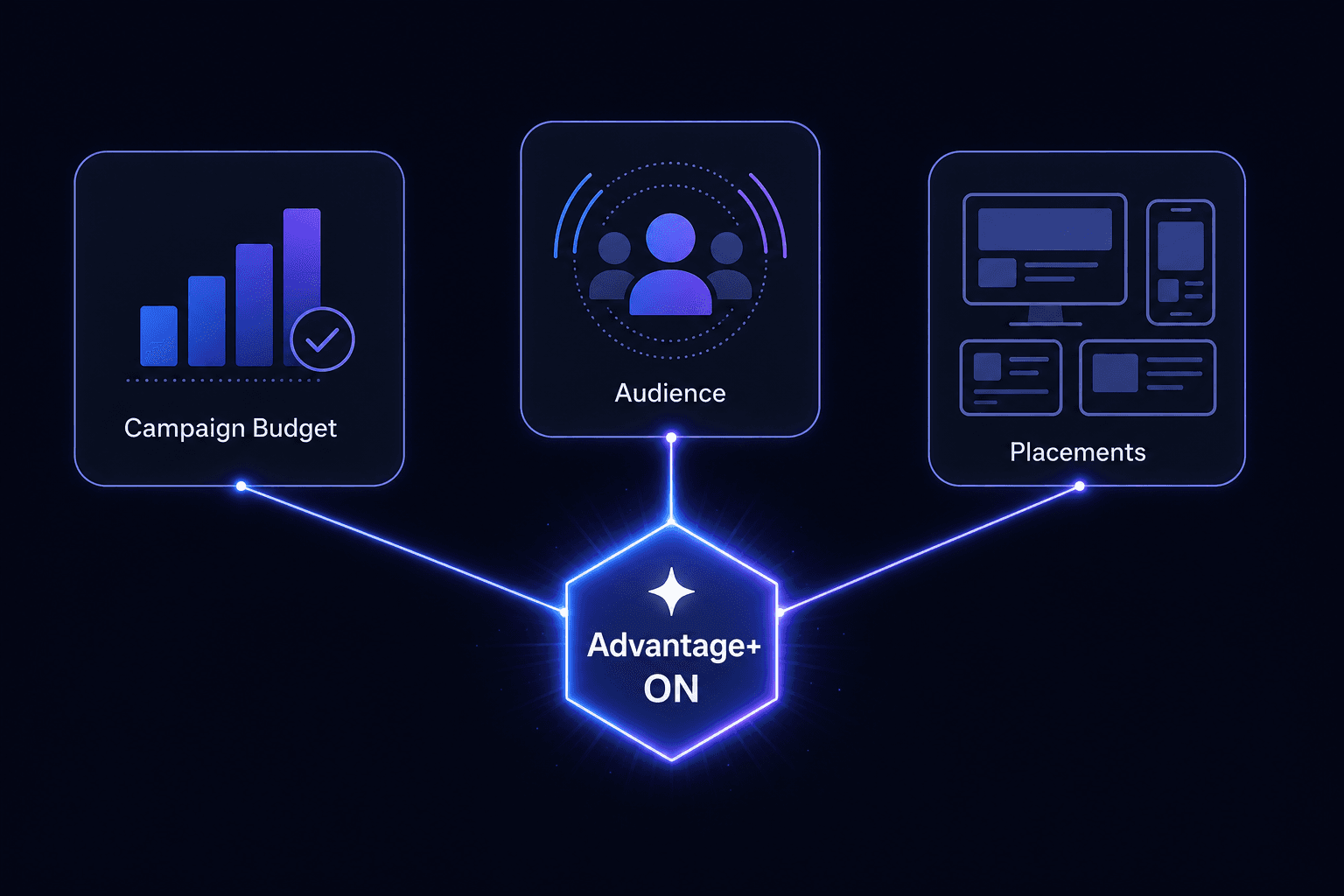
- Advantage+ campaign budget enabled at the campaign level. This is the campaign-level budget setting, not ad-set-level budget control.
- Advantage+ Audience active in at least one ad set. You do not need it in every ad set, but at least one must use it.
- Advantage+ Placements active in all ad sets. This is the default when creating campaigns via the API. If you manually restrict placements in any ad set, Advantage+ ON state is disabled.
For advertisers managing campaigns programmatically, Meta introduced the advantage_state_info API field (readable from MAPI v23.0 onward). This field returns one of three values: ADVANTAGE_PLUS_SALES, ADVANTAGE_PLUS_APP, or DISABLED. Use it to verify programmatically that a campaign is in the correct state before relying on the AI optimization benefits.
Step-by-Step Setup Guide for Advantage+ Sales Campaigns in 2026
The following walkthrough covers the key configuration decisions for a new Advantage+ Sales Campaign. This assumes you are building in Ads Manager or via MAPI v25.0+.
Campaign-Level Settings
- Select Sales as your campaign objective.
- Enable Advantage+ campaign budget at the campaign level. This is required for Advantage+ ON state and allows Meta to allocate budget across ad sets algorithmically.
- Do not set an ad-set-level budget — campaign-level budget and ad-set-level budget are mutually exclusive in this configuration.
Ad Set Structure and Audience Configuration
Advantage+ Audience introduces a two-tier structure that is critical to understand: Audience Controls (hard constraints the algorithm will not override) and Audience Suggestions (soft inputs Meta may expand beyond).
| Setting Type | Examples | Can Meta Expand Beyond? |
|---|---|---|
| Audience Controls (hard constraints) | Location, minimum age, excluded custom audiences, language | No — these are enforced limits |
| Audience Suggestions (soft inputs) | Age maximum, gender, included custom audiences, detailed targeting | Yes — Meta may serve ads outside these parameters if it predicts better results |
- Enable Advantage+ Audience in each ad set. This is required in at least one ad set for Advantage+ ON state.
- Set location as an Audience Control (hard constraint). This is the primary geographic limit.
- Set minimum age if your product has a legal or practical lower age limit. This is also a hard constraint.
- Add excluded custom audiences if you need to prevent specific segments from seeing ads (e.g., recent purchasers in a limited-time offer context).
- Add audience suggestions (age maximum, gender, custom audiences, detailed targeting) as directional inputs. Understand that Meta may serve outside these suggestions if the algorithm predicts better outcomes.
Placement Settings
Leave Advantage+ Placements on across all ad sets. This is the default in the API and is required for Advantage+ ON state. Manually restricting placements in any ad set disables the ON state for the campaign.
Conversion Settings and Bid Strategy
- Set Purchase as your conversion event. This is the recommended event for ecommerce Advantage+ Sales Campaigns. Optimizing for a higher-funnel event (add to cart, view content) undermines the algorithm's ability to find purchase-intent signals.
- Choose Highest Volume as your default bid strategy if your primary goal is maximizing total conversions.
- Switch to Highest Value if you have wide product price variance and sufficient purchase volume — this tells Meta to prioritize higher-value orders over raw conversion count.
- Optionally set a ROAS Goal as a floor. If the goal is unachievable given current market conditions, Meta will leave budget largely unspent rather than serve ads at below-floor efficiency. Use this setting conservatively.
Creative Strategy, Bidding Options, and Audience Segment Reporting
With targeting and placement decisions largely handled algorithmically, creative quality has become the primary lever that advertisers actually control. This was true in ASC and it remains true — arguably more so — in Advantage+ Sales.
Maximizing Creative Volume and Diversity
ASC allowed 150 creative combinations within a single ad set. Advantage+ Sales allows 50 ads per ad set — but with no limit on ad sets, you can exceed 150 total by distributing creative across multiple ad sets. Three ad sets with 50 ads each gives you 150 combinations. Five ad sets gives you 250.
The practical strategy: build ad sets around distinct creative themes or product categories rather than audience segments (since Advantage+ Audience handles audience expansion automatically). This gives Andromeda more candidate variation to work with while keeping your campaign structure organized.
Meta's GenAI image generation tools are worth using for creative variation. The reported +7% conversion lift for businesses using image generation (Meta-reported figure) suggests the additional variation is useful to the retrieval system, not just cosmetically different.
Value Optimization: When It Makes Sense
Highest Value bid strategy is not the right default for every ecommerce advertiser. Two conditions should both be true before switching from Highest Volume:
- Wide product price variance — your catalog includes items with meaningfully different price points, so optimizing for order value produces a different result than optimizing for order count.
- Sufficient existing purchase volume — the algorithm needs historical conversion data to learn which users are likely to make higher-value purchases. If you are not already generating strong purchase volume, Highest Value has no signal to work from.
If your product prices are narrow or you are struggling to generate purchase volume, Highest Value is unlikely to improve results and may reduce delivery.
Unlocking Audience Segments Reporting
Advantage+ Sales retains the Audience Segments breakdown from ASC, giving you reporting visibility into New Customers, Existing Customers, and Engaged Audience. This reporting is not automatic — you must define your Existing Customers and Engaged Audience segments in Advertising Settings first.
- Go to Advertising Settings in Business Manager.
- Define your Existing Customers segment using a customer list or pixel-based custom audience.
- Define your Engaged Audience segment (typically users who have interacted with your ads or page but have not purchased).
- Once defined, the Breakdown menu in Ads Manager will show performance split by New Customers, Existing Customers, and Engaged Audience.
This reporting is especially important for advertisers who relied on the Existing Customer Budget Cap — it is now the primary visibility mechanism for understanding how budget is distributing across customer segments, even though you can no longer cap it directly.
Limitations, Honest Caveats, and What to Watch For
Replacing the Existing Customer Budget Cap
The ECBC was a meaningful budget control tool for advertisers who needed to limit retargeting spend and push budget toward new customer acquisition. Its removal is a real operational change, not a minor cleanup.
The workaround: create separate ad sets targeting new customers and existing customers, then use ad-set-level spend controls or simply monitor the Audience Segments breakdown to adjust budget allocation manually. This replicates the intent of ECBC but requires active management rather than a single cap setting.
Advantage+ Audience Limitations
Opportunity Score: Diagnostic Tool, Not Performance Indicator
Opportunity Score is a 0–100 metric in Ads Manager that reflects how many of Meta's delivery recommendations you have adopted. It is not a measure of campaign performance.
A high score doesn't mean that your campaign is performing optimally and a low score doesn't mean it's performing poorly. Adopting recommendations to increase your score also doesn't guarantee you'll get better results.
Meta's own early testing reported a 5% decrease in median cost per result for advertisers who adopted Opportunity Score recommendations — again, a vendor-reported figure for a specific cohort. Use Opportunity Score as a diagnostic prompt when performance is declining, not as a target to optimize toward. Many of its suggestions will point toward enabling additional Advantage+ features; evaluate each on its own merits for your campaign goals.
Attribution Complexity and Documentation Lag
Advantage+ Sales inherits the attribution complexity that comes with any broad AI-driven campaign format. Because Andromeda is selecting from a wide candidate pool and Meta is expanding beyond audience suggestions, isolating the contribution of specific creative, audience, or placement decisions is difficult. Standard attribution windows apply, but the algorithmic nature of delivery means you cannot cleanly attribute performance to individual campaign choices the way you can in manually configured campaigns.
There is also a documentation lag to be aware of: Advantage+ Sales may have received UI updates and feature additions after Meta's February 2025 announcement and before the Q1 2026 MAPI v25.0 breaking change. Pre-breaking-change documentation may not reflect the current state of the Ads Manager interface. When in doubt, verify current settings directly in Ads Manager or in Meta's current developer changelog rather than relying on documentation dated before Q1 2026.
Comments
Join the discussion with an anonymous comment.