
AEO Tactics for Marketers: How to Get Your Content Cited in AI Answer Engines
A structured implementation guide for SEO managers and content strategists who are past the 'what is AEO' stage and need specific, evidence-backed tactics for getting content cited in ChatGPT, Google AI Mode, and Perplexity — covering on-page structure, schema markup, crawler permissions, earned media strategy, and measurement.
The Unit of AEO Is a Fragment, Not a Page
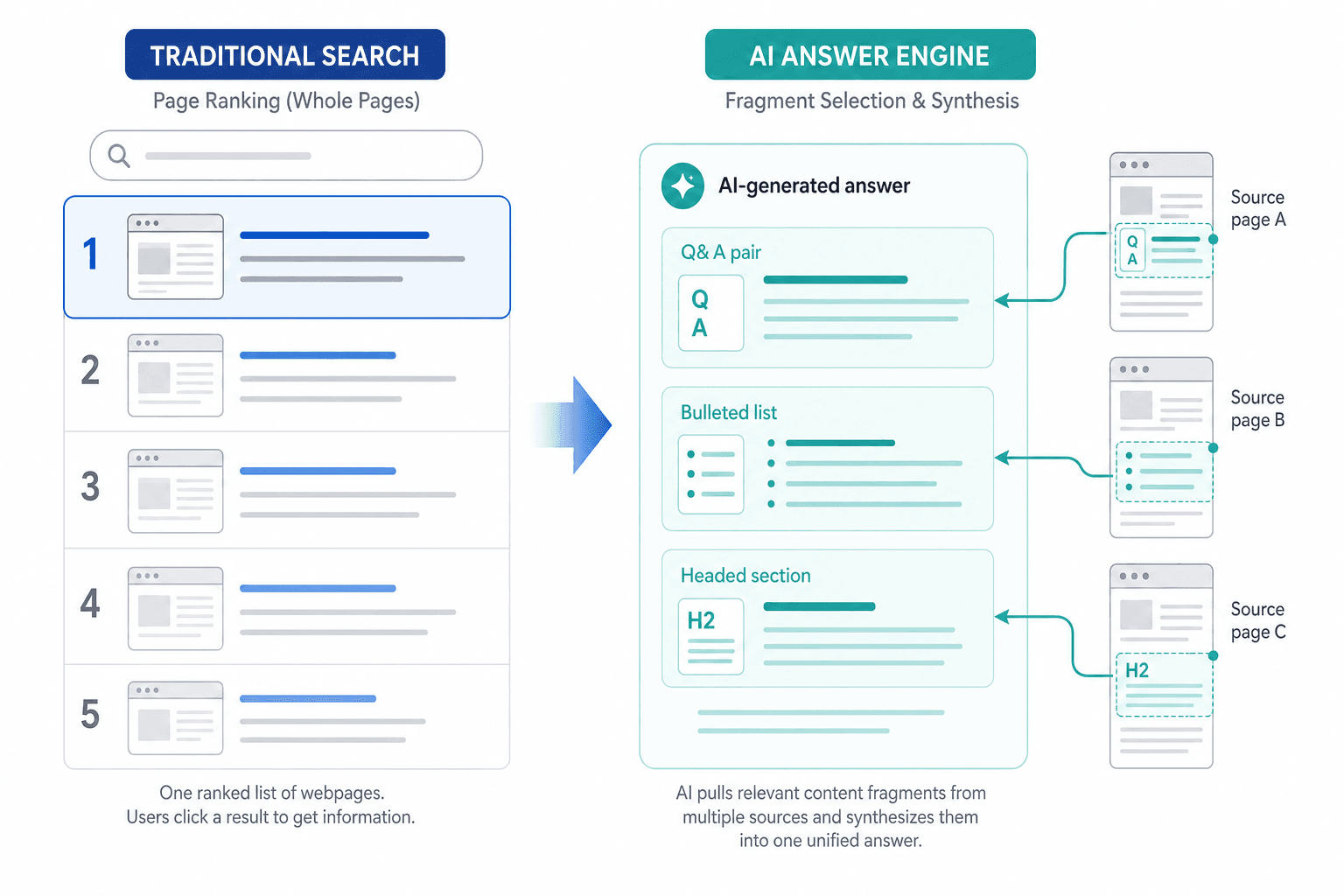
Traditional SEO operates on a page-ranking model: get a page to position one, and traffic follows. That mental model breaks down for AI answer engines. When ChatGPT, Google AI Mode, or Perplexity generates a response, it does not retrieve and present a single winning page. It parses content from multiple sources, extracts discrete sections that answer the query, and assembles them into a synthesized response.
AI assistants 'break content down, a process called parsing, into smaller, structured pieces that can be evaluated for authority and relevance. Those pieces are then assembled into answers, often drawing from multiple sources to create a single, coherent response.'
That description — from Krishna Madhavan, Principal Product Manager at Microsoft Bing — defines the core shift. The unit of optimization is no longer the page. It is the extractable fragment: a self-contained Q&A pair, a headed section, a structured list, a table with clear column labels. Each of these is a candidate for inclusion in an AI-generated answer. The rest of the page is irrelevant to whether that fragment gets cited.
This distinction matters because most AEO advice in circulation today is recycled SEO advice with new terminology attached. 'Write quality content' and 'earn authoritative backlinks' are not wrong, but they are insufficient. They describe eligibility conditions, not citation mechanics. The tactics in this guide address the structural and technical specifics that determine whether your content is fragment-extractable — and therefore citable — by AI systems.
On-Page Structure: Writing Content AI Can Extract
If AI systems parse pages into fragments before evaluating them, then on-page structure directly determines what gets extracted — and what gets skipped. The following structural patterns have the strongest evidence for improving fragment extractability.
Q&A Heading Format
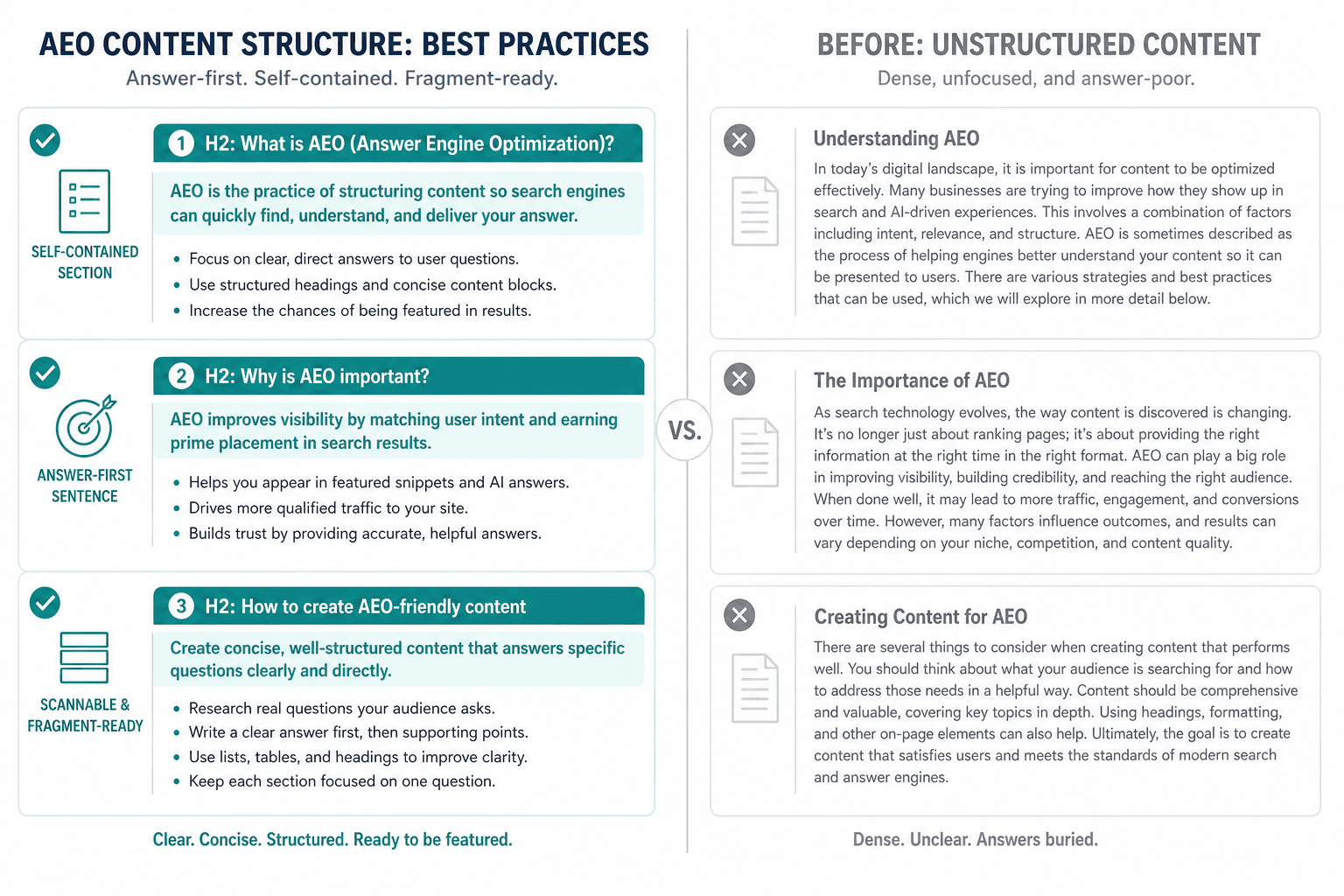
Framing headings as explicit questions — "What is the difference between FAQPage and HowTo schema?" rather than "Schema Types" — creates a direct match with the query format AI systems process. Microsoft's Madhavan noted that AI assistants can often lift Q&A pairs word for word into generated responses. The heading provides the question; the first paragraph or two provides the answer. That pair is the extractable unit.
Answer-First Writing
Front-load the direct answer before context, caveats, or background. AI systems parsing a section do not read to the end to find the conclusion — they extract the most answer-dense passage near the top of each section. If your answer is buried in paragraph four after two paragraphs of setup, the setup is what gets extracted, not the answer.
Descriptive Headings as Fragment Delimiters
H2 and H3 headings function as chapter titles for AI parsing — they define where one content slice ends and another begins. A heading like "Benefits" gives an AI system no information about what the section covers without the surrounding context. A heading like "Three Measurable Benefits of FAQPage Schema for AI Visibility" is a self-contained signal. The section beneath it can be evaluated independently.
Self-Contained Sections
Each section should make sense when read in isolation, without requiring the reader to have read the preceding sections. AI systems assembling multi-source answers do not carry context from one extracted fragment to another. If your section opens with "As mentioned above..." or relies on a definition introduced three sections earlier, the extracted fragment will be incomplete or misleading.
Snippet-Ready Formatting
Numbered lists, bulleted lists, and tables break complex information into segments that AI systems can reuse individually. A wall of prose describing five steps is harder to extract than a numbered list of five steps. A comparison of three options in prose is harder to extract than a three-row table. The formatting is not cosmetic — it is structural signal.
The before/after contrast below illustrates the difference between unstructured and AEO-ready content for the same information:
| Unstructured (AEO-weak) | Structured (AEO-ready) |
|---|---|
| Heading: 'Schema Markup' Content: 'There are several types of schema markup that can help your content. FAQPage is useful for questions and answers. HowTo works well for step-by-step content. You should also consider Article schema for blog posts...' | Heading: 'Which Schema Types Improve AI Citation Rates?' Content: 'FAQPage schema directly maps to the Q&A format AI systems use to generate answers. Use it for any content section structured as a question followed by a direct answer. • FAQPage — Q&A content • HowTo — step-by-step instructions • Article/BlogPosting — authorship and date signals • Organization — brand entity recognition' |
Technical AEO: Schema, Crawlers, and Freshness Signals
Three technical levers have the clearest evidence behind them: schema markup, crawler permissions in robots.txt, and freshness signaling. Each addresses a different layer of how AI systems evaluate and index your content.
Schema Markup
The GEO-16 framework — which analyzed 1,702 real AI citations — identified structured data as one of the top three predictors of citation likelihood, alongside metadata/freshness signals and semantic HTML. Schema markup is the most direct way to provide structured data.
Four schema types are most directly relevant to AI citation:
- FAQPage — maps directly to the question-answer format AI systems use. Each Question/Answer pair in the markup is a discrete extractable unit. Apply to any page section structured as explicit Q&A.
- HowTo — marks up step-by-step instructional content. AI systems can extract individual steps as ordered fragments.
- Article / BlogPosting — provides authorship, publication date, and modification date signals. These are freshness and authority indicators AI systems use to evaluate source recency.
- Organization — establishes brand entity identity with consistent name, URL, logo, and contact information. Supports entity recognition across AI knowledge graphs.
A minimal FAQPage implementation looks like this:
{
  "@context": "https://schema.org",
  "@type": "FAQPage",
  "mainEntity": [
    {
      "@type": "Question",
      "name": "What is the difference between OAI-SearchBot and GPTBot?",
      "acceptedAnswer": {
        "@type": "Answer",
        "text": "OAI-SearchBot is OpenAI's crawler for ChatGPT search results. GPTBot is OpenAI's crawler for training data. They are distinct bots and can be controlled separately in robots.txt."
      }
    }
  ]
}
Crawler Permissions in robots.txt
Most publishers have not updated their robots.txt files to account for the distinction between AI search crawlers and AI training crawlers. These are not the same bot, and they can be controlled independently.
| Bot name | Purpose | Effect of blocking |
|---|---|---|
| OAI-SearchBot | ChatGPT search citations | Blocks your content from appearing in ChatGPT search responses |
| GPTBot | OpenAI training data collection | Blocks your content from being used in OpenAI model training — does not affect ChatGPT search |
| Google-Extended | Google Gemini and Bard training | Blocks Gemini model training — does not affect Google AI Overviews or standard Google Search |
| PerplexityBot | Perplexity search citations | Blocks your content from Perplexity responses (compliance disputed — see caveat below) |
A publisher who wants to appear in ChatGPT search results while blocking OpenAI's training crawler would configure robots.txt as follows:
# Allow ChatGPT search crawler
User-agent: OAI-SearchBot
Disallow:

# Block OpenAI training crawler
User-agent: GPTBot
Disallow: /

# Block Gemini training (does not affect Google AI Overviews)
User-agent: Google-Extended
Disallow: /Freshness Signaling
AI systems weight content freshness as a citation signal. The GEO-16 framework identifies metadata and freshness as one of the top three citation predictors. Two practical implementations:
- Visible last-updated timestamps — display the date a page was last reviewed or updated in a machine-readable format (ISO 8601 in the Article schema's dateModified field, plus a visible on-page date). A Semrush-cited AirOps study reported that pages with a clear 'last updated' timestamp receive 1.8x more AI citations than those without — treat this figure as directionally useful but verify the primary source before citing it as a hard statistic, as it was reported secondhand.
- IndexNow — submit URLs to IndexNow immediately after updating content. IndexNow notifies participating search engines (including Bing) of content changes in real time, reducing the lag between a content update and crawler re-evaluation.
Off-Page AEO: Why Earned Media Outweighs On-Site Optimization
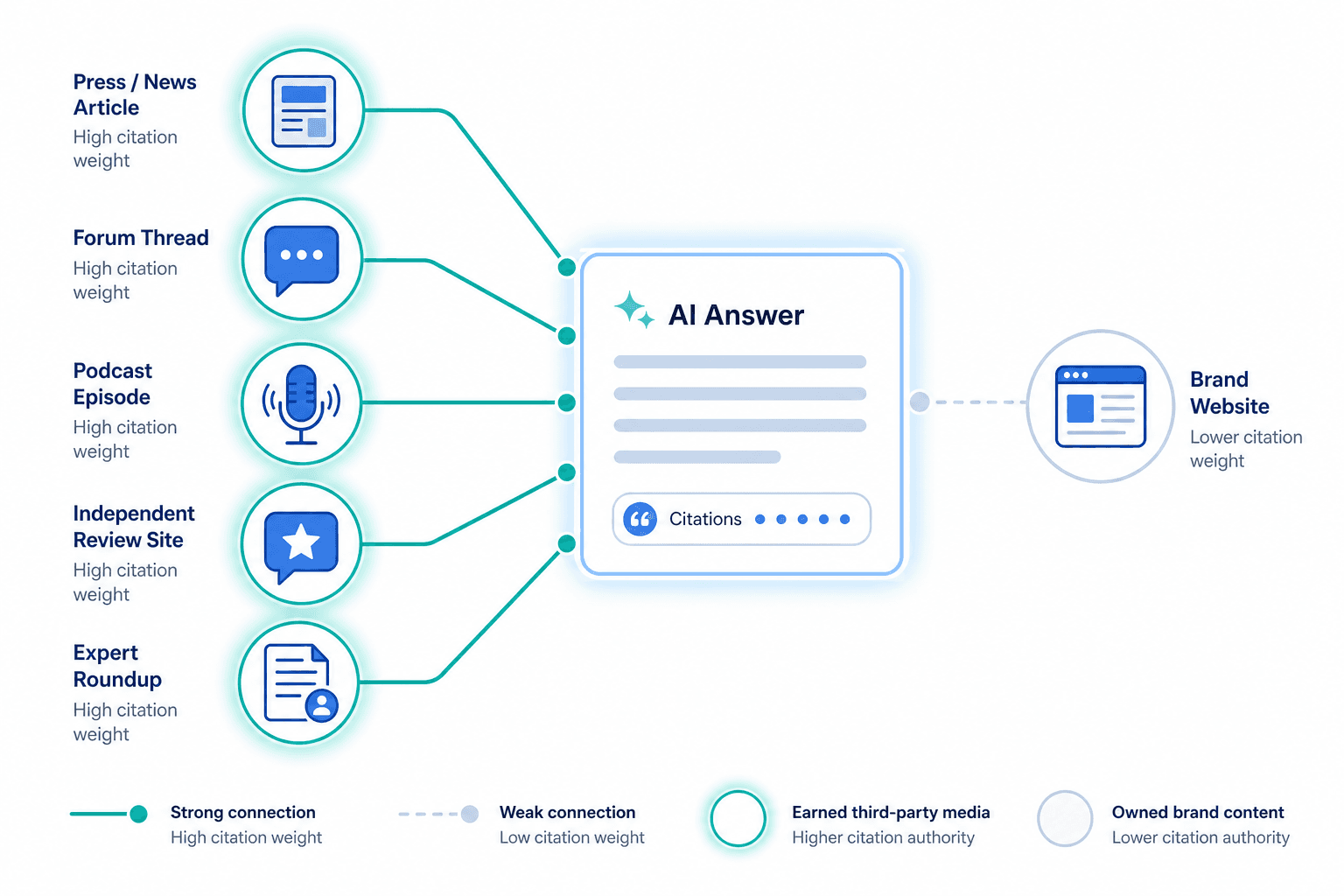
On-page structure and schema markup create the conditions for AI citation. But the weight of available evidence suggests that what happens off your site matters more than what happens on it.
A University of Toronto study examining AI citation behavior in consumer electronics found that AI systems cited third-party authoritative sources 92.1% of the time — compared to 54.1% for Google Search. That 38-point gap is not a rounding error. It reflects a structural preference in how AI systems are trained to synthesize information: they weight independent verification over brand-owned claims.
The practical implication is that the highest-leverage AEO work for most organizations is not on their own website — it is building the third-party presence that AI systems treat as authoritative signal. Neil Patel's analysis of 80+ factors for ChatGPT recommendations identified six top predictors that converge on this point:
- Brand mentions across the web — volume and consistency of brand name appearances on independent sites
- Quality and volume of third-party reviews — on independent review platforms, not on your own site
- Appearance in 'best of' listicles and expert roundups — editorial inclusion signals category authority
- High-authority domain backlinks — traditional link authority remains a citation eligibility signal
- Keyword relevancy match — the content's topical alignment with the query
- Domain and brand age — established brands with longer track records are weighted more heavily
Four earned media channels have the most direct impact on AI citation rates:
Digital PR and Press Coverage
Coverage in trade publications, news outlets, and industry media creates the third-party authoritative mentions AI systems weight most heavily. A brand mentioned in a TechCrunch article, a Wired product review, or an industry analyst report carries more citation authority than the same claim made on the brand's own blog.
Forum Participation
Reddit threads are frequently cited in AI-generated responses, particularly for comparative and recommendation queries. Genuine participation in relevant subreddits — answering questions with specific, accurate information rather than promotional content — creates citable mentions in a format AI systems regularly draw from.
Podcast Appearances and Expert Roundups
Podcast show notes, transcript pages, and expert roundup articles create indexed third-party mentions with named attribution. These pages often rank well independently and serve as secondary citation sources when AI systems look for corroborating evidence across multiple sources.
Entity Consistency Across Platforms
AI knowledge graphs resolve brand entities by matching consistent signals across multiple data sources: name, URL, description, and category. If your brand name, website URL, and business description are inconsistent across Google Business Profile, LinkedIn, Wikipedia, Wikidata, Crunchbase, and industry directories, AI systems have a harder time building a confident entity representation. Consistency across these platforms is a supporting signal, not a primary one — but it reduces friction in entity resolution.
What Actively Hurts AI Citation Rates
Several common content practices that are neutral or mildly positive for traditional SEO are active liabilities for AI citation. The academic evidence here is specific enough to be actionable.
Persuasive Tone and Marketing Language
The GEO paper (Princeton, IIT Delhi, Georgia Tech — accepted to KDD 2024) found that citing credible sources produced a 115.1% increase in AI visibility. Persuasive tone, by contrast, showed no statistically meaningful improvement. The implication is direct: content written to convince rather than to inform is deprioritized by AI systems.
Marketing language is a specific subset of this problem. Terms like 'innovative,' 'next-gen,' 'cutting-edge,' 'best-in-class,' and 'revolutionary' are vague claims without measurable anchors. AI systems trained on factual synthesis treat these terms as low-signal noise. Microsoft's Madhavan put it directly: such terms 'mean little without specifics; anchor claims in measurable facts.'
Content Rewriting Heuristics That Do Not Work
A study from Columbia and MIT examining ecommerce content found that 10 of 15 common content rewriting heuristics produced negligible or negative results for AI citation rates. This finding — cited secondhand via Search Engine Journal and not directly verified for this article — is worth flagging because it runs counter to the instinct to 'optimize' existing content by rewriting it with AEO in mind.
The implication is that surface-level rewriting — adding keywords, adjusting tone, inserting Q&A formatting onto content that is structurally weak — does not reliably improve AI citation rates. Structural changes (heading format, section self-containment, answer placement) and off-page authority building have more consistent evidence behind them than content rewrites.
Other Active Liabilities
- Walls of undifferentiated prose — long paragraphs with no structural breaks give AI systems no fragment boundaries to work with. The entire block may be skipped in favor of a more parseable source.
- Missing authorship signals — content without a named author, publication date, or organization attribution lacks the authority metadata AI systems use to evaluate source credibility.
- Outdated content without visible review dates — AI systems weight freshness. A page last updated in 2021 with no visible review date is a weaker citation candidate than a page with a current 'last reviewed' timestamp, even if the underlying information is still accurate.
- Core content in PDFs — PDFs are not reliably crawled by AI search bots. If your most authoritative technical documentation, research, or product information lives only in downloadable PDFs, it may be invisible to AI citation systems.
Measurement: Tracking AI Visibility Without Reliable Click Data
Standard traffic analytics undercount AEO impact by design. A usability study of 37 participants across 250 Google AI Mode sessions found that approximately 75% of sessions produced zero external visits, and the median number of external clicks per task was zero. Users were discovering, evaluating, and forming opinions entirely within the AI interface — without clicking through to source pages.
This does not mean AI visibility is unmeasurable. It means the measurement framework needs to shift from click-through rate to citation presence. Here is what to track:
UTM Tracking for AI Referral Traffic
ChatGPT drives 87.4% of all AI referral traffic across industries, according to Conductor's analysis of 13,770 domains and 17 million AI-generated responses. These referrals are trackable: ChatGPT sends traffic with utm_source=chatgpt.com in GA4. Set up a dedicated segment or channel grouping in GA4 to isolate this traffic. Note that Conductor also found AI referral visitors convert at 4.4x the rate of traditional organic visitors — a meaningful signal even at low absolute volumes.
For platform context on ChatGPT's evolving search behavior, the ChatGPT 2026 changelog for marketers covers what changed from GPT-4o through the current release and what those changes mean for citation behavior.
Google Search Console AI Overviews Impressions
Google Search Console now surfaces AI Overview appearances as impressions even when those appearances do not generate clicks. This is the clearest direct signal available for Google AI Mode citation rates. Filter by 'AI Overviews' in the Search Type dropdown to isolate this data. Being cited within a Google AI Overview correlates with 35% more organic clicks compared to not being cited, per Conductor's benchmarks — which suggests citation visibility and click traffic are not fully decoupled.
Bing Webmaster Tools AI Performance Report
Bing Webmaster Tools includes a free AI Performance Report that shows how your content is appearing in Copilot and AI-assisted Bing results. This is underused relative to GSC but provides a distinct data source for non-Google AI citation tracking.
Manual Citation Audit
Run structured manual prompts in ChatGPT and Perplexity using both branded queries ("[Brand name] reviews," "Is [Brand name] good for [use case]") and non-branded category queries ("best [category] tools for [use case]"). Record which pages are cited, which competitors appear, and which third-party sources AI systems draw from when describing your category. This baseline audit identifies both citation gaps and the specific third-party sources you need coverage on.
AI Visibility Monitoring Platforms
Several platforms now offer automated AI citation monitoring: Profound, Peec.ai, and Advanced Web Ranking all track brand mentions across AI-generated responses at scale. These are useful for organizations that cannot run manual audits at frequency. For readers evaluating which SEO platform to use for AI visibility tracking alongside traditional SEO metrics, the Semrush vs. Ahrefs AI features comparison for 2026 covers what each platform currently offers in this area.
| Measurement method | What it tracks | Cost | Limitation |
|---|---|---|---|
| GA4 utm_source=chatgpt.com | ChatGPT referral clicks and conversions | Free | Only captures sessions that clicked through — misses zero-click citations |
| GSC AI Overviews impressions | Google AI Mode citation appearances | Free | Google-only; no Perplexity or ChatGPT data |
| Bing Webmaster Tools AI report | Copilot and Bing AI citation appearances | Free | Bing ecosystem only |
| Manual prompting audit | Current citation status across platforms | Free (time cost) | Not scalable; requires regular repetition to track changes |
| AI visibility platforms (Profound, Peec.ai, AWR) | Automated cross-platform citation monitoring | Paid | Early-stage tooling; methodology varies by provider |
Platform Differences: Google AI Mode, ChatGPT, and Perplexity
Google and Microsoft have taken meaningfully different official positions on what publishers should do to improve AI citation rates — and understanding that divergence helps with prioritization.
Google's official stance is that publishers should follow existing SEO best practices and that no additional AI-specific optimization steps are required. The Ahrefs study of 1.9 million AI Overview citations supports this position structurally: 76% of AI Overview citations come from pages that already rank in Google's top 10. The foundation SEO work that earns a top-10 ranking creates the eligibility condition for AI citation — ranking first gives roughly a coin-flip chance of being cited, not a guarantee, but not ranking in the top 10 makes citation unlikely.
Microsoft's position is more prescriptive. The October 2025 guide from Krishna Madhavan and the January 2026 GEO guide from Microsoft Advertising both provide specific structural and technical recommendations — Q&A headings, self-contained sections, schema markup, freshness signals, earned media strategy. Importantly, Microsoft's guidance is not Bing-exclusive. The structural changes it recommends improve content parsability for all AI systems, including Google's.
| Platform | Official guidance | Citation source behavior | Key differentiator |
|---|---|---|---|
| Google AI Mode | 'Follow existing SEO best practices' | 76% of citations from Google top-10 pages (Ahrefs, July 2025) | Foundation SEO creates eligibility; specific AEO tactics not officially required but structurally beneficial |
| ChatGPT Search | No official publisher guidance published | 87.4% of AI referral traffic across industries (Conductor, 2025) | OAI-SearchBot is the relevant crawler; trackable via utm_source=chatgpt.com |
| Perplexity | No official publisher guidance published | Frequently cites Reddit, news sources, independent reviews | Crawler compliance with robots.txt is disputed; treat as best-effort |
Implementation Priority: Where to Start
The tactics in this guide are not equally urgent. A sequenced starting point prevents the common failure mode of implementing schema on pages that are structurally unparseable, or running citation audits before setting up the tracking infrastructure to act on what they reveal.
- Audit existing high-traffic content for fragment-readiness. Check your top 20 pages by organic traffic for: self-contained sections, answer-first paragraph structure, descriptive H2/H3 headings, and content not hidden in tabs or expandable elements. This audit identifies where structural changes will have the most immediate impact.
- Implement FAQPage and Article schema on high-traffic pages. Start with pages that already have Q&A content or step-by-step instructions — these map most directly to FAQPage and HowTo schema. Add Article schema with dateModified to establish freshness signals.
- Set up UTM tracking and GSC AI Overview monitoring. Confirm that ChatGPT referral traffic is visible in GA4 via utm_source=chatgpt.com. Enable AI Overview impressions in GSC. These free tools establish the baseline before you spend time on more complex monitoring.
- Run a manual citation audit in ChatGPT and Perplexity. Use both branded and non-branded queries relevant to your category. Record which pages are cited, which competitors appear, and which third-party sources AI systems draw from. This is your gap analysis.
- Identify earned media gaps. From your citation audit, note which third-party sources AI currently cites when describing your topic area. Those are the publications, forums, and review platforms where you need coverage. Build your digital PR and outreach priorities around closing those specific gaps.
For teams producing content at scale, structuring AEO requirements into the brief stage is more efficient than retrofitting published content. The Claude AI SEO content brief prompt template provides an XML-structured brief format that can be adapted to include AEO-specific requirements — descriptive heading format, self-contained section requirements, answer-first structure, and schema type designation — before content is written rather than after.
Comments
Join the discussion with an anonymous comment.