
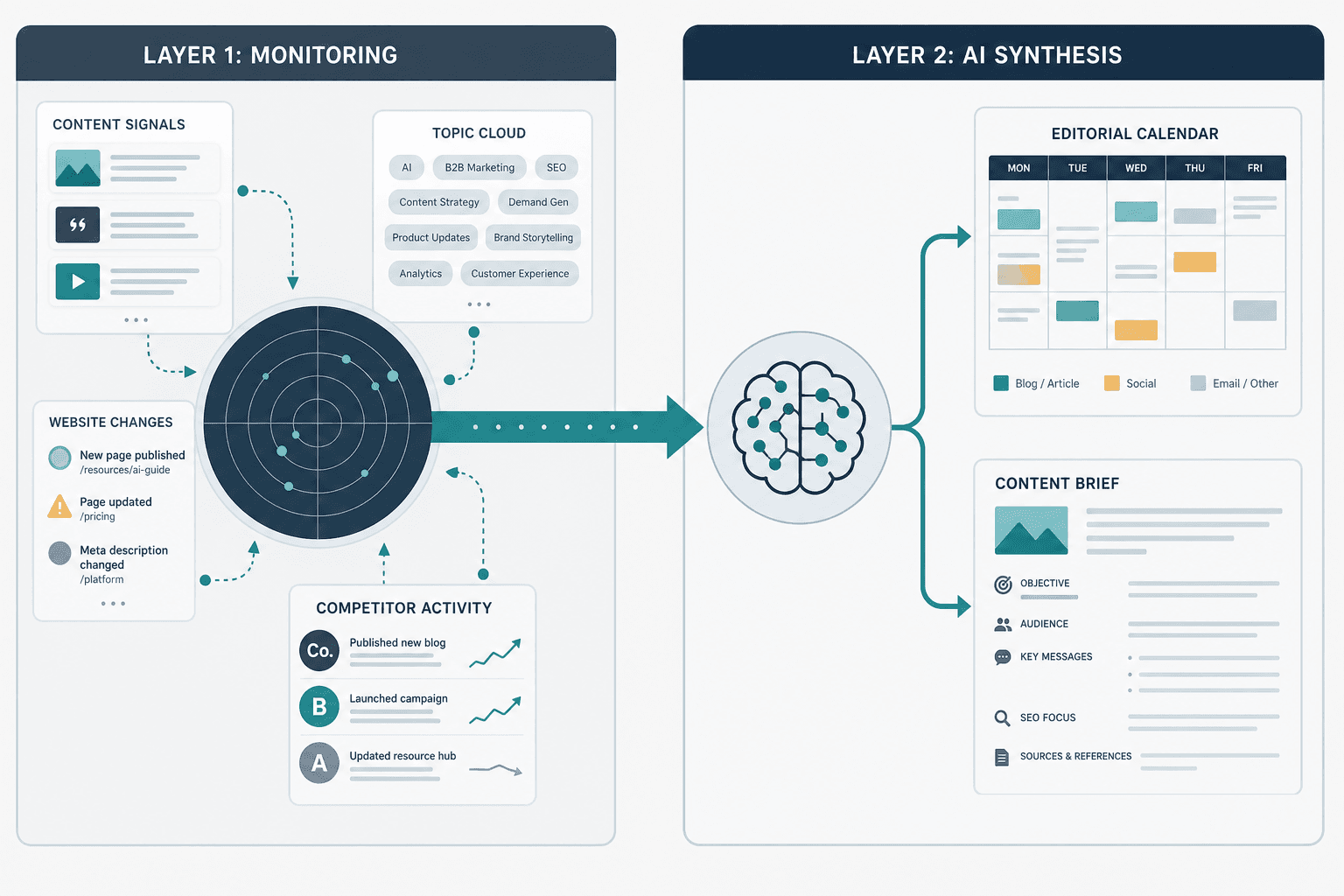
AI-Powered Competitive Intelligence for Content Marketers: A Practical Two-Layer Workflow
Most content marketers track competitors reactively — scanning feeds, skimming dashboards, reacting after the fact. This guide walks through a practical two-layer system — specialized monitoring tools paired with LLM synthesis — that turns scattered competitor signals into proactive editorial positioning decisions, built for SMB-to-mid-market content teams without enterprise CI budgets.
The Content Marketer's CI Problem: Watching Without Understanding
Most content teams have some version of a competitive monitoring setup. Someone has a Google Alerts folder they check occasionally. There's a shared doc where someone pastes competitor blog titles once a month. Maybe a Semrush dashboard gets opened before quarterly planning. The inputs exist — but they don't connect to anything. Observations pile up without becoming decisions.
This is the content marketer's version of the CI problem: not a lack of data, but a missing system for converting competitor signals into editorial positioning choices. The result is a team that reacts to what competitors published last quarter instead of anticipating what topics, formats, and messages are gaining ground right now.
It's worth naming what this problem is not. Sales teams need battlecard-style CI — deal-level intelligence about competitor pricing, feature gaps, and objection handling, delivered through CRM integrations. That's a different workflow with different tools and different outputs. Content teams need something narrower: intelligence about what topics are gaining traction, how competitor messaging is shifting, which content formats are earning attention, and where audiences are underserved. These are editorial decisions, not sales decisions.
The fix is a two-layer architecture. Layer 1 handles monitoring — structured tracking of competitor content, search visibility, and messaging changes using purpose-built tools. Layer 2 handles synthesis — using LLMs to translate those raw signals into patterns, gaps, and positioning opportunities. Neither layer works well without the other. Monitoring without synthesis produces data dumps. Synthesis without monitoring produces hallucinated competitor landscapes.
The Four Signal Types That Actually Matter for Editorial Work
Not all competitive signals are equally useful for content decisions. Sales CI tends to prioritize pricing changes, feature announcements, and customer win/loss patterns. Content CI requires a different signal set — one that maps directly to editorial planning choices.
There are four signal categories worth tracking consistently:
- Topic trends. What subjects are competitors publishing into, and which of those topics are gaining engagement? This is the raw material for content gap analysis — identifying where competitors are investing editorial attention and where they're absent.
- Messaging pivots. Shifts in how competitors describe their positioning, value proposition, or target audience. A competitor that starts emphasizing "AI-native" instead of "automation-first" is signaling a strategic repositioning. These shifts show up in homepage copy, pillar page language, and email subject lines before they show up in press releases.
- Content format shifts. Movement from long-form blog content to video series, from blog to newsletter, from written guides to interactive tools. Format investment signals where a competitor believes audience attention is moving — and where your team may have an opening to go deeper in a format they're abandoning.
- Audience sentiment shifts. How competitor audiences are responding — in comments, social shares, review platforms, and community discussions. Declining engagement on a competitor's previously high-performing topic cluster is a signal worth investigating. Consistent complaints about content quality or depth in competitor comment sections are signals about underserved audience needs.
These four signal types connect directly to editorial decisions: topic trends feed your content calendar, messaging pivots trigger positioning reviews, format shifts inform channel investment, and sentiment data surfaces audience needs your competitors aren't meeting. The workflow in this guide is built around capturing and acting on all four.
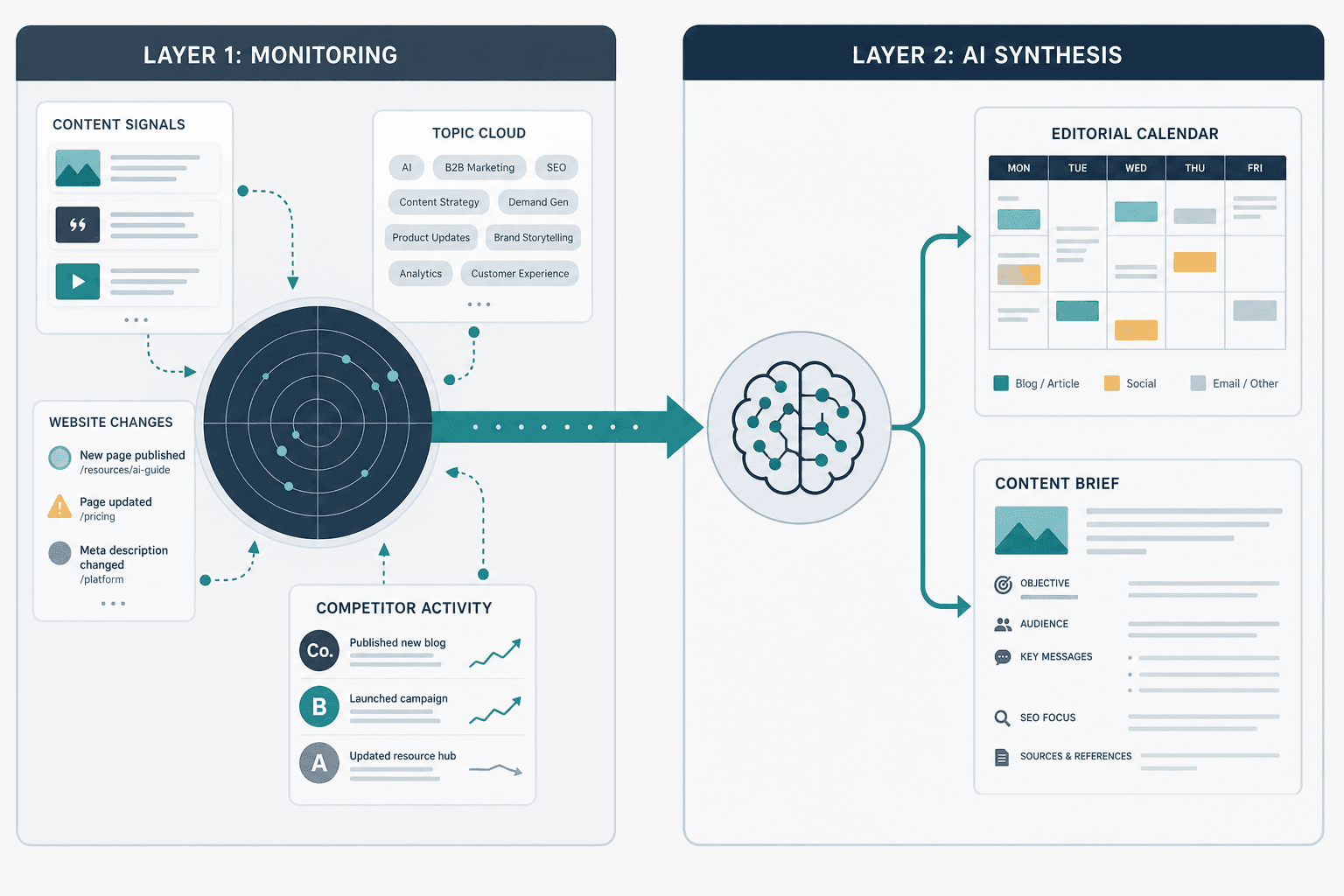
Layer 1 — Monitoring Tools for Content Teams
The monitoring layer is where you collect the raw signals. Five tools cover the meaningful ground for content-team CI at SMB-to-mid-market budgets. Each solves a specific part of the problem — none of them solve all of it, and that's expected. The goal is a stack, not a single platform.
BuzzSumo
BuzzSumo is the closest thing to a purpose-built content CI platform available at non-enterprise pricing. Its core function is tracking which competitor content earns the most shares, backlinks, and engagement — across formats and channels. You can monitor a competitor's domain, track specific topics, and see which content types are performing. Pricing runs $199–$999+/month depending on tier.
The honest limitation: BuzzSumo surfaces engagement signals well, but it doesn't interpret them. High share counts don't automatically translate into editorial opportunities — that translation requires the synthesis layer. BuzzSumo also lags on real-time data; it's better for trend analysis over weeks than for detecting a messaging change that happened yesterday.
Semrush
For keyword-level competitive intelligence, Semrush's Content Gap tool is the most practical entry point. It shows which keywords competitors rank for that your site doesn't — a direct input for topic prioritization. The Organic Research feature lets you track competitor domain visibility over time, which is a reliable proxy for content investment direction. Pro plan starts at $117/month; a limited free tier is available.
Limitation: Semrush is keyword-centric, not content-strategy-centric. It tells you what competitors rank for, not why their content is resonating or what their editorial positioning is. It's a strong Layer 1 tool for topic gap detection but doesn't replace qualitative content analysis.
Ahrefs
Ahrefs is the preferred tool for backlink intelligence and content gap analysis among SEO-oriented content teams. The Content Gap tool identifies keyword opportunities similar to Semrush's version, and the backlink database is more comprehensive for link-building competitive analysis. Lite plan starts at $129/month.
Limitation: Ahrefs and Semrush overlap significantly on content gap functionality. Most content teams don't need both — pick one based on which interface and data export format fits your workflow. Ahrefs has a slight edge on backlink depth; Semrush has broader channel coverage including paid search.
Visualping
Visualping is the most underused tool in content CI stacks. It monitors specific web pages for changes and alerts you when they update — making it the most direct way to catch competitor messaging pivots. Point it at a competitor's homepage, positioning page, pricing page, or key pillar content. When copy changes, you get an alert with a visual diff. It was rated G2's Highest Performer in CI for 2026. Pricing ranges from free to approximately $3,000/month at enterprise scale; for content team use cases, the lower tiers are sufficient.
Limitation: Visualping monitors web pages only — it has no content analytics, keyword tracking, or social listening capability. It's a single-purpose tool that does one thing well. It's also not useful for detecting content publishing frequency or topic trends; that's BuzzSumo and Semrush's job.
SparkToro
SparkToro answers a different question than the other four tools: where does a specific audience actually spend time online? For content CI, this means you can look up where your competitors' audiences read, what podcasts they listen to, and which social accounts they follow — intelligence that informs both content distribution strategy and audience need identification. Free tier offers five searches per month; paid plans run up to $300/month.
Limitation: SparkToro is audience intelligence, not competitor content intelligence. It tells you about the people in a market segment, not about what competitors are publishing. It's most valuable for distribution strategy and audience gap identification, less useful for editorial topic tracking.
| Tool | Primary CI use case | Starting price | Free tier | Key limitation for content teams |
|---|---|---|---|---|
| BuzzSumo | Content engagement tracking, format performance, share analysis | $199/mo | No | Doesn't interpret signals — requires LLM synthesis layer to act on data |
| Semrush | Keyword gap analysis, competitor organic visibility tracking | $117/mo | Limited | Keyword-centric; doesn't capture qualitative messaging or editorial positioning |
| Ahrefs | Backlink database, content gap analysis, keyword opportunities | $129/mo | No | Significant overlap with Semrush; most teams need one, not both |
| Visualping | Website change detection for messaging pivots | Free–$3,000/mo | Yes | Web monitoring only — no content analytics, keyword data, or social listening |
| SparkToro | Audience intelligence — where competitor audiences spend time | Free–$300/mo | Yes (5 searches/mo) | Audience data, not competitor content data; limited for topic trend tracking |
Layer 2 — LLM Synthesis: Why One Model Isn't Enough
The monitoring layer gives you raw signals. The synthesis layer is where those signals become intelligence — patterns, positioning gaps, and editorial opportunities. LLMs are the practical tool for this synthesis work, but they require a specific approach to be useful rather than misleading.
Claude, Perplexity, and ChatGPT each handle competitive synthesis differently, and those differences matter:
- Claude handles long-context, multi-document analysis well. If you're feeding in a competitor's last 20 blog posts, a PDF of their annual report, and a set of Visualping change alerts, Claude can synthesize across all of it in a single pass. As of April 2026, Claude Cowork is generally available as a desktop workspace for recurring analysis on local files — useful for teams that run the same CI synthesis on a weekly cadence.
- Perplexity has live web access and returns cited sources with its outputs. For competitive fact-finding — checking a competitor's current positioning, scanning recent coverage, or verifying a product update — Perplexity is the right starting point. Its citations make outputs easier to verify before acting on them.
- ChatGPT has the most mature third-party integrations, including direct connections to HubSpot and other marketing platforms. For teams already working inside those ecosystems, ChatGPT's integration layer reduces friction in getting CI outputs into editorial workflows.
The more important point is this: running the same competitive analysis prompt across multiple models and mapping where they agree versus diverge produces more reliable intelligence than any single model can deliver alone.
Elizabeta Kuzevska, co-founder of Revenue Experts AI, documented a clear illustration of this in a practitioner framework published on Medium: when she asked ChatGPT, Claude, Gemini, and Perplexity the same question about HubSpot versus Salesforce competitive positioning, each model returned a different confident answer — emphasizing different advantages, different weaknesses, different market positions. None of them flagged the disagreement. A marketer relying on any single model's output would have built their competitive understanding on one model's particular training bias.
If you're using one AI for competitive intelligence, you're building strategy on one model's biased perspective. — Elizabeta Kuzevska, Revenue Experts AI (Medium, January 2026)
The practical fix is a consensus-mapping step: run the same prompt on two or three models, then explicitly ask a model to identify where the outputs agree (high-confidence findings), where they diverge (findings that need verification), and what none of them covered (gaps). This is the methodology the weekly workflow below is built around.
The Weekly Workflow: Step-by-Step with Prompt Templates
The workflow below combines the monitoring and synthesis layers into a repeatable weekly process. Initial setup takes 2–3 hours. Weekly maintenance runs approximately 30 minutes once the stack is configured. The prompt templates are adapted from Kuzevska's practitioner framework — treat them as starting points and adjust the competitor names, context, and output format for your specific situation.
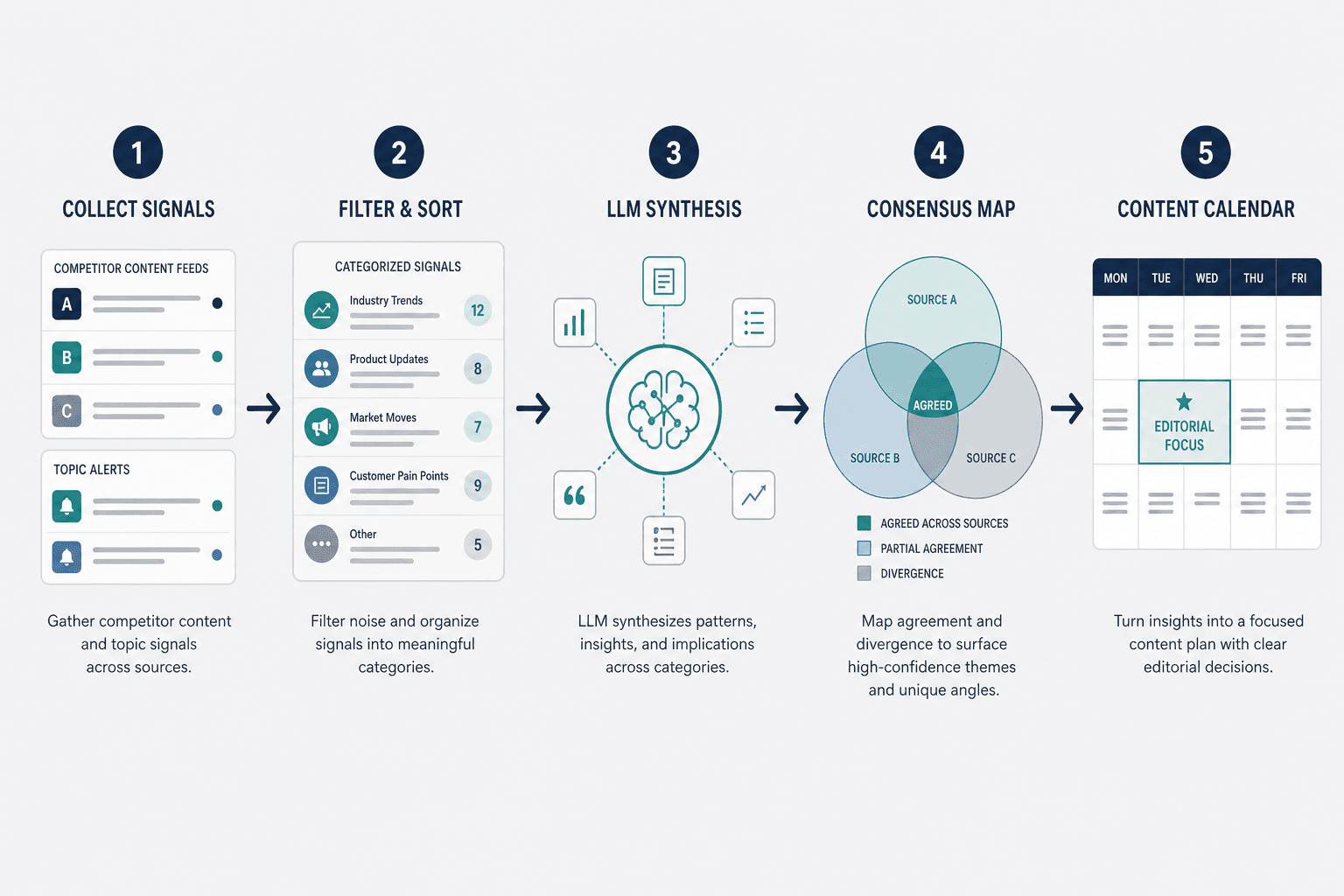
- Pull weekly monitoring inputs from Layer 1 tools. Check Visualping alerts for competitor page changes. Export the week's top-performing competitor content from BuzzSumo. Run a quick Content Gap check in Semrush or Ahrefs for any new keyword opportunities. Note any Google Alerts that flagged news or coverage. This step should take 10–15 minutes and produces a set of raw inputs for synthesis.
- Run the Competitor Research Prompt across two or more LLMs. Use Claude and Perplexity as your default pair — Claude for depth and multi-document synthesis, Perplexity for current web access and citations. Paste the same prompt into both and save both outputs.
- Run the Consensus Mapping Prompt to identify agreement, divergence, and gaps. Paste both model outputs into a single model and ask it to map findings into four categories: high-confidence (both models agree), medium-confidence (one model only), divergent (models contradict each other), and gaps (neither model addressed). This step is what separates a reliable CI output from a single model's confident guess.
- Run the Weekly Monitoring Prompt to surface news, messaging changes, and content signals. This prompt is narrower than the Competitor Research Prompt — it focuses on what changed in the past week rather than a full competitive landscape scan. Use Perplexity for this step since live web access matters more than long-context synthesis.
- Rate findings HIGH / MEDIUM / LOW significance. HIGH: competitor is actively investing in a topic area where you have a clear differentiation opportunity, or has made a major messaging change. MEDIUM: emerging trend worth monitoring for another 2–3 weeks before acting. LOW: single data point with no corroborating signals.
- Log HIGH and MEDIUM findings to your editorial planning document. Include the signal source, the synthesis finding, the significance rating, and a proposed editorial response. This log becomes the bridge between CI and content calendar decisions.
Prompt Template 1: Competitor Research Prompt
You are conducting competitive intelligence for a content marketing team. Analyze [COMPETITOR NAME] as a content competitor.

Cover the following:
1. Current content positioning: What topics, themes, and audience segments are they primarily publishing for?
2. Messaging and value proposition: How do they describe their positioning? What language do they use consistently?
3. Content strengths: Where does their content appear to be resonating (based on what you can observe)?
4. Content gaps or weaknesses: Where are they thin, inconsistent, or absent?
5. Recent shifts: Any notable changes in topic focus, format, or messaging in the past 60–90 days?
6. Audience signals: What does their audience engagement suggest about unmet needs or frustrations?

For each finding, note your confidence level and the basis for it. Flag anything where your information may be outdated or unverifiable.

Context about our company: [BRIEF DESCRIPTION OF YOUR COMPANY, AUDIENCE, AND CONTENT FOCUS]
Prompt Template 2: Consensus Mapping Prompt
I have run the same competitive analysis on [COMPETITOR NAME] using two different AI models. Below are both outputs.

[MODEL A OUTPUT]
[Paste full output here]

[MODEL B OUTPUT]
[Paste full output here]

Please synthesize these two analyses by mapping findings into four categories:

1. HIGH CONFIDENCE: Both models agree on this finding
2. MEDIUM CONFIDENCE: Only one model raised this — worth investigating further
3. DIVERGENT: The models contradict each other on this point — do not act on this without independent verification
4. GAPS: Important questions neither model addressed

For each HIGH CONFIDENCE finding, suggest a specific editorial implication for our content team.
Prompt Template 3: Weekly Monitoring Prompt
Conduct a weekly competitive content monitoring check for [COMPETITOR NAME] covering the past 7 days.

Focus on:
1. News and announcements: Any notable press coverage, product updates, or public statements?
2. Content and messaging changes: Any visible shifts in their website copy, blog focus, or social content?
3. Content signals: Any high-engagement content they published this week?
4. Pricing or offer changes: Any observable changes to their pricing, packaging, or free tier?
5. Customer signals: Any notable reviews, complaints, or praise in public forums?

For each item found, rate it HIGH / MEDIUM / LOW significance for our editorial planning.
HIGH = requires an editorial response or positioning review this week
MEDIUM = worth monitoring for 2–3 more weeks
LOW = single data point, no action needed

Note the source and date for any specific claim. If you cannot verify something, say so explicitly.From Competitive Signals to Editorial Decisions
The most common place content teams stall in CI is the translation step: they have a log of competitive findings and no clear process for turning those findings into calendar decisions. The signals stay in a document; the editorial calendar stays unchanged.
Each signal type maps to a specific editorial response:
- Topic trends → content priorities. When you identify a topic area where competitors are publishing heavily and you have a differentiated perspective, that's a content priority. When competitors are publishing heavily and you have nothing distinctive to add, that's a topic to deprioritize — not match.
- Messaging pivots → positioning reviews. A competitor shifting their primary value proposition language is a signal to audit your own positioning language. It doesn't mean you should mirror the change — it means you should understand what audience insight is driving it, and decide whether your current positioning still clearly differentiates.
- Content format shifts → channel investment decisions. A competitor abandoning long-form written content for short-form video is a signal, not a directive. It could mean they're following audience attention — or it could mean they're struggling with written content quality. Investigate the engagement data before changing your format mix.
- Audience sentiment shifts → underserved need identification. Consistent complaints in competitor comment sections, review platforms, or community discussions about shallow coverage, outdated examples, or missing use cases are direct signals about what their audience isn't getting. Those gaps are content opportunities — not to publish the same thing, but to publish what's actually missing.
The critical distinction is differentiation over mimicry. Knowing what competitors publish is not a reason to publish the same thing. Competitive intelligence is most valuable when it reveals where not to compete — topic areas that are already saturated with similar content — and where a distinctive perspective can fill a real gap.
Failure Modes and Trust Guardrails
AI-assisted CI has a specific failure pattern that's worth naming directly: confident-sounding outputs built on weak or unverifiable sources. The synthesis layer is good at producing fluent, structured analysis. It's less reliable at flagging when that analysis is based on outdated training data, a single low-quality source, or a gap in its knowledge that it didn't disclose.
Klue's 2026 AI in Competitive Intelligence Report — a survey of 250+ CI and PMM professionals — found that 76% of CI teams have had an AI output they couldn't stand behind, and 73% cited confident answers with weak or unverifiable sources as the primary failure mode. It's worth noting that this survey covered CI practitioners and product marketers, not content marketers specifically, so the exact percentages don't translate directly to content team workflows. But the failure pattern they're describing is real and consistent with how LLMs behave across use cases.
For content CI specifically, the most common failure modes are:
- Stale competitor positioning presented as current. LLMs with training cutoffs will describe a competitor's messaging as it was 12–18 months ago. A competitor that pivoted their positioning six months ago may still be described in the model's output using their old language. Perplexity's live web access mitigates this; Claude and ChatGPT without browsing enabled do not.
- Generic synthesis that lacks editorial specificity. Outputs that describe a competitor as "focusing on thought leadership" or "targeting enterprise customers" without specific evidence are not actionable. If a synthesis output doesn't contain specific topic examples, specific content formats, or specific messaging language, it's too generic to inform editorial decisions.
- False consensus between models. Two models agreeing on a finding doesn't guarantee the finding is accurate — they may share the same training data biases. High-confidence consensus findings should still be spot-checked against Perplexity's cited sources or direct observation before influencing editorial strategy.
- Missing the competitor's recent moves entirely. LLMs have no awareness of a competitor's content published last week or a homepage redesign that went live yesterday. The monitoring layer — specifically Visualping alerts and BuzzSumo's recent content tracking — exists precisely to catch what the synthesis layer will miss.
The workflow in this guide is designed with that review step built in: the consensus mapping prompt explicitly flags divergent findings and unverifiable claims, and the significance rating system is meant to slow down action on anything below HIGH confidence. The tools don't remove the need for editorial judgment — they make that judgment faster and better-informed.

Comments
Join the discussion with an anonymous comment.