
AI Marketing Attribution Models in 2026: How to Choose and Layer MMM, MTA, and Incrementality Testing
For marketing managers running multi-channel campaigns in 2026, no single attribution model produces trustworthy output on its own — cookie deprecation, AI black-box campaigns, and platform double-counting have made that impossible. This guide provides a threshold-driven decision framework for selecting and layering media mix modeling, multi-touch attribution, and incrementality testing based on your specific data conditions, with failure diagnostics and a budget-tier implementation roadmap.
Why Attribution Is Structurally Broken in 2026
If you run multi-channel campaigns and your attribution reports have started feeling less like measurement and more like creative fiction, you are not imagining it. Three structural changes have converged in 2026 to make single-model attribution genuinely unreliable — not just imprecise, but systematically misleading in ways that cause real budget misallocation.
The first is the complete collapse of third-party cookie tracking. Google cancelled Privacy Sandbox in October 2025, ending the multi-year effort to replace cookies with a browser-native alternative. The practical result: pixel-based multi-touch attribution (MTA) cannot observe 40–60% of conversion journeys. iOS ATT opt-in rates have stabilized at 15–25% globally, meaning most iOS users are untracked by default. Any MTA system that depends on user-level path data is working with a structurally incomplete picture.
The second is the attribution black box created by AI-driven campaign formats. Performance Max, Meta Advantage+, and TikTok Smart+ now optimize automatically across placements, audiences, and creatives. Their reported conversions cannot be attributed at channel or creative level without independent measurement — the algorithm decides where to show ads, and it does not share that data in any usable form. Meta's Advantage+ reached a $60 billion annual revenue run rate in Q3 2025, meaning a substantial share of social ad spend is now flowing through a system that is, by design, opaque to attribution.
The third is platform double-counting. Meta, Google, and TikTok each use different attribution windows and each counts conversions using its own self-serving logic. When you add up the conversions each platform claims credit for, the total routinely exceeds your actual revenue by 2–3x. This is not a rounding error — it is a structural feature of how platforms report performance. The specific overcounting ratio varies by account and industry, so treat the 2–3x range as directional and validate it against your own revenue reconciliation.
The response is not to abandon attribution. It is to select and layer methods based on your actual data conditions rather than defaulting to whatever your analytics platform offers. That is what this guide covers.
A Brief Taxonomy of Attribution Methods
If you need a full definition of each model type, the AI Marketing Analytics Practitioner's Reference Guide covers them at length. For the purposes of this decision framework, four categories matter:
| Method | Data approach | Best time horizon | Privacy dependency |
|---|---|---|---|
| Rule-based (last-click, linear, time-decay, etc.) | User-level path tracking | Tactical / daily | High — requires observable touchpoints |
| Data-driven attribution (DDA) in GA4 / Google Ads | ML on conversion path data | Tactical / weekly | High — requires 3,000+ conversions/month; degrades with signal loss |
| Media mix modeling (MMM) | Aggregate regression on historical spend and outcome data | Strategic / quarterly | None — no user-level tracking required |
| Incrementality testing (geo holdouts, synthetic controls) | Controlled experiment comparing test vs. holdout groups | Periodic / quarterly | None — measures causal lift, not individual paths |
The critical point: these methods answer different questions on different timescales. MMM tells you how to allocate budget across channels quarterly. MTA tells you which campaigns to optimize this week. Incrementality testing tells you whether a channel is actually causing conversions at all. Using only one means you are answering one question and guessing at the others.
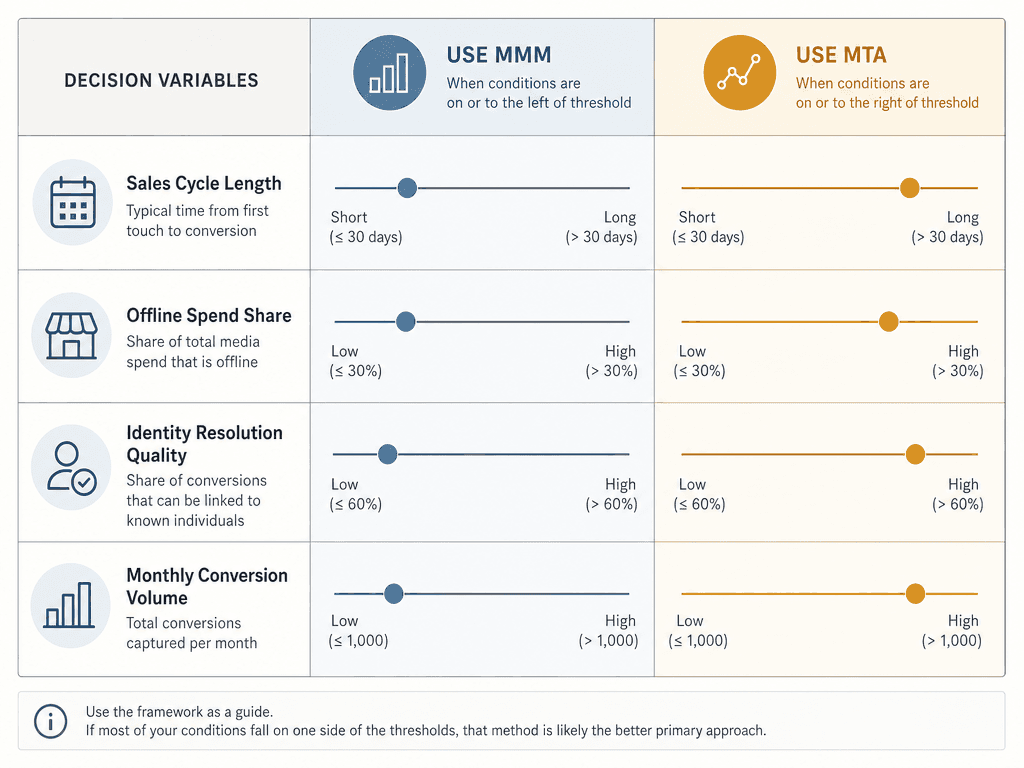
The Four-Variable Decision Matrix: Which Method Fits Your Situation
Attribution model selection is a data infrastructure decision. The right model is the one your data conditions can actually support. Four variables determine which method is viable for your situation:
- Sales cycle length — how many days from first touch to conversion
- Offline spend share — what percentage of your total ad budget runs through channels with no pixel (TV, print, OOH, events, direct mail)
- Identity resolution quality — what percentage of your conversion journeys have a consistent, observable user identifier across touchpoints
- Monthly conversion volume — how many tracked conversions your account generates per month
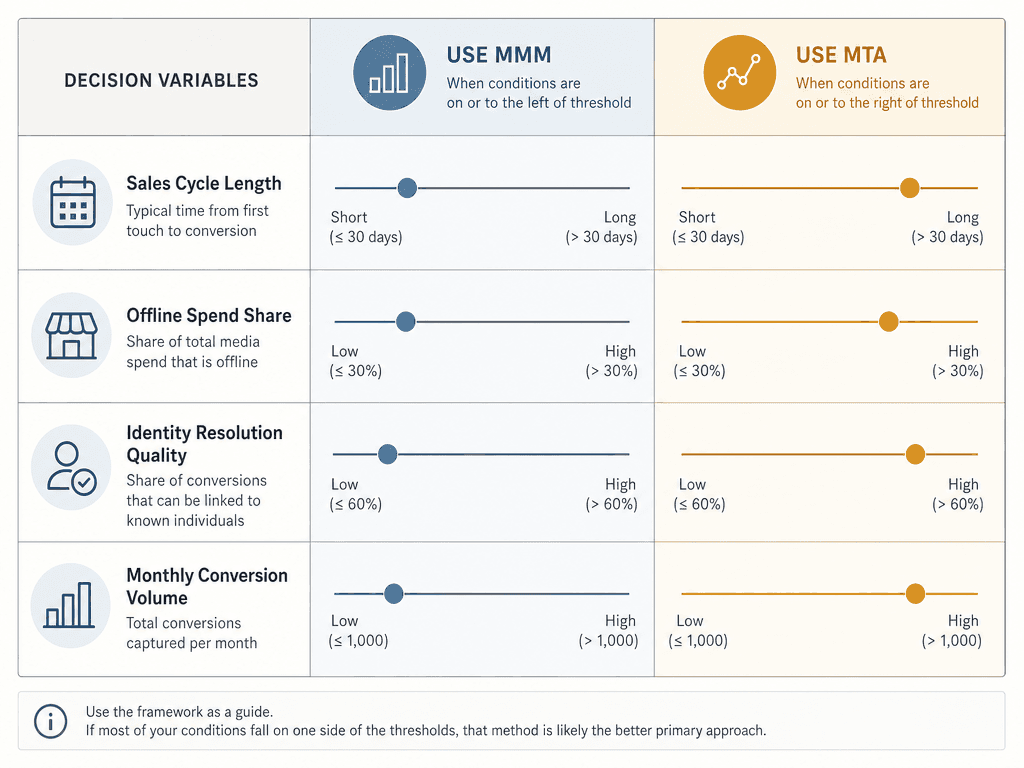
Here are the specific thresholds, drawn from current practitioner guidance:
| Variable | Use MMM when... | MTA is viable when... |
|---|---|---|
| Sales cycle length | Median cycle exceeds 30 days | Median cycle is under 7 days |
| Offline spend share | Offline spend exceeds 30% of total budget | Spend is primarily digital with full pixel coverage |
| Identity resolution quality | Resolution falls below 60% of journeys | Resolution exceeds 70% of journeys |
| Monthly conversion volume | Fewer than 1,000 tracked conversions per month | More than 1,000 conversions per month |
When two or more MTA failure conditions exist — for example, a 45-day B2B sales cycle combined with 25% offline spend — MTA will produce misleading outputs regardless of how well it is implemented. In those situations, MMM is not a preference; it is the only method that can produce defensible numbers.
For paid search specifically, where MTA often still has viability due to short cycles and strong first-party signal, see the AI in Paid Search channel guide for channel-specific attribution mechanics.
Data-Driven Attribution (DDA): Capabilities, Requirements, and Where It Fails
Data-driven attribution in GA4 and Google Ads uses machine learning to analyze converting and non-converting paths and assign fractional credit to each touchpoint based on its estimated contribution to conversion. It is more sophisticated than rule-based models and, under the right conditions, more accurate than last-click or linear attribution.
The critical constraint is data volume. GA4 DDA requires approximately 3,000 or more monthly conversions to function reliably. Below that threshold, the model silently reverts to a rule-based fallback — but the interface does not prominently flag this. Teams running DDA on low-volume accounts may believe they are using ML-informed attribution when they are actually using a degraded rule-based model. Verify current thresholds in Google Ads Help Center documentation, as these requirements can change.
Even above the volume threshold, DDA degrades in 2026 conditions for two specific reasons:
- Signal loss from iOS ATT: With opt-in rates stabilized at 15–25% globally, most iOS user journeys are invisible to path-based models. DDA can only assign credit to observable touchpoints — unobservable touchpoints are simply excluded, which systematically under-credits channels where iOS users are concentrated.
- AI black-box campaign opacity: Performance Max and Advantage+ do not expose placement-level or creative-level conversion data in a form that DDA can use. The model receives an aggregated conversion signal from a campaign that ran across multiple placements, audiences, and formats — and it cannot disaggregate that signal into meaningful path data.
When Media Mix Modeling Is the Right Call
MMM uses aggregate statistical regression on historical spend and outcome data. It does not require user-level tracking, is not affected by cookie deprecation or ATT, and can incorporate offline channels, TV, events, and external factors like seasonality and competitor activity. For teams that fail two or more MTA viability conditions, MMM is not just better — it is the only method that can produce reliable budget allocation guidance.
The minimum data requirement is substantial: 100 weeks of weekly historical data, with 150+ weeks preferred. Below 18 months of history, the model cannot reliably separate media effects from seasonality — and the output will be unreliable in ways that are difficult to detect without external validation.
Three forces are driving rapid MMM adoption growth. According to a survey of 1,200+ B2B teams conducted between 2024 and 2026, MMM adoption has reached 26% — up from 9% in 2023, a tripling in three years. The accelerants cited by adopters: signal loss (43%), Google's open-source Meridian release (38%), and board-level pressure to make attribution defensible to finance leadership.
Open-Source Entry Points
The open-source MMM landscape has expanded significantly. Google launched Meridian as a Bayesian MMM solution in January 2025, making the methodology accessible without six-figure consulting budgets. A no-code Scenario Planner was added in February 2026. Meta Robyn and PyMC-Marketing are additional open-source options. Meta GeoLift is available for incrementality testing.
Incrementality Testing: The Only Causal Ground Truth
Both MMM and MTA measure correlation — they identify patterns in data and infer which channels contributed to conversions. Incrementality testing is different in kind: it measures causation. A geo holdout or audience split directly answers whether removing a channel's spend would reduce conversions, by comparing conversion rates between groups that received the marketing and groups that did not.
This distinction matters most when MMM and MTA disagree. Consider a concrete example: if MTA reports a $3.20 CPA for Facebook, but your MMM model implies a $5.80 CPA for the same channel, you have a real conflict with real budget implications. A geo holdout showing $4.20 is the definitive answer — not because it is more sophisticated, but because it is the only method that creates random variation in marketing delivery and measures the actual result.
The five-step process for running an incrementality test:
- Define the hypothesis: State what you are testing and what decision the result will inform (e.g., "Does Facebook spend above $X/week produce incremental conversions at an acceptable CPA?").
- Design the test: Determine holdout size, test duration, and geographic or audience cells. Underpowered tests produce unreliable results — err toward longer duration and larger holdouts.
- Run the experiment: Pause or reduce spend in holdout regions or audience segments while maintaining spend in test regions. Do not make other campaign changes during the test period.
- Measure incremental lift: Compare conversion rates between test and holdout groups. The difference is the incremental lift attributable to the channel.
- Act on results: Use the measured CPA or ROAS to calibrate your MMM coefficients and adjust MTA credit weights for the tested channel.
Platforms like Haus use synthetic control methods to construct control groups that closely match test groups, producing results approximately 4x more precise than standard matched-market tests. Meta GeoLift is a free open-source option for teams running geo holdouts on Meta campaigns.
How Mature Teams Layer All Three Methods
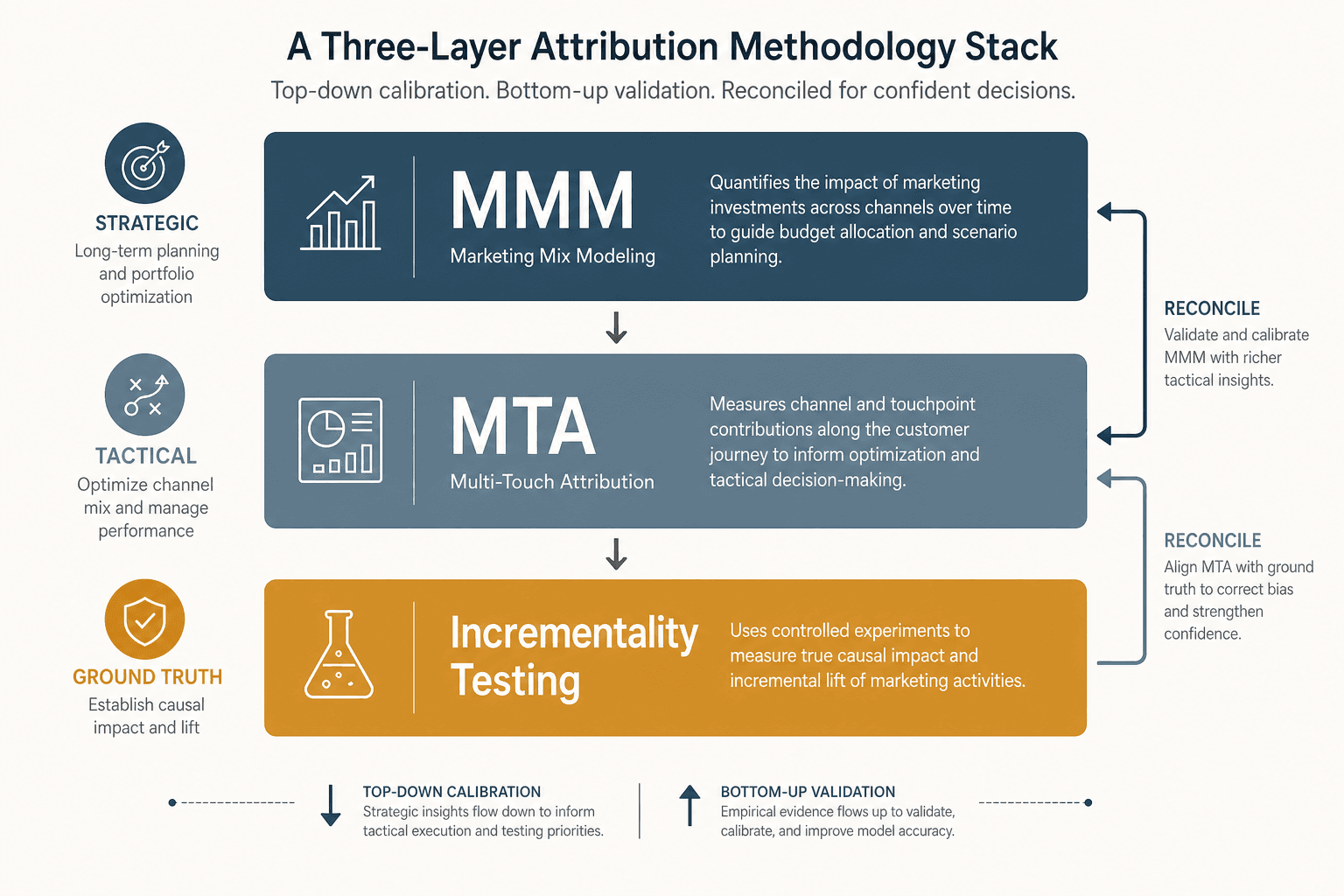
The layered approach is now industry standard, not an advanced practice reserved for enterprise teams. Meta's Robyn documentation explicitly assumes that MTA runs alongside MMM — the two methods are designed to complement each other, not compete. According to the same Digital Applied survey of 1,200+ B2B teams, 33% now run explicit hybrid MTA+MMM stacks.
The three layers serve distinct functions:
- MMM (strategic envelope): Run quarterly to determine how budget should be distributed across channels. MMM answers the high-level question: given our historical spend and outcomes, what is the optimal allocation across paid search, paid social, TV, events, and other channels?
- MTA (tactical optimization): Run continuously to optimize campaigns within the channels and budget ranges validated by MMM. MTA answers the day-to-day question: within our Facebook budget, which campaigns, audiences, and creatives are performing best this week?
- Incrementality testing (calibration): Run quarterly on major channels to validate that MMM coefficients and MTA credit weights reflect actual causal impact. When tests contradict model outputs, update the models — not the other way around.
Five Signals Your Current Attribution Model Is Lying
Generic attribution failure descriptions — "conflicting numbers," "incomplete journeys" — do not help you diagnose a specific problem. These five diagnostics have concrete numerical thresholds you can check against your own data today.
| Signal | What it means | What to do |
|---|---|---|
| Last-click receiving >80% of DDA credit | Mid-funnel tracking failure — the model cannot observe touchpoints between first interaction and conversion, so it defaults to the last observable event | Audit your tracking implementation for gaps in mid-funnel pages, cross-device events, and app-to-web journeys |
| Negative MMM coefficients on an active, spending channel | Multicollinearity — a variance inflation factor (VIF) above 10 means two or more channels move together so closely the model cannot separate their effects | Check for channels that are always active simultaneously (e.g., branded search always on when display is on); consider running them at different spend levels in different periods to create variation |
| MTA and platform-reported conversions differing by >20% | Tracking pipeline failure — events are being lost between the user action and the analytics platform, or attribution windows are misaligned | Run a conversion data audit: compare raw event counts in your tag manager against what appears in GA4 and each platform's reporting interface |
| Incrementality test results contradicting MTA credit by >2x | Over-crediting — the channel is receiving attribution for conversions that would have happened anyway | Use the incrementality result as the authoritative CPA; recalibrate MTA weights for that channel and flag it in your MMM model inputs |
| Sum of platform-reported conversions exceeding actual revenue by 2x or more | Attribution window conflicts — each platform is claiming credit for the same conversion using different lookback windows | Establish a single source of truth for conversion counting (typically your CRM or order management system) and use platform reports only for directional optimization, not for revenue attribution |
One additional diagnostic applies specifically to AI black-box campaigns: if Performance Max or Advantage+ accounts for more than 30% of your total conversions and you are relying on platform-reported attribution for those campaigns, your attribution is structurally unreliable for that portion of spend. Independent measurement — either MMM or incrementality testing — is the only solution. The platform cannot give you what it does not expose.
Implementation Roadmap: What to Do This Quarter by Budget Tier
The right starting point depends on your annual ad spend and the data infrastructure you already have. This roadmap is based on budget-tier guidance from current practitioner sources.
| Annual ad spend | Recommended approach | Open-source tools available |
|---|---|---|
| Under $1M | Platform attribution (DDA where volume supports it) plus selective incrementality tests on your largest channel. Focus on fixing tracking gaps before adding model complexity. | Meta GeoLift for incrementality; GA4 DDA for digital attribution |
| $1M–$5M | Platform attribution plus 1–2 geo-lift tests per year on your largest channels. Use incrementality results to validate or challenge platform-reported ROAS before budget decisions. | Meta GeoLift, Haus (paid); GA4 DDA |
| $5M–$20M | Add a full MMM run (requires 18+ months of clean weekly data). Run 2–4 incrementality tests per year. Use MMM for quarterly budget allocation; MTA for weekly optimization within validated channels. | Google Meridian, Meta Robyn, PyMC-Marketing; Meta GeoLift |
| $20M+ | All three methods running continuously. MMM quarterly for strategic allocation; MTA continuously for tactical optimization; incrementality tests quarterly to calibrate both. Dedicated measurement function or external partner typically required. | Google Meridian (with Scenario Planner), Meta Robyn, PyMC-Marketing; Haus or equivalent for precision incrementality |
A practical note on sequencing: before adding any new attribution method, audit your existing tracking for the failure signals described in the previous section. An MMM built on two years of inaccurate weekly spend data will produce inaccurate budget recommendations. Data quality is a prerequisite, not a parallel workstream.
For teams that need a broader organizational readiness framework before tackling attribution infrastructure — including how to build the internal case for measurement investment and how to sequence data capability development — the AI Growth Strategy Framework for Marketing Directors covers the organizational and strategic layer that attribution decisions sit within.
The core principle holds across all budget tiers: attribution model selection is a data infrastructure decision. The correct model is not the most sophisticated one available — it is the one your actual data conditions can support. A well-run geo holdout on a $200K annual budget will produce more defensible budget decisions than a misconfigured MMM on a $10M budget. Start with what your data can sustain, validate it with incrementality testing, and layer in additional methods as your data infrastructure matures.

Comments
Join the discussion with an anonymous comment.