

HubSpot AI Content Assistant vs. Jasper
For mid-market B2B teams already paying for HubSpot Professional or Enterprise, choosing between HubSpot's built-in Breeze AI content tools and Jasper is a workflow-fit and cost-justification problem — this guide provides a structured decision framework, side-by-side comparison, and total cost scenarios to help marketing managers determine which path fits their team.
Key Integrations
Marketing Categories
⚠ Notable Limitations
HubSpot Breeze Content Agent requires heavy editing for long-form and brand-sensitive copy; brand voice enforcement is less configurable than Jasper; credit-based pricing makes total cost unpredictable. Jasper has no native CRM integration and does not read HubSpot contact data. Running both tools combined reaches $977+/month before credit usage and requires clear workflow ownership to justify.
Why Mid-Market HubSpot Teams Face a Distinct Version of This Decision
Most AI writing tool comparisons treat the decision as a clean starting-from-zero choice. For mid-market B2B teams already on HubSpot Professional or Enterprise, it is not. HubSpot Professional starts at roughly $800/month before any add-ons. That subscription already includes Breeze AI content features. So the real question is not "which AI writing tool should we buy" — it is "does adding Jasper at $59/seat/month on top of what we already pay produce enough workflow gain to justify the incremental cost."
That framing changes the analysis significantly. It is not a raw capability debate between two AI engines. It is a workflow-fit and cost-justification problem. The answer depends on what your content function actually produces, how tightly it is tied to CRM data, and how many assets your team ships per month.
This guide is written for marketing managers and content strategists at in-house B2B teams in the 50–500 employee range who are already paying for HubSpot and need a structured framework for this specific decision — not a feature checklist, not an agency workflow, and not a general AI writing roundup.
What HubSpot AI Content Assistant Actually Does in 2026
HubSpot groups its AI features under the Breeze brand. For content creation specifically, three components are relevant to this decision. (Breeze Intelligence, Prospecting Agent, Customer Agent, and Data Agent are outside the scope of this comparison — see the HubSpot Breeze AI tool profile for the full feature picture.)
- Breeze Assistant — available on all plans including free. Provides inline AI writing suggestions across HubSpot's text editors: emails, landing pages, blog posts, social copy, and CRM records. Operates contextually within whatever you are editing.
- Content Agent — available on Professional and above, and uses HubSpot Credits. Generates full blog posts and landing pages from uploaded reference files. Suggests blog topics based on your top-performing content and target audience. Automates pre-publish tasks including meta descriptions, internal link insertion, and form confirmation emails. The Spring 2025 platform update expanded Content Agent's ability to use reference files as source material for generation.
- Content Remix — available on Professional and above. Takes existing content and reformats it for different channels: a blog post into a three-email nurture sequence, a case study into social posts, a product page into ad copy. Practitioners consistently report this as more reliable than generating from scratch.
The core advantage of Breeze is integration depth. Because it operates inside HubSpot where your contact records, deal stages, email engagement data, and CRM segments already live, it can surface contextually relevant suggestions that a standalone tool cannot. An email drafted for a specific lifecycle stage can pull from actual contact data without copy-pasting context manually.
The limitations are real and worth stating plainly. Content Agent output for long-form blog posts and brand-differentiated copy consistently requires significant editing before it is publishable. Brand voice settings in Breeze require intentional setup and are less configurable than Jasper's system — even with guidelines entered, enforcement at generation time is less reliable. Credit-based pricing for Content Agent makes total cost of ownership harder to predict as usage scales. And Breeze's accuracy drops when your content strategy is disconnected from HubSpot data — if your knowledge base, product documentation, or competitive research lives outside HubSpot, the AI has less to work with.
What Jasper Does for Marketing Teams in 2026
Jasper is a dedicated AI content platform, not a CRM feature. Its differentiated position for marketing teams rests on three capabilities that Breeze does not replicate at equivalent depth. (For a full walkthrough of Jasper's feature set, pricing tiers, and use case coverage, see the Jasper AI marketing tool profile and the Jasper AI in 2026 review covering agentic features and Jasper IQ governance. This section treats Jasper features as comparison inputs only.
- Brand IQ and Style Guide enforcement at generation time — Jasper learns brand voice from uploaded style guides and sample content, then applies those guidelines proactively when generating output. It flags off-brand tone before publishing rather than requiring post-hoc editing. This is the capability that most directly addresses the editing overhead problem for high-volume content teams.
- 50+ purpose-built marketing templates and Canvas for long-form collaboration — Templates are scoped to specific marketing tasks: ad headlines, email subject lines, product descriptions, LinkedIn posts, case study sections. Canvas provides a document environment for longer-form drafts where multiple team members can work on a single asset. These reduce the blank-page problem and structure output toward marketing-specific formats.
- Chrome extension that works inside HubSpot, Gmail, WordPress, and Google Docs — Jasper is not a separate tab. It surfaces inside the tools your team already uses, including HubSpot's own interface. This is the key reason HubSpot and Jasper are positioned as complementary rather than competing — Jasper's brand voice capabilities can be applied while working inside HubSpot's editor.
On pricing: Jasper Pro is $59/seat/month billed annually (or $69/month billed monthly). Pro includes up to 3 brand voices, 10 knowledge assets, 3 audiences, Canvas, and the full template library. The Business plan is custom-priced and adds unlimited brand voices and knowledge assets, advanced agents, API access, and SSO — relevant for enterprise teams but not the primary comparison point for most mid-market teams.
Side-by-Side Comparison: Breeze Content Tools vs. Jasper
The matrix below is scoped to the mid-market decision factors — not a generic capability checklist. It focuses on the dimensions that actually differentiate the two tools for in-house teams already on HubSpot. Note that this matrix is framed differently from the Jasper vs. Copy.ai agency comparison table published separately on this site.

| Dimension | HubSpot Breeze AI | Jasper Pro |
|---|---|---|
| Content type coverage | Emails, nurture sequences, landing pages, blog posts, social copy, ad copy via Content Remix. Strongest for CRM-triggered content types. | Blog posts, ad copy, email, social, product descriptions, case study sections, video scripts. 50+ purpose-built templates across channel formats. |
| Brand voice enforcement | Brand voice settings available but require intentional setup. Enforcement is applied at a settings level — not flagged proactively at generation time. Less configurable than Jasper. | Brand IQ system learns voice from uploaded style guides and sample content. Flags off-brand tone before publishing. Applied proactively at generation time — not post-hoc. |
| Team collaboration | Operates within HubSpot's existing collaboration model (shared portals, user permissions). No dedicated co-editing environment for AI content drafts. | Canvas provides a shared long-form document environment. Multiple team members can work on a single AI-assisted draft. Knowledge assets shared across seats on Pro plan. |
| CRM integration depth | Native — operates inside HubSpot where contact records, deal stages, and engagement data already live. AI suggestions can draw on CRM context automatically. | No native CRM integration. Chrome extension brings Jasper into HubSpot's interface, but it does not read or reference CRM data. Brand and knowledge context is file-based. |
| Long-form output quality | Content Agent generates full drafts from reference files. Practitioner-reported: requires significant editing for tone, brand fit, and factual accuracy in long-form pieces. | Canvas and long-form templates produce structured drafts. Style Guide reduces editing cycles for brand alignment. Still requires human editing for factual accuracy and nuance. |
| Short-form output quality | Content Remix is reported as more reliable than generating from scratch. Strong for repurposing existing HubSpot content into emails and social posts. | Template-driven short-form output (ad headlines, email subjects, social captions) is a core strength. Brand IQ reduces editing cycles for on-brand short-form copy at volume. |
| Pricing transparency | Breeze Assistant included on all plans. Content Agent and Content Remix require Professional tier ($800+/month base) plus HubSpot Credits for agent usage. Credit consumption is variable and can be hard to predict. | Pro plan is a flat $59/seat/month billed annually. No credit-based consumption model for standard generation. Business plan is custom-priced. |
| Plan requirements | Content Agent and Content Remix require HubSpot Professional or Enterprise. Breeze Assistant available on all plans including free. | Pro plan is the entry point for multi-brand voice and knowledge assets. Business plan required for unlimited brand voices, API access, and advanced agents. |
| Works inside HubSpot | Native — Breeze is built into HubSpot's editor interface. | Yes, via Chrome extension. Jasper surfaces inside HubSpot's editor alongside Breeze. The two tools can be used simultaneously. |
Decision Framework: Which Tool Fits Your Team Profile
The decision breaks cleanly into three team profiles. Most mid-market marketing teams will recognize themselves in one of these scenarios.
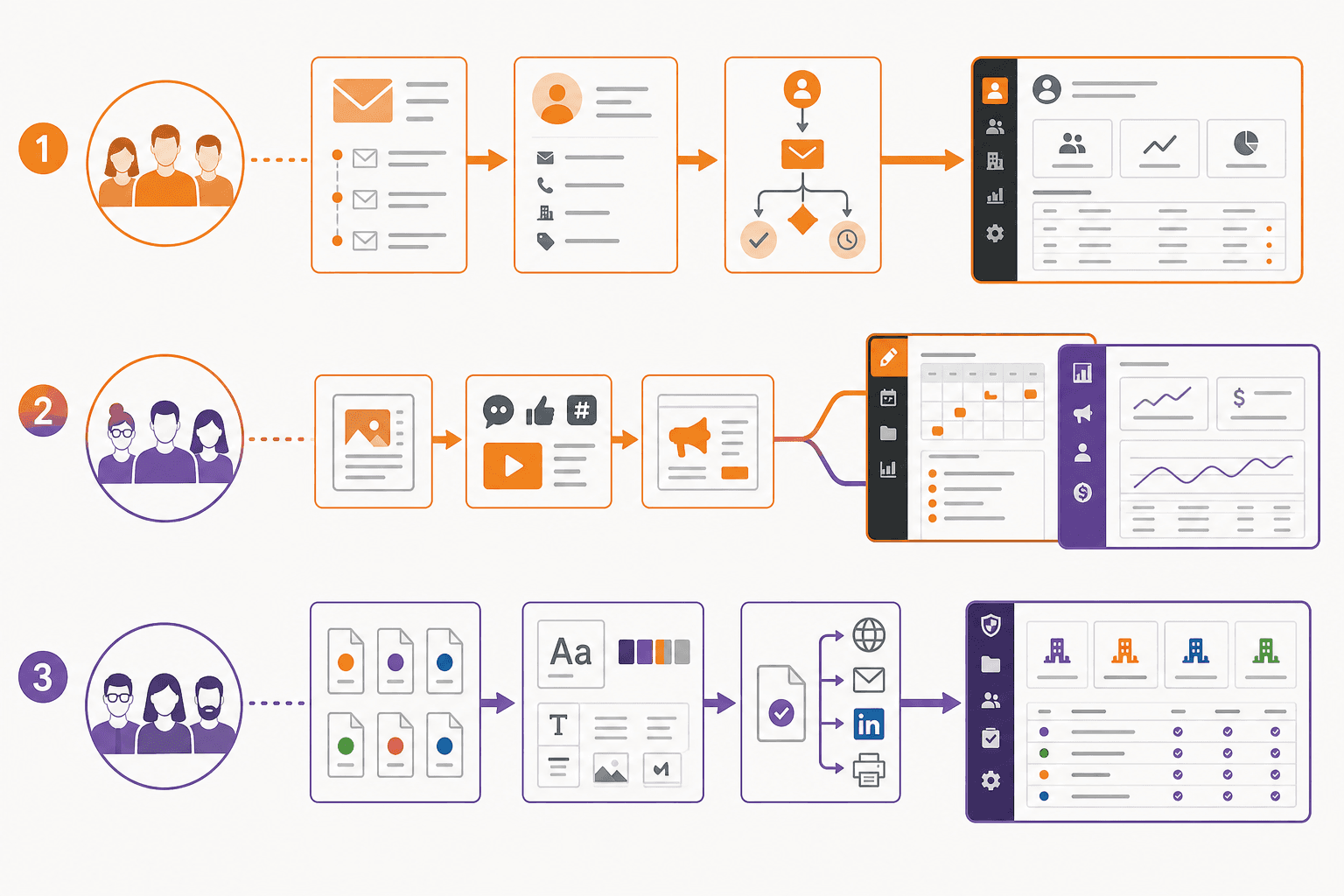
Profile A: CRM-Workflow-Primary Teams
Your content function primarily produces emails, nurture sequences, sales enablement pages, and landing pages that live inside HubSpot and draw on contact and deal data. Monthly content volume is moderate — under 20 assets across formats. Your writers spend most of their time in HubSpot's editor, not in a separate content platform.
For this team: Breeze is sufficient and Jasper is not needed. The CRM integration depth is Breeze's genuine advantage, and it is the advantage that matters most for this workflow. Adding Jasper at $59/seat/month adds cost without addressing a gap that actually exists in your process.
Profile B: High-Volume Standalone Content Teams
Your content function runs a publishing program across blog, paid ads, social, and email — producing 20–30 or more assets per month. Content strategy is partially or fully independent of CRM-triggered workflows. Writers spend significant time in Google Docs, WordPress, or other platforms outside HubSpot. Brand consistency across formats and writers is a recurring editing problem.
For this team: Jasper earns its per-seat cost. The template library, Brand IQ enforcement at generation time, and Canvas for long-form drafts directly address the editing overhead and brand consistency problems that Breeze does not solve well at this volume. The Chrome extension means Jasper can be used inside HubSpot where needed, so Breeze's CRM-context advantage is not lost.
Teams in this profile evaluating high-volume content production workflows may find the AI monthly content calendar workflow playbook a useful companion resource.
Profile C: Multi-Brand or Multi-Channel Brand-Governance Teams
Your team manages content across multiple brands, sub-brands, geographies, or product lines — each with distinct voice, tone, and style requirements. Maintaining brand consistency across writers and channels is an active governance problem, not just an editing preference. You may also be operating in multiple languages or regional markets.
For this team: Jasper's Brand IQ is the differentiated capability. The ability to maintain separate brand voices, style guides, and knowledge assets across brands — and enforce them proactively at generation time — is not replicated by Breeze's brand voice settings. The Pro plan's limit of 3 brand voices may be a constraint at this profile's upper end; Business plan pricing should be evaluated for teams managing more than three distinct brand identities.
Total Cost Scenarios for a 3-Writer Mid-Market Team
Three illustrative cost paths for a team of three content writers. These figures are meant to frame the decision, not serve as a budget quote. Verify current pricing before committing.
| Scenario | Monthly Cost (est.) | What's included | Key variable |
|---|---|---|---|
| HubSpot only (Breeze included) | $800+/month | HubSpot Professional base subscription. Breeze Assistant, Content Agent, and Content Remix included. HubSpot Credits for agent usage variable by consumption. | Credit usage for Content Agent. Heavy Content Agent use can add meaningful cost above the base subscription. Credit pack pricing varies by plan. |
| Jasper Pro only (3 seats) | $177/month (billed annually) | 3 Jasper Pro seats at $59/seat/month. Includes 3 brand voices, 10 knowledge assets, Canvas, full template library, Chrome extension. | Does not include HubSpot. If your team is already on HubSpot, this scenario only applies if you are evaluating replacing HubSpot's content tools entirely — which most mid-market teams will not do. |
| Both tools combined | $977+/month | HubSpot Professional base ($800+) plus 3 Jasper Pro seats ($177/month). Breeze available for CRM-context content; Jasper for high-volume and brand-governed content. | Per-writer cost reaches $800–$1,200+/month at scale when credit usage is factored in. Requires clear ownership to avoid duplicate tool usage and justify the combined spend. |
Verdict: When to Use Each, When to Run Both
The honest verdict is that most mid-market HubSpot teams do not need both tools — they need to be honest about which content problem they are actually trying to solve.
- Use Breeze as your primary AI content tool if your content function is primarily CRM-driven — emails, sequences, nurture flows, landing pages — and your monthly asset volume is under 20 pieces. The CRM integration advantage is real and Breeze is already included in what you are paying.
- Add Jasper when your content function is volume-driven and channel-diverse — specifically when you are producing 20+ assets per month across blog, ads, social, and email, and brand consistency across writers is a recurring editing problem. At that volume, Jasper's template library and Brand IQ enforcement reduce editing cycles in ways that Breeze's settings layer does not.
- Run both tools in parallel only when you have two distinct content functions — a HubSpot-driven revenue marketing workflow (sequences, nurture, CRM-triggered pages) AND a separate content marketing function publishing at volume across multiple channels. The threshold is not just asset count — it is whether the two functions have genuinely different tool requirements that cannot be served by one platform.
One practical point worth emphasizing: because Jasper's Chrome extension works inside HubSpot's editor, running both does not mean switching between platforms. A writer can use Jasper's brand voice enforcement while working in a HubSpot email or landing page editor — the two tools are genuinely complementary in the interface layer, not mutually exclusive.
What the "run both" decision requires is not just a workflow rationale — it requires clear internal ownership. Which team uses which tool for which content types? Without that definition, the combined spend of $977+/month becomes difficult to justify and the tools end up creating inconsistency rather than eliminating it.

Comments
Join the discussion with an anonymous comment.