
AI Monthly Content Calendar Workflow: A Five-Phase Playbook for Content Teams
A structured, phase-by-phase operating guide for content marketing managers and strategists who want to integrate AI into their monthly content planning process — covering pre-month research, scheduling, brief generation, distribution planning, and performance review — with specific prompt approaches, human handoff checkpoints, and honest notes on where AI adds the most value.
Why Monthly Content Calendar Planning Breaks Down at Scale
Most content teams hit the same two walls when they try to scale monthly planning. The first is planning overhead: assembling topic lists, researching audience needs, writing briefs, assigning slots, and coordinating across writers and channels takes more time than anyone budgets for. The second is consistency failure: when planning overhead spikes, the month's calendar gets populated reactively — recycled ideas, skipped brief stages, last-minute assignments — and output quality becomes uneven regardless of individual writer skill.
These are operational problems, not tool problems. Adding an AI writing assistant to a broken planning process speeds up drafting but leaves the structural failure intact. The teams that get compounding value from AI are the ones applying it at the planning stages — research, scheduling, brief generation, distribution mapping, and performance review — rather than treating AI as a drafting shortcut layered on top of the same manual workflow.
The gap between where AI is being used and where it delivers the most value is well-documented. Orbit Media's 2025 blogger survey (n=808, data collected August 2025) found that marketers who use AI to write complete articles are the least likely to report strong results, while those using AI for idea generation and editing see more positive correlations with performance. The implication is direct: the workflow application matters more than the tool.
The Five-Phase Monthly Workflow: An Overview
The workflow is structured as five sequential phases, each with a defined AI role, a human decision point, and a handoff to the next phase. The phases run in order at the start and end of each month, with Phases 3 and 4 running in parallel during the production window.
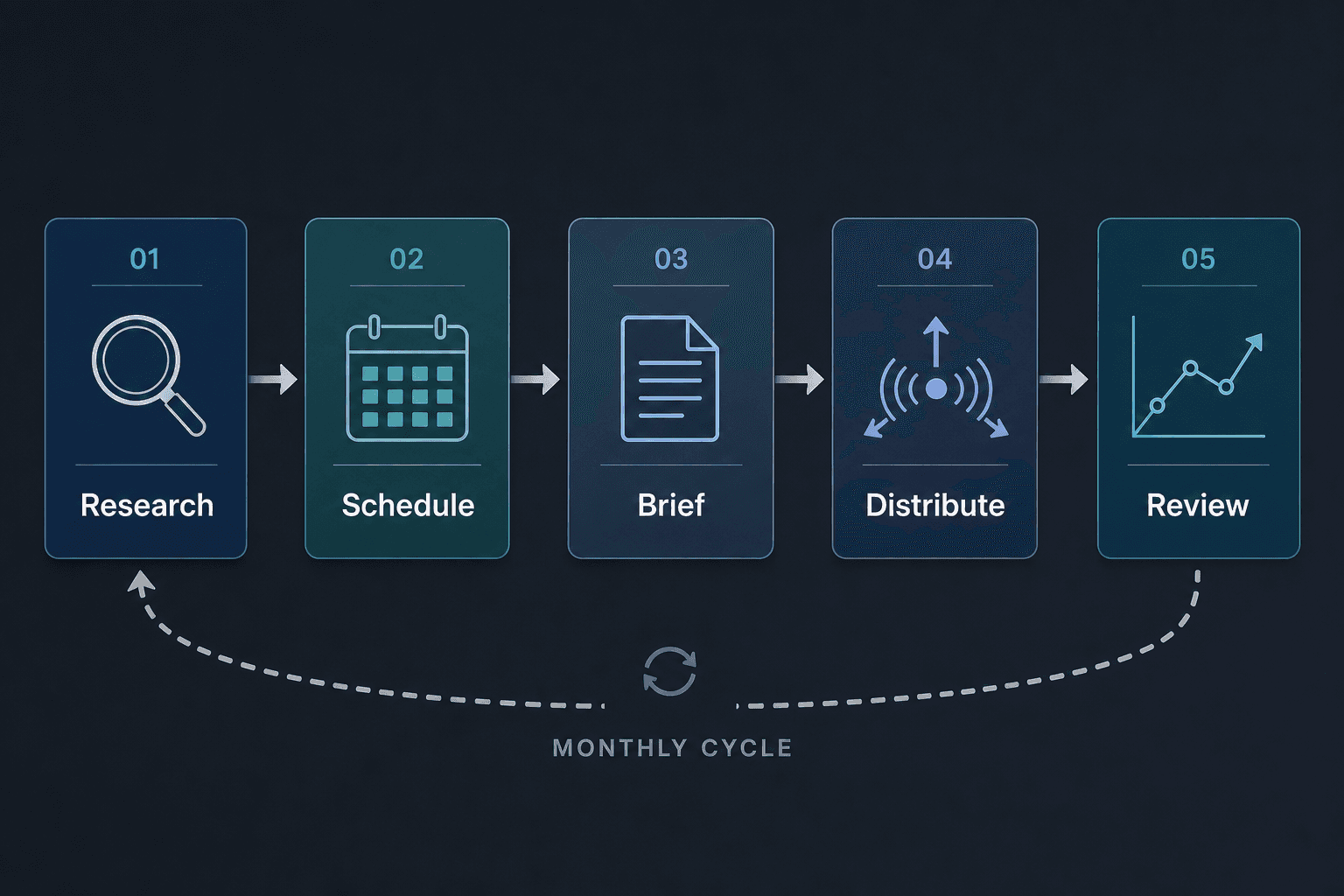
The core thesis of this playbook: AI delivers the most compounding value at Phase 1 (research) and Phase 5 (review), not at Phase 3 (drafting and briefs), which is where most teams currently concentrate their AI use. Applying AI at the strategic bookends of the month — research inputs and performance feedback — is what produces a self-improving planning cycle.
| Phase | Primary AI Role | Human Decision Point | Timing |
|---|---|---|---|
| 1. Pre-Month Research | Persona refresh, topic ideation, channel alignment analysis | Topic prioritization and brand fit filtering | Days 1–3 of planning window |
| 2. Scheduling and Prioritization | Sequencing suggestions, slot-fill logic | Capacity judgment, channel mix decisions | Days 3–5 of planning window |
| 3. Brief Generation and Asset Scoping | Structured brief drafting from research inputs | Brief QC review before writer handoff | Days 5–7 of planning window |
| 4. Repurposing and Distribution Planning | Identifying repurposing candidates, channel mapping | Format selection and distribution prioritization | Runs parallel to production |
| 5. End-of-Month Review and Next-Month Seeding | Performance pattern analysis, seeded topic candidates | Interpreting results, deciding what to carry forward | Final 3–5 days of the month |
For broader context on how AI fits across all marketing functions — not just content planning — the AI in Digital Marketing: A Function-by-Function Guide for 2026 provides a useful reference before diving into the phase detail below.
Phase 1: Pre-Month Topic and Audience Research
The research phase is where most of the monthly planning leverage lives, and where most teams spend the least structured time. The goal of Phase 1 is to enter the scheduling stage with a prioritized list of topic candidates that are grounded in audience need, aligned with your content mission, and mapped to the channels most likely to distribute them effectively.
Andy Crestodina at Orbit Media has made the case directly: AI is most powerful at the research and strategy phases, not content drafting. The research tasks where AI accelerates planning the most are precisely the ones that tend to get skipped when teams are under pressure: persona work, content mission drafting, topic ideation with a strategic frame, and channel-audience alignment analysis.
What AI Does in Phase 1
- Persona refresh: Before any topic work begins, feed your existing audience persona documentation into the LLM context. Ask it to surface assumptions that may have aged, flag gaps in the persona, and generate 3–5 questions your audience is most likely asking right now in your category. This primes the model for better topic generation and keeps research grounded in audience reality rather than internal assumptions.
- Content mission drafting: If your team does not have a written content mission statement ("We publish X for Y audience so they can Z"), AI can draft a candidate from your existing About page, top-performing articles, and brand guidelines. Use this to anchor topic prioritization decisions in Phase 2.
- Topic ideation with a strategic frame: Prompt the LLM to generate topic candidates that are "provocative but not controversial" — opinions your audience would find interesting and shareable but that do not require a contrarian position to defend. This avoids the generic listicle output that results from open-ended "give me content ideas" prompts.
- Audience watering hole mapping: Ask the LLM to identify where your target audience gathers online and offline — specific subreddits, LinkedIn groups, newsletters, Slack communities, industry events, and publications. This output feeds directly into Phase 4 distribution planning.
- GA4 channel alignment analysis: Upload a GA4 export of your top-performing content (by traffic source, engagement rate, or conversion) to an LLM with file-analysis capability. Ask it to identify which topic clusters drive traffic from which channels, and which topics have been underserved relative to their traffic potential. This surfaces both new topic ideas and channel-specific distribution recommendations before content is created.
What Stays Human in Phase 1
Topic prioritization is a human judgment call. AI will generate more topic candidates than you can publish, and it has no reliable way to weigh strategic priorities — a product launch coming next month, a topic your competitor just dominated, a content gap your sales team flagged last week. The human role in Phase 1 is filtering, ranking, and annotating the AI's topic output against those strategic inputs before anything moves to scheduling.
Phase 2: Prioritizing and Scheduling Content Slots
Phase 2 converts the research output into a populated calendar. The decisions here are not primarily about topic quality — that was Phase 1 — but about operational fit: how many pieces can the team realistically produce and review this month, what mix of content types and channels serves the strategy, and in what sequence should pieces be published.
Capacity Modeling Before Slot-Filling
Before assigning topics to calendar slots, establish the realistic production capacity for the month. This means counting available writer-days, accounting for review cycles, and building in buffer time for the pieces that will run late. A common failure mode is filling every slot with ambitious pieces and then scrambling when two writers are out the same week.
A useful prompt approach: give the LLM your team's available capacity (writer count, hours per week, typical review turnaround) and the list of topic candidates from Phase 1, annotated with content type and estimated production effort. Ask it to suggest a sequenced calendar that fits the capacity, prioritizes the highest-value topics early in the month, and flags which topics should be held for next month rather than rushed.
Channel Mix and Content Type Sequencing
A well-structured monthly calendar is not just a list of topics — it is a deliberate mix of content types across channels, sequenced so that assets can support each other. A long-form blog post published mid-month should have email and social distribution slots built in. A research-heavy piece should be scheduled with enough lead time for fact-checking.
| Content Type | Typical Lead Time | Repurposing Potential | Channel Priority |
|---|---|---|---|
| Long-form blog / pillar post | 10–14 days | High (email, social, clips) | SEO / organic |
| Email newsletter | 5–7 days | Medium (social, blog recap) | Owned list |
| Short-form social series | 2–4 days | Low (standalone) | Social channels |
| Original research / data post | 14–21 days | Very high (PR, slides, email) | SEO / PR / social |
| Repurposed asset | 1–3 days | N/A (derivative) | Channel-specific |
AI assists well with sequencing logic — suggesting which pieces should publish first to support later pieces, identifying gaps in the channel mix, and flagging weeks where the calendar is front- or back-loaded. The human decision is channel mix strategy: which channels are priorities this month, and does the calendar reflect that?
Phase 3: Brief Generation and Asset Scoping
The content brief is the quality control gateway for everything that gets produced this month. A brief that is vague, misaligned with the research inputs, or missing key parameters produces content that requires heavy revision — or gets published in a state that damages brand credibility. Brief generation is where AI can do significant structured work, and where the human review checkpoint is most critical.
What a Structured AI-Generated Brief Covers
A brief generated from Phase 1 research inputs — persona context, content mission, topic prioritization rationale, and channel alignment data — should include:
- Target audience segment and the specific question or job-to-be-done this piece addresses
- Angle and editorial stance (not just the topic, but the specific take)
- Key claims or arguments the piece must support, with source suggestions where relevant
- Format specification: content type, approximate word count or length, structural elements (e.g., table, checklist, step-by-step)
- Internal link targets from the existing content library
- Brand voice notes or constraints specific to this piece
- Distribution channel and any format adaptations needed for that channel
The brief-generation prompt should pass in the Phase 1 research context — not just the topic title. An AI brief generated from "write a brief about content calendars" will be generic. A brief generated from "write a brief for a 1,500-word guide targeting content marketing managers at B2B SaaS companies who are trying to reduce planning overhead, using the following persona summary and content mission" will be usable.
The Human QC Checkpoint Before Writer Handoff
Every AI-generated brief must pass through a human review checkpoint before it reaches a writer or an AI drafting tool. The checkpoint should catch:
- Factual errors in the key claims section — AI will sometimes generate plausible-sounding but incorrect source attributions or statistics. See the documented failure patterns in AI Hallucination in Marketing Content: Documented Failure Cases and What They Cost for context on why this checkpoint cannot be skipped.
- Brand voice drift — AI briefs will sometimes produce angles or tonal directions that are technically on-topic but inconsistent with how your brand communicates. This is a compounding risk in high-volume monthly output scenarios. The AI Brand Voice Consistency Failures: Documented Cases and What They Reveal article documents where this failure mode appears most frequently.
- Missing strategic context — the brief may not reflect a product launch, a competitive development, or an editorial priority that was not in the original prompt context.
- Format mismatches — the AI may have specified a format that does not match the channel's requirements or the team's production capacity for that slot.
Phase 4: Repurposing and Cross-Channel Distribution Planning
Most monthly content calendars are organized around net-new content creation. A better-structured calendar includes explicit repurposing slots alongside original content — treating the one-piece-many-formats approach as a planned workflow step, not an afterthought.
The monthly planning question for Phase 4 is not "how do we repurpose this piece" — that is an execution question. The planning question is: which assets published this month (or in recent months) have repurposing potential, which channels do the derivative formats map to, and which repurposing slots should be built into the calendar alongside original content slots?
How AI Assists in Phase 4 Planning
- Repurposing candidate identification: Feed the LLM a list of recently published or planned assets with their performance data. Ask it to identify which pieces have the highest repurposing potential based on topic breadth, format, and channel fit — and which channels each derivative format should target.
- Distribution channel mapping: Using the audience watering hole map from Phase 1, ask the LLM to suggest which formats (email summary, social thread, short video script, slide deck, newsletter excerpt) are best suited to each channel for each planned piece.
- Calendar slot allocation: Repurposing slots should be explicitly labeled in the calendar — not assumed to happen organically. AI can suggest sequencing: publish the original piece first, then distribute derivative formats in a staggered schedule across the following 1–2 weeks.
A practical rule of thumb: for every long-form original piece in the calendar, plan at least two derivative distribution slots. This does not require significantly more production time — AI can generate social copy, email excerpts, and short-form summaries from a completed draft in minutes — but it does require those slots to be in the calendar before the month begins, not improvised after publication.
Phase 5: End-of-Month Performance Review and Next-Month Seeding
The analytics-to-calendar feedback loop is the most underused step in the monthly content workflow — and the one most likely to compound results over time if consistently applied.
Orbit Media's 2025 blogger survey (n=808) found that only about one-third of content marketers consistently check the performance of each individual published article. Yet the same data shows that analytics use is one of the strongest behavioral correlates with reporting strong content results. The gap between what effective marketers do and what most marketers do is most visible here, in Phase 5.
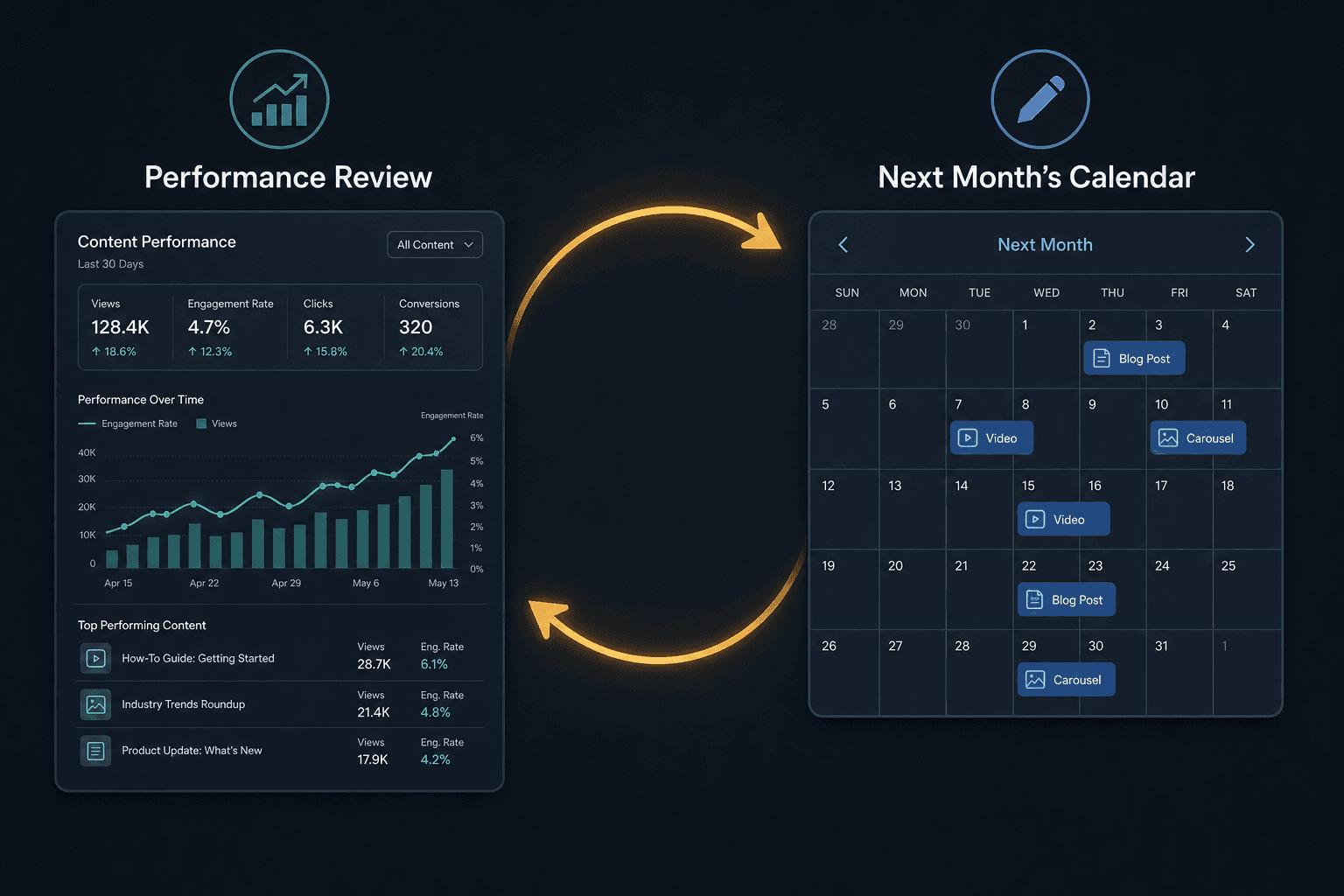
What the End-of-Month Review Covers
- Performance data export: Pull a GA4 export of the month's published content — traffic, engagement rate, time on page, scroll depth, and conversion events where tracked. Include channel-level breakdown (organic, email, social, direct).
- AI pattern analysis: Upload the export to an LLM and ask it to identify patterns: which topic clusters performed above average, which formats drove the most engagement by channel, which pieces underperformed relative to their production investment, and what the data suggests about audience interest shifts.
- Seeded topic candidates: Ask the LLM to generate 10–15 seeded topic candidates for next month's Phase 1 research, grounded in the performance patterns identified. These are not the final topic list — they are starting inputs for Phase 1, which will refine and expand them with fresh audience research.
- Workflow retrospective: Note what broke in the workflow this month — missed deadlines, briefs that required heavy revision, distribution slots that were skipped. Feed these observations into the next month's Phase 2 capacity modeling.
The compounding effect of Phase 5 is what distinguishes a self-improving content operation from one that restarts from zero each month. Teams that close this loop consistently — even with a lightweight 60-minute end-of-month review — enter Phase 1 of the next month with better inputs, better-calibrated topic priorities, and clearer evidence of what their audience actually responds to.
Common Failure Modes and How to Avoid Them
- Skipping the Phase 3 brief QC checkpoint. When production pressure builds, the brief review is the first thing cut. This is the most direct path to AI-generated content with factual errors, brand voice drift, or missing strategic context reaching publication. The checkpoint is not optional — it is the mechanism that makes AI-assisted production reliable rather than risky.
- Using AI for complete article drafting without research-phase inputs. Orbit Media's 2025 data is clear: AI use for writing complete articles correlates with the lowest strong-result rates among content marketers. The workflow in this playbook deliberately positions AI drafting assistance downstream of a research-grounded brief — not as a replacement for the research phase.
- Failing to close the Phase 5 feedback loop. Skipping the end-of-month review means each month's planning starts from scratch rather than from evidence. This is the most common reason content calendars plateau — the planning process never learns from what worked.
- Over-automating without human editorial oversight. AI can generate topic lists, briefs, distribution plans, and performance summaries — but none of these outputs should flow directly into production without a human decision point. Each phase has a defined handoff moment for a reason.
- Tool-switching mid-month. Introducing a new LLM, switching project management tools, or changing brief templates during an active production month disrupts workflow continuity and adds overhead at exactly the wrong time. Evaluate and test new tools during the Phase 5 window, not mid-cycle.
- Treating the calendar as a topic list rather than a production system. A calendar that lists topics without assigned writers, review owners, publication dates, and distribution slots is not a production system — it is a wish list. AI can help populate and sequence the calendar, but the structural fields must be there for it to function.
Per-Phase Tool Stack Notes
Different phases of this workflow call for different tool categories. The following is a brief, honest summary of what each category does well and where its limitations show up. This is not a ranked list or a pricing guide — it is a functional map.
| Phase | Tool Category | What It Does Well | Honest Limitation |
|---|---|---|---|
| Phase 1: Research | General-purpose LLMs (ChatGPT, Claude, Gemini) | Persona generation, topic ideation, watering hole mapping, GA4 data analysis with file upload | No real-time search data by default; persona outputs require human validation against actual audience data |
| Phase 2: Scheduling | Project management tools (Asana, Notion, Airtable, ClickUp) | Calendar visualization, assignment tracking, deadline management, status views | AI scheduling features in these tools are nascent; sequencing logic still requires human input |
| Phase 3: Brief Generation | General-purpose LLMs + content platforms (e.g., Jasper) | Structured brief drafting from research inputs, format specification, internal link suggestions | Brief quality is only as good as the research context passed in; hallucination risk in key claims section |
| Phase 4: Distribution Planning | General-purpose LLMs + social scheduling tools | Channel mapping, format adaptation suggestions, distribution sequencing | Social scheduling tools handle execution; LLMs handle planning — they are not the same workflow |
| Phase 5: Review | GA4 + LLMs with file analysis | Performance pattern identification, seeded topic generation from data | LLMs cannot access live analytics; data must be exported and uploaded manually |
Monthly Workflow Checklist
Use this checklist as a monthly reference. It is organized by phase and covers the key actions and human checkpoints for each stage of the workflow.
| Phase | Action | Owner | Done? |
|---|---|---|---|
| Phase 1: Research | Refresh audience persona in LLM context | Content lead | ☐ |
| Phase 1: Research | Draft or confirm content mission statement | Content lead | ☐ |
| Phase 1: Research | Generate topic candidates with strategic frame prompt | Content lead + LLM | ☐ |
| Phase 1: Research | Map audience watering holes for distribution planning | Content lead + LLM | ☐ |
| Phase 1: Research | Upload GA4 export for channel-topic alignment analysis | Content lead + LLM | ☐ |
| Phase 1: Research | Human review and prioritization of topic candidates | Content lead | ☐ |
| Phase 2: Scheduling | Confirm team capacity for the month | Content lead | ☐ |
| Phase 2: Scheduling | Assign content types and channels to topic priorities | Content lead | ☐ |
| Phase 2: Scheduling | Populate calendar with slots, owners, and deadlines | Content lead | ☐ |
| Phase 2: Scheduling | Build in buffer slots (at least one per two-week window) | Content lead | ☐ |
| Phase 3: Brief Generation | Generate structured briefs from Phase 1 research inputs | Content lead + LLM | ☐ |
| Phase 3: Brief Generation | Human QC review: fact-check key claims, check brand voice | Content lead / editor | ☐ |
| Phase 3: Brief Generation | Assign reviewed briefs to writers or drafting tools | Content lead | ☐ |
| Phase 4: Distribution | Identify repurposing candidates from planned and recent assets | Content lead + LLM | ☐ |
| Phase 4: Distribution | Map derivative formats to distribution channels | Content lead + LLM | ☐ |
| Phase 4: Distribution | Add repurposing and distribution slots to calendar | Content lead | ☐ |
| Phase 5: Review | Export GA4 performance data for the month's published content | Content lead / analyst | ☐ |
| Phase 5: Review | Upload to LLM for pattern analysis | Content lead + LLM | ☐ |
| Phase 5: Review | Generate seeded topic candidates for next month's Phase 1 | Content lead + LLM | ☐ |
| Phase 5: Review | Document workflow retrospective: what broke, what to adjust | Content lead | ☐ |
| Phase 5: Review | Carry seeded topics and workflow notes into next month's Phase 1 | Content lead | ☐ |
Tools mentioned in this guide
Comments
Join the discussion with an anonymous comment.