
Salesforce Einstein for B2B Marketing: What the Features Actually Do and Where the ROI Is
A practitioner-grade breakdown of Salesforce Einstein AI for B2B marketing teams on Marketing Cloud Account Engagement (MCAE), covering which features apply to marketing workflows, what realistic performance benchmarks look like from real deployments, and exactly which pricing tier unlocks what — without the vendor hype or rebrand confusion.
The Naming Maze, Decoded
If you've searched for "Salesforce Einstein GPT" recently and landed on conflicting information, the confusion is structural, not accidental. Salesforce has renamed and repositioned its AI stack three times in roughly 18 months, and the terminology in most published guides hasn't caught up.
Here's the short version of what happened:
| Term | When used | What it actually refers to | Impact on MCAE users |
|---|---|---|---|
| Einstein GPT | 2023 launch | Salesforce's initial branding for generative AI features across the platform | None — mostly a marketing label |
| Einstein Copilot | 2023–Jan 2025 | The conversational AI assistant layer embedded in Salesforce | Renamed to Agentforce in January 2025; no functional change |
| Agentforce | Jan 2025–present | Autonomous AI agents built on the Einstein platform, requiring Data Cloud | Complementary to Einstein predictive features, not a replacement |
| Agentforce Marketing | Dreamforce 2025–present | Rebranded name for Marketing Cloud | Existing MCAE access and Einstein features unchanged |
| Marketing Cloud Next (MCN) | Connections June 2025–present | Ground-up architectural rebuild on Data 360, merging B2B and B2C | Accessible via Account Engagement+ upgrade; no forced migration, no EOL date announced |
The key distinction that matters for B2B marketing teams: Einstein is the predictive AI layer — lead scoring, behavior scoring, campaign insights, attribution. Agentforce is the autonomous-agent platform — AI that can take actions, not just surface predictions. They are complementary layers, not competing products.
For existing MCAE customers: the January 2025 Agentforce rename changed nothing in your Setup menu beyond a label. Your permissions, workflows, and Einstein scoring features remained intact. The Dreamforce 2025 Agentforce Marketing rebrand similarly preserved existing feature access. Marketing Cloud Next is a future architectural direction, not a forced migration — no sunset date has been announced for MCAE.
The B2B Einstein Feature Map: MCAE vs. Marketing Cloud Engagement
Most Einstein marketing coverage conflates two distinct products: Marketing Cloud Account Engagement (MCAE, formerly Pardot) for B2B, and Marketing Cloud Engagement for B2C. The Einstein features available in each product are different. If you're on MCAE, several commonly cited Einstein capabilities simply don't apply to your platform.
| Einstein Feature | Available in MCAE (B2B) | Available in MCE (B2C only) | Notes |
|---|---|---|---|
| Einstein Lead Scoring | Yes | No | Analyzes Lead object fields to predict conversion likelihood |
| Einstein Behavior Scoring | Yes | No | ML-driven engagement scoring with automatic decay; replaces static Pardot scoring |
| Einstein Campaign Insights | Yes | No | Surfaces engagement pattern anomalies across campaigns |
| Einstein Key Accounts Identification | Yes | No | Account-level purchase likelihood scoring |
| Einstein Attribution | Yes | No | AI-driven multi-touch attribution with virtual Opportunity Contact roles |
| Agentforce Campaign Creation | Yes | No | Natural language drafting of email copy, landing pages, and segments |
| Einstein Send-Time Optimization | Yes | Yes | Predicts optimal send time per contact |
| Einstein Engagement Scoring | No | Yes | B2C-specific engagement prediction |
| Einstein Content Selection | No | Yes | Dynamic content block selection for B2C journeys |
| Einstein Web Recommendations | No | Yes | Personalized web content recommendations |
| Einstein Path Optimizer | No | Yes | A/B testing optimization for Journey Builder |
Feature-by-Feature Honest Assessment
Here's what each B2B-relevant Einstein feature actually does, how it works mechanically, and an honest read on its practical value.
Einstein Lead Scoring
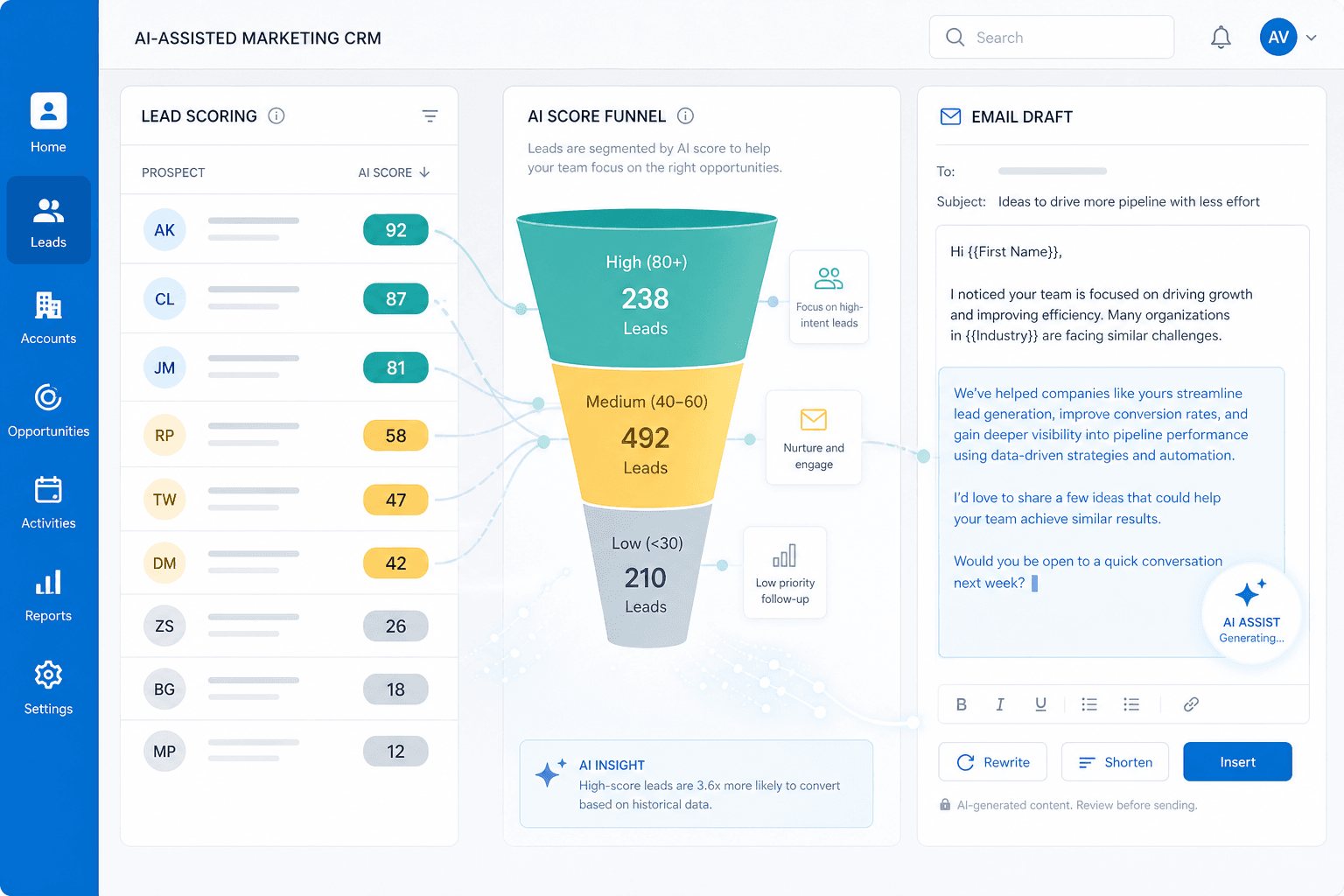
This is Einstein's highest-value B2B marketing feature. It analyzes all historical field data on the Lead object — including custom fields — to identify patterns in past conversion history and assign each lead a score from 0–100 reflecting its likelihood to convert.
Unlike rules-based scoring, Einstein Lead Scoring doesn't require a marketing ops team to define which fields matter. The model finds the patterns. When used alongside Behavior Scoring, it prioritizes best-bet leads for sales routing based on both profile fit and engagement signals.
Practical value: high, provided your database has the volume to support it (see the data prerequisites section below).
Einstein Behavior Scoring
Behavior Scoring is the ML-driven replacement for static Pardot scoring rules. It analyzes each prospect's activity history — email opens, form fills, page views, content downloads — and assigns a 0–100 score relative to all other prospects in the database.
The key improvement over rules-based scoring: score decay is built into the model. When a prospect goes cold, their score drops automatically without requiring manual resets. This addresses one of the most common pain points with traditional Pardot scoring, where inactive leads retained inflated scores indefinitely.
Practical value: meaningful for B2B nurture programs, but requires at least one year of engagement data and a minimum of 20 prospects linked to opportunities before the model has enough signal to work with.
Einstein Send-Time Optimization
Send-Time Optimization predicts the best time to send an email to each individual contact based on their historical engagement patterns. It's available across both MCAE and Marketing Cloud Engagement.
Practical value: modest. Real deployment data shows roughly a 3-percentage-point improvement in open rates — meaningful at scale, but not transformative. It's a low-effort feature to enable and worth running, but don't build a strategy around it.
Einstein Campaign Insights
Campaign Insights surfaces anomalies and engagement patterns across your campaigns — flagging which segments are over- or under-performing relative to historical baselines. It's a pattern-detection layer rather than a prescriptive recommendation engine.
Practical value: directional. Useful for flagging what to investigate, not for telling you what to do. Teams without strong existing campaign analytics infrastructure will find more value here than teams already running sophisticated reporting.
Einstein Key Accounts Identification
This feature operates at the account level rather than the individual lead level. It summarizes purchase likelihood across all contacts at an account and surfaces accounts with the highest probability of buying. It's the account-based marketing layer within Einstein's B2B feature set.
Practical value: relevant for ABM-focused teams, less useful for high-volume inbound lead models where account-level aggregation adds limited signal over individual lead scores.
Einstein Attribution
Einstein Attribution uses an AI-driven multi-touch model to assign revenue credit across marketing touchpoints. Its key differentiator is the use of virtual Opportunity Contact roles — AI-inferred connections between contacts and opportunities that aren't manually created in Salesforce. According to Salesforce, virtual contact roles can provide up to 10x greater attribution coverage than manually maintained records.
Practical value: high for teams with incomplete Opportunity Contact role hygiene — which describes most B2B organizations. If your sales reps consistently maintain contact roles, the incremental value is lower.
Agentforce Campaign Creation
Agentforce Campaign Creation lets marketers describe a campaign goal in natural language and receive AI-drafted email copy, landing page content, and audience segment definitions grounded in CRM data. It's the generative AI feature most visible in Salesforce's current marketing.
Practical value: genuine content drafting accelerator — particularly useful for first-draft generation and reducing blank-page time. It is not a replacement for marketing strategy or brand voice review. Outputs require human editing before deployment.
Performance Benchmarks from Real Deployments
Most Einstein coverage relies on Salesforce's own claims. The most useful independent data point comes from an 18-month deployment review covering a B2B sales organization with 22 reps, 180,000 contacts, 23,000 opportunities, and six years of historical CRM data. The numbers below are from that single deployment and should be treated as directional benchmarks, not universal guarantees — your results will vary based on data volume, data quality, and how you configure routing rules.
| Feature | Metric | Observed result | Interpretation |
|---|---|---|---|
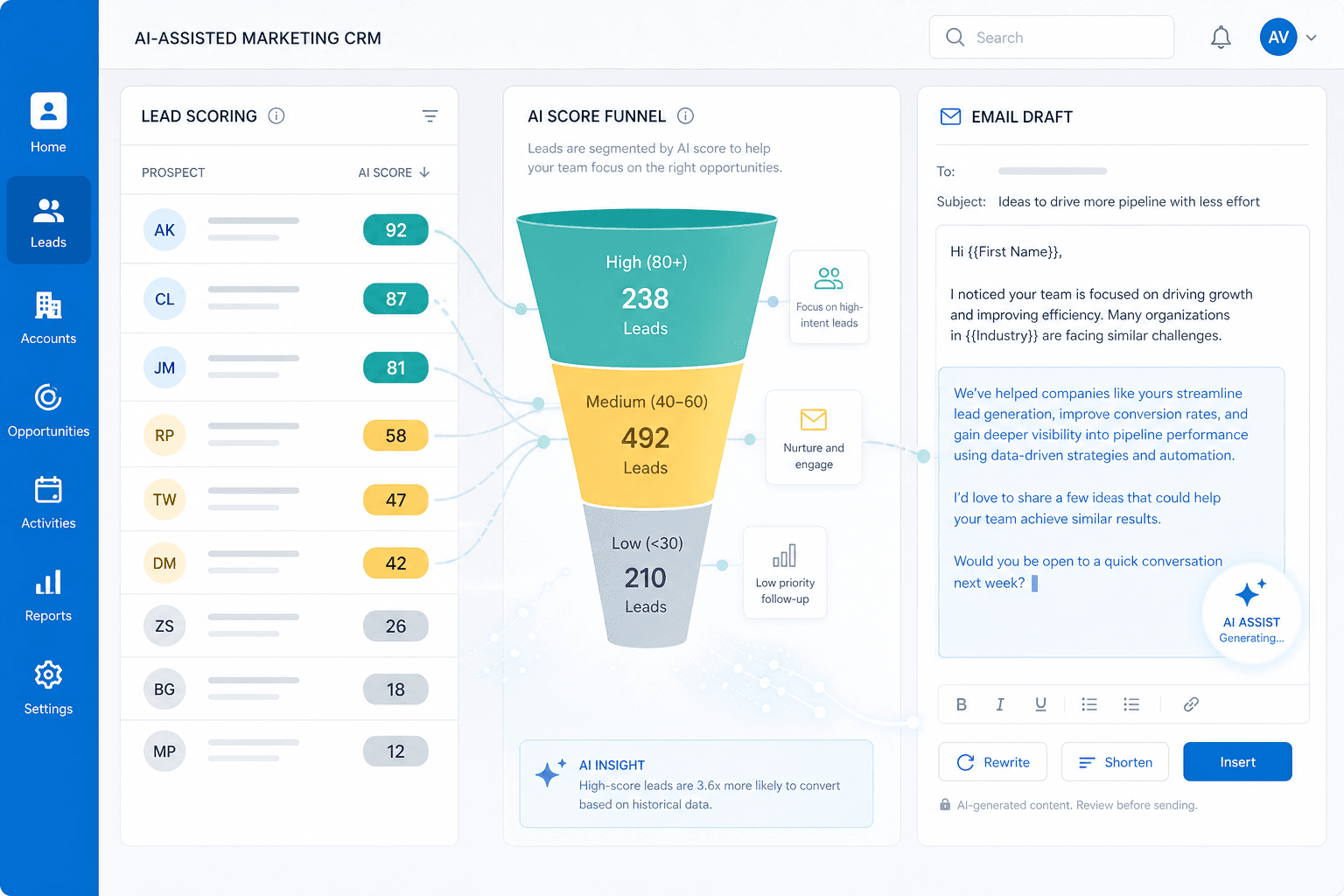
| Einstein Lead Scoring | Conversion rate — leads scored 80+ | 34% | Strong signal; prioritize these for immediate sales routing |
| Einstein Lead Scoring | Conversion rate — leads scored 40–60 | 11% | Moderate signal; appropriate for nurture sequences |
| Einstein Lead Scoring | Conversion rate — leads scored <30 | 3% | Low signal; deprioritize or route to long-term nurture |
| Score-based routing | Lead-to-opportunity conversion (before) | 14% | Baseline before Einstein-informed routing |
| Score-based routing | Lead-to-opportunity conversion (after, 6 months) | 19% | Meaningful improvement; 5-point lift attributed to score-based prioritization |
| Einstein Send-Time Optimization | Open rate improvement | ~3 percentage points | Modest; worth enabling but not a primary strategy lever |
| Opportunity close prediction | Accuracy | 52% | Near-random; treat as weak directional signal only |
| At-risk deal detection | Accuracy (deals needing intervention) | ~68% | More reliable; useful for pipeline review prioritization |
The lead scoring conversion data is the most actionable finding: the gap between the 80+ tier (34% conversion) and the sub-30 tier (3% conversion) is large enough to justify significant changes to routing logic, SLA commitments, and sales rep time allocation. That gap is where Einstein's ROI is most clearly visible.
The Data Prerequisite: Minimum Volume and CRM Hygiene Requirements
Einstein's outputs are only as good as the data it reads. This is not a caveat buried in fine print — it's the primary variable determining whether the features produce actionable signal or statistical noise. The Agentforce rebrand does not change these dependencies.
The minimum data thresholds for reliable Einstein outputs in MCAE:
- Einstein Lead Scoring: Approximately 1,000 leads with recorded conversion outcomes (converted or not converted). Below this threshold, the model has insufficient pattern data and scores will be unreliable.
- Einstein Behavior Scoring: At least one year of engagement data for connected prospects, and a minimum of 20 prospects linked to opportunities. Without this, the model cannot establish meaningful behavioral baselines.
- Einstein Attribution: Sufficient closed opportunities with associated contact touchpoints to train the multi-touch model. Sparse opportunity data produces attribution outputs with wide error margins.
- General CRM hygiene: Einstein observes only what is in Salesforce. It cannot access external intent signals, third-party data, or information that isn't captured in your CRM records. Incomplete lead records, missing field values, and inconsistent data entry directly degrade output quality.
This constraint is particularly relevant for teams considering a full Agentforce autonomous-agent deployment. Agentforce requires Data Cloud (Data 360) as a hard prerequisite — a separate, significant licensing cost. Without clean, well-governed data feeding into Data Cloud, the agents have nothing useful to act on. Evidence from B2B implementations suggests that the majority of Agentforce projects that fail do so because of foundational data quality issues, not because of the technology itself.
Tier and Pricing Guide: Which MCAE Tier Unlocks What
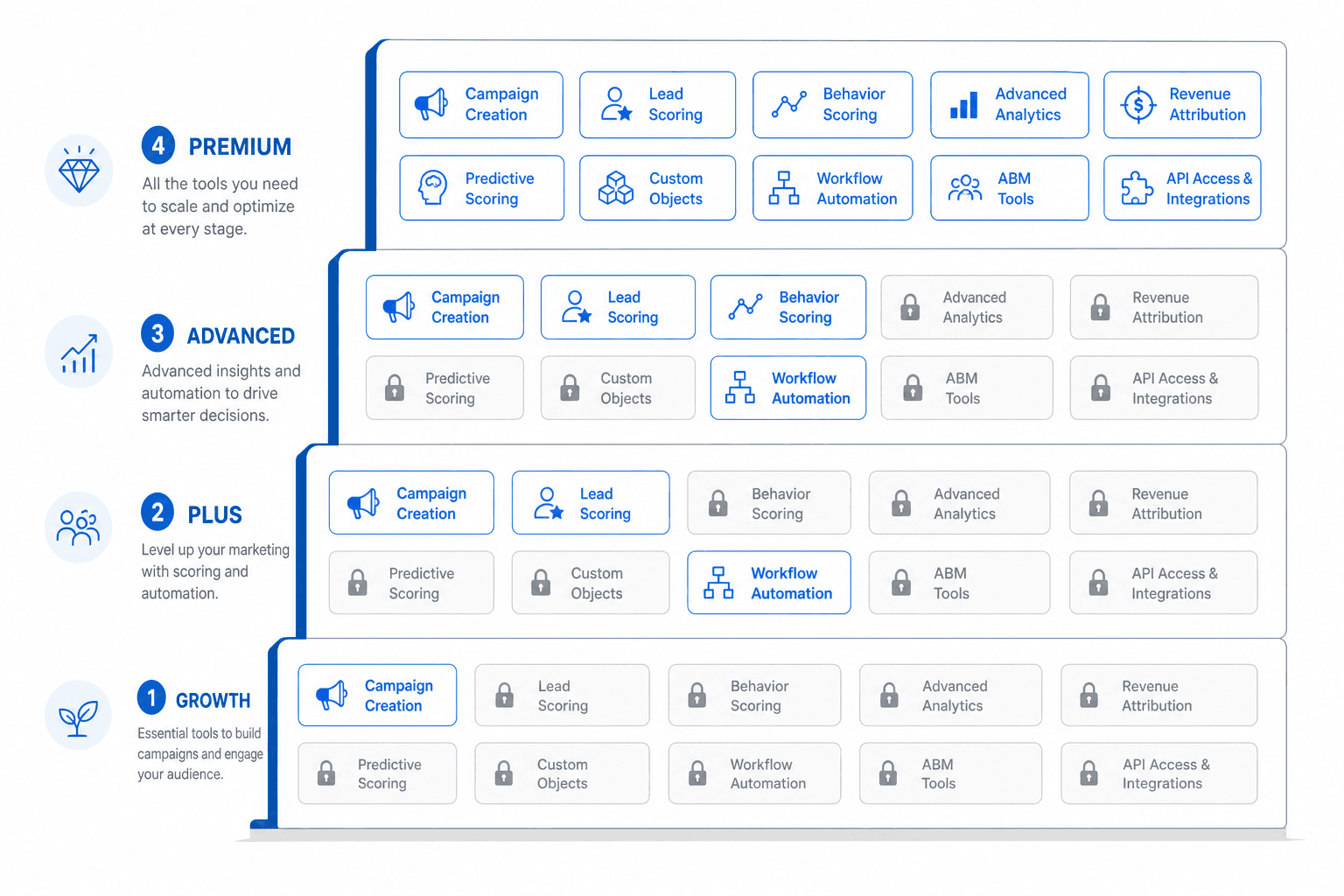
MCAE pricing as of June 2026 follows four tiers. The AI feature gating is the most important practical distinction between them.
| Tier | Price (org/month) | Key AI features included | What's missing |
|---|---|---|---|
| Growth+ | $1,250 | Agentforce Campaign Creation (via Account Engagement+); Marketing Cloud Next Growth Edition | AI-Powered Scoring (Lead and Behavior Scoring); Campaign Insights; Key Accounts Identification; Attribution; B2B Marketing Analytics |
| Plus+ | $2,750 | Everything in Growth+; AI-Powered Scoring (Einstein Lead Scoring + Behavior Scoring); Einstein Campaign Insights; B2B Marketing Analytics | Business Units; Dedicated IP; Key Accounts Identification; Attribution (Advanced+ and above) |
| Advanced+ | $4,400 | Everything in Plus+; Einstein Key Accounts Identification; Einstein Attribution; Business Units; Dedicated IP | Premier Success; Sandboxes (Premium+ only) |
| Premium+ | $15,000 | All capabilities; Premier Success Plan; Sandboxes; Full feature access | — |
The most important tier decision for most B2B marketing teams: AI-Powered Scoring — the feature with the clearest documented ROI — is gated at Plus+ ($2,750/org/month). Teams on Growth+ get Agentforce Campaign Creation for content drafting but do not get lead or behavior scoring. If lead prioritization is your primary use case, Growth+ is not sufficient.
Where Einstein Falls Short
Einstein's limitations are structural, not just gaps that future updates will close. Understanding them before committing to a tier or implementation plan prevents expensive disappointment.
- CRM-only data access. Einstein reads what's in Salesforce. It has no access to external intent data, third-party signals, web analytics outside of tracked Pardot activity, or data in systems not integrated with your CRM. Competitors using intent data platforms (Bombora, G2, etc.) are feeding signals Einstein cannot see.
- Volume thresholds create a cold-start problem. Organizations with fewer than 1,000 leads with conversion outcomes get low-confidence scoring. This disproportionately affects smaller B2B teams and companies with long sales cycles where conversion data accumulates slowly.
- Opportunity close prediction is near-random. The 52% accuracy observed in a well-resourced 18-month deployment is barely above chance. Do not use Einstein's win/loss predictions as a primary input to pipeline forecasting or commit calls.
- Full Agentforce autonomy requires Data Cloud — a separate major cost. Autonomous Agentforce agents require Data Cloud (Data 360) as a hard prerequisite. Data Cloud is a separate product with its own licensing cost. A 50,000-conversation Agentforce deployment typically lands in the $200K–$400K range in total first-year cost, including Data Cloud, platform fees, and professional services. This is not a typical MCAE entry point.
- Data quality problems compound at scale. Evidence from B2B Agentforce implementations points to foundational data quality issues as the primary failure driver. Agentforce depends on clean metadata, consistent field definitions, and well-governed business logic. Teams with dirty CRM data who enable Einstein or Agentforce without fixing the foundation will get proportionally weaker outputs — and potentially misleading ones.
Getting Started: Activation Sequence and First 90-Day Priorities
Given the data dependencies and feature gating, the order in which you activate Einstein features matters. Here's the recommended sequence for a team on Plus+ or above with a reasonably clean database:
- Enable Einstein Lead Scoring first. This has the highest documented ROI and the lowest setup complexity. Confirm you have at least 1,000 leads with conversion outcomes before enabling. Set up score-based routing rules to direct 80+ scored leads to your fastest sales response path.
- Add Einstein Behavior Scoring once data volume is confirmed. Verify you have at least one year of engagement data and 20+ prospects linked to opportunities. After enabling, allow up to 48 hours for scores to appear; scores refresh approximately every four hours thereafter. Use behavior scores to inform nurture sequence branching, not just routing.
- Enable Einstein Send-Time Optimization as a low-effort add-on. The ~3-percentage-point open rate improvement is modest but requires minimal configuration. Apply it to your highest-volume email sends where even small lift compounds meaningfully.
- Defer Campaign Insights and Attribution until data foundations are solid. These features are directional rather than precise, and their value increases significantly with cleaner, more complete data. Don't activate them as a first step — they'll reward you more after you've addressed CRM hygiene.
- Treat Agentforce Campaign Creation as a content drafting accelerator from day one. If you're on Growth+ or above, this is worth enabling early. Use it to generate first drafts of email sequences, landing page copy, and segment definitions — then review and edit before deployment. It reduces blank-page time; it does not replace marketing judgment.
Verdict: Who Should Invest, Who Should Wait
Einstein's B2B marketing value is real but conditional. Here's a clear segmentation of where the investment makes sense:
- Teams with 1,000+ leads and clean CRM data on Plus+ or above: Lead scoring alone justifies the tier. The conversion rate differential between score bands is large enough to meaningfully change how you allocate sales capacity. This is the clearest ROI case.
- Teams on Growth+ with content production bottlenecks: Agentforce Campaign Creation provides real first-draft value. Enable it, build a review process, and use it to accelerate campaign velocity without scaling headcount.
- Teams with sparse databases or dirty CRM records: Fix your data before expecting Einstein to perform. Enabling scoring on a database below the minimum thresholds produces low-confidence outputs that can mislead routing decisions. A data cleanup project will deliver more value than an AI feature activation.
- Teams considering full Agentforce autonomy: This requires Data Cloud, significant implementation investment, and a level of data maturity most MCAE teams have not yet reached. It is not a typical MCAE entry point. Evaluate it as a future-state architecture, not a near-term activation.
- Teams using Einstein for pipeline forecasting: Limit your reliance on opportunity close-prediction accuracy. At roughly 52% in real deployments, it is not a reliable forecasting input. Use at-risk deal detection (~68% accuracy) as a flag for human pipeline review, not as an automated trigger.

Comments
Join the discussion with an anonymous comment.