
AI in B2B Demand Generation: A Channel-by-Channel Guide for 2026
A practitioner-first guide for B2B demand generation managers who need to know where AI actually moves the needle — and where it doesn't. Covers six major demand gen channels with specific workflows, sourced benchmarks, honest limitations, and clear guidance on what to automate versus keep human.
The Adoption Reality Gap: Why 87% Isn't the Number That Matters
The headline statistic circulating through B2B marketing in 2026 is that 87% of B2B marketers are using or testing AI — a figure cited from ON24 and G2 research and referenced widely across industry reports. That number is real. It is also nearly useless as a guide to competitive advantage.
The more instructive figures, drawn from Prospeo's AI in B2B Marketing analysis synthesizing McKinsey productivity data, are these: only 19% of B2B teams have fully integrated AI into daily workflows, and just 6% qualify as AI high performers — organizations where AI meaningfully contributes to bottom-line results. The gap between 87% and 6% is not a technology access problem. It is a workflow design problem.
Most B2B teams have plugged AI tools into existing workflows without redesigning those workflows around AI's actual strengths. The result is marginal efficiency gains — a faster first draft here, a slightly cleaner lead list there — rather than the compounding pipeline advantage that high-performer organizations are building.
Channel specificity is what separates meaningful adoption from performative adoption. AI does not improve every demand generation channel equally. The productivity gains McKinsey estimates for marketing (5–15%) and sales (3–5%) are averages that obscure enormous variance across channels. In outbound email and intent-driven ABM, AI creates compounding returns. In programmatic display and podcast, it remains supplementary at best.
There is a second strategic layer beneath the channel question. 80% of B2B buyers have a preferred vendor before first sales contact — a finding from LeadSpot's benchmark research drawing on Forrester buyer journey data. That means the majority of pipeline influence happens before any intent signal reaches your CRM. AI demand gen that targets only late-stage intent signals is competing for buyers who have already made up their minds. The channels and workflows that shape preference before intent appears are where the highest-leverage AI applications live.
How to Use This Guide: Matching Channels to Your Situation
The six channel deep dives that follow each use a consistent schema: what AI does in that channel, the specific workflow, benchmark uplift data with source context, tool examples, and honest limitations. Before diving in, use the channel selection framework below to identify which two or three channels deserve your immediate attention.
Three variables should drive your prioritization: where your buyers are in the funnel, your average deal size, and how quickly you need pipeline results. A mid-market SaaS company with a 60-day sales cycle and a $25K ACV has different channel priorities than an enterprise infrastructure vendor with a 9-month cycle and a $500K ACV.
| Channel | CAC (Baseline) | ROI (Baseline) | Time to Results | AI Leverage Level |
|---|---|---|---|---|
| Thought Leadership SEO / GEO | $647 | 748% | 4–6 months | High — distinct AI discovery workflow |
| Email / AI-Augmented SDR | $510 | 312% | 3–6 months | Very High — sharpest ROI signal in data |
| LinkedIn Advertising | $983 | 192% | 3–4 months | Medium — AI as supporting layer |
| Account-Based Marketing | $4,664 | 240% | 4–8 months | Very High — AI enables scale previously impossible |
| Conversational AI / Chatbots | Varies | Varies | 1–3 months | Medium — high-traffic sites only |
| Content Syndication + AI Nurture | 50% lower CPL vs. intent-only | 2x shortlist consideration | 3 months | High — mid-funnel compounding |
| Programmatic Display | $802 (PPC/SEM baseline) | 36% | Immediate | Low — supplementary air cover |
| Podcasts | $1,472 | 307% | 12–18 months | Low — longest ramp, lowest AI leverage |
Content Marketing + GEO/AEO: Engineering for AI Discovery
Generative Engine Optimization (GEO) and Answer Engine Optimization (AEO) are not SEO with a new name. They require a fundamentally different content architecture — and for B2B demand gen, they represent a genuinely new discovery channel, not an update to an existing one.
The performance signal is meaningful: according to an Amsive study cited by BOL Agency, LLM-referred traffic converts at 3.76% compared to 1.19% for organic search traffic — a 216% improvement in conversion performance. This is an early-stage research finding with limited published methodology, so treat it as a directional benchmark rather than a guaranteed outcome. But the directional signal is consistent with what practitioners are observing: buyers arriving from AI systems are further along in their research and more specifically qualified than typical organic visitors.
The scale of the shift matters too. Forrester research cited by LeadSpot found that 80–90% of B2B buyers now use GenAI in their purchasing research. Perplexity queries average 10–11 words compared to 2–3 words on traditional Google — buyers are asking detailed, contextual questions, not entering short keyword strings.
The Passage-Level Content Workflow
Traditional SEO optimizes at the page level: a URL targets a keyword cluster, earns authority through links, and ranks for related queries. GEO/AEO requires optimization at the passage level. AI systems do not retrieve pages — they retrieve passages. Each content block must function as a semantically complete unit that can answer a question without requiring the reader to access surrounding context.
The practical workflow shift involves four elements:
- Semantic completeness per passage: Each H2 or H3 section should open with a clear topic sentence that names the subject, states the core claim, and can stand alone as a complete answer to a specific question.
- Entity-rich language: Name specific tools, platforms, organizations, and concepts explicitly. AI systems build entity graphs — vague language ('a leading platform,' 'major vendors') reduces citation probability.
- Explicit concept relationships: State the 'because' and 'therefore' connections that AI systems use to assess whether your content is authoritative on a topic, not just relevant to a keyword.
- Query fan-out compatibility: Structure content to answer not just your target query but the adjacent questions a buyer would ask before and after. Perplexity and ChatGPT generate follow-up queries automatically — content that addresses a cluster of related questions earns more surface area in AI responses.
Two additional limitations are worth naming explicitly. First, GEO citation patterns are volatile — a page cited in AI responses today may not be cited next month as models update. Second, measurement infrastructure for LLM-referred traffic is still immature; most analytics setups do not cleanly separate ChatGPT, Perplexity, and Gemini referral traffic from other sources. Build the workflow, but do not expect clean attribution data yet.
Outbound Email + AI-Augmented SDR: Where the ROI Signal Is Sharpest
Of all the channels covered in this guide, outbound email with AI-driven personalization has the clearest and most consistent ROI signal in the available research. The baseline is not good: standard cold email reply rates run 1–5% (Gradient Works data, cited by LeadSpot). The gap between that baseline and what AI-augmented programs achieve is substantial.
According to LeadSpot's 2025 AI-Driven Demand Generation Benchmark Report, AI-driven hyper-personalized campaigns achieve 15–25% positive reply rates with 30–40% open rates. These figures come from LeadSpot's Accelerate managed service program data — they represent best-in-class outcomes from a specialist provider, not universal averages across all AI email implementations. Your baseline will depend heavily on data quality, ICP precision, and the depth of personalization your workflow actually produces.
Where the Gain Actually Comes From
The performance difference is not simply GPT-generated copy replacing human-written copy. Generic AI-generated email performs similarly to generic human-written email — both land in the 1–5% reply range. The gain comes from three specific workflow components:
- AI-driven prospect identification: Using intent data and firmographic signals to identify accounts showing active buying behavior, rather than working from static list segments.
- Hyper-personalized opening lines at cadence scale: AI generates prospect-specific first sentences referencing recent company news, job postings, product launches, or stated priorities — at volumes no SDR team could produce manually.
- Send-time and sequence optimization: AI models predict optimal send times per prospect and adjust multi-touch cadence timing based on engagement signals, rather than applying uniform scheduling.
The data quality prerequisite is non-negotiable here. 58% of B2B professionals cite data quality as the #1 automation success factor. AI personalization that draws on stale job titles, incorrect company data, or outdated firmographics does not just fail — it actively damages sender reputation and prospect relationships. Audit your CRM and contact enrichment data before scaling this workflow.
LinkedIn Ads + Programmatic Display: AI as Supporting Layer, Not Lead Driver
Set expectations correctly before investing in AI tooling for paid media. LinkedIn Advertising's baseline economics — $983 CAC, 192% ROI, 3–4 months to meaningful results — are already established, and AI's role in improving those numbers is real but incremental rather than transformative for most B2B teams.
AI's supporting role in LinkedIn Ads covers three areas: audience targeting refinement using lookalike modeling and intent-signal overlays, creative variant testing at scale (testing more headline and visual combinations than a human team would manually produce), and retargeting sequencing that adjusts message based on prior engagement. These are genuine efficiency improvements. They are not the same as the compounding pipeline advantage available in email or ABM.
Programmatic B2B display is more limited still. CTRs in B2B programmatic typically run 0.1–0.3%, and AI-assisted targeting produces modest incremental lift in the 5–10% range on assisted conversions according to LeadSpot's benchmark data. The primary value of programmatic display in B2B is awareness and retargeting support — it reinforces other channels rather than generating net-new pipeline on its own.
| Channel | AI Role | Incremental Lift (Documented) | Priority Recommendation |
|---|---|---|---|
| LinkedIn Ads | Audience targeting, creative testing, retargeting sequencing | Incremental — not independently documented at channel level | Secondary — after email and ABM are running |
| Programmatic Display | Targeting refinement, frequency management | 5–10% on assisted conversions (LeadSpot) | Supplementary air cover only |
| LinkedIn Organic | Content scheduling, topic optimization, engagement analysis | Supports GEO/AEO strategy | Medium — worth AI investment if content team is active |
Account-Based Marketing: AI Unlocks Scale That Was Previously Impossible
ABM has the highest CAC of any channel in the First Page Sage benchmark table — $4,664 — and the longest learning curve. It also has a 240% ROI baseline and is explicitly described as 'high risk, high reward' due to its potential for large-deal outcomes. The reason most B2B teams have historically limited ABM to 10–50 target accounts is not strategic preference — it is operational capacity. Personalized buying committee outreach at account level is labor-intensive to execute at scale.
AI changes this constraint directly. Predictive scoring models can identify in-market accounts from behavioral and intent signals across hundreds of accounts simultaneously. Buying committee mapping tools surface decision-maker and influencer contacts at each account without manual research. Dynamic content personalization adjusts messaging for CFO, CTO, and end-user personas within the same account — what MassMetric describes as moving beyond token insertion into 'true narrative-level personalization' for each stakeholder simultaneously.
The pipeline impact is documented: revenue intelligence platforms that apply AI to complex B2B sales cycles shorten those cycles by approximately 55%, according to McKinsey data cited by MassMetric. Gartner projects that 60% of lead-scoring decisions will be made by AI by 2028 — a trajectory that makes AI-driven account scoring a near-term operational requirement for competitive B2B teams, not a future-state aspiration.
Segmenting ABM AI Investment by Company Size
The ABM AI stack recommendation for a $5M ARR company is fundamentally different from a $100M ARR enterprise. Enterprise ABM platforms like Demandbase and 6sense run $30,000–$100,000+ per year and require dedicated RevOps resources to implement and maintain. That price point and operational overhead is not appropriate for most early-stage or mid-market B2B teams.
| Company Stage | Recommended ABM AI Approach | Approximate Investment | Starting Point |
|---|---|---|---|
| SMB / Early Stage (<$10M ARR) | Intent data layer + CRM enrichment + manual account selection | $200–500/month | Clay or Apollo for enrichment; LinkedIn Sales Navigator for account signals |
| Mid-Market ($10M–$100M ARR) | Dedicated ABM platform at entry tier + intent data integration | $2,000–5,000/month | Demandbase Go or 6sense Revenue AI for SMB; integrate with existing MAP |
| Enterprise ($100M+ ARR) | Full ABM platform with AI scoring, committee mapping, dynamic personalization | $5,000–15,000+/month | Demandbase or 6sense enterprise tier; dedicated RevOps implementation |
Conversational AI and Content Syndication + Nurture: Filling the Mid-Funnel
Two mid-funnel channels deserve treatment together because they address the same structural problem: 69% of the B2B buyer journey happens anonymously, according to LeadSpot's benchmark research. Buyers research, compare, and form preferences before they fill out a form or respond to outreach. The mid-funnel is where AI can intercept that anonymous journey and begin converting it into identifiable pipeline signals.
Conversational AI and Chatbots
57% of B2B teams have deployed AI chatbots, and 26% report a 10–20% lift in lead generation from those deployments, according to data cited by Prospeo drawing on G2 research. The qualification is important: chatbot value is highest for high-traffic sites with clearly defined ICP criteria and a fast lead-routing path to sales. Low-traffic B2B sites — under a few thousand monthly visitors — typically see marginal lift from chatbot deployment because the volume of qualifying conversations is too low to produce meaningful pipeline.
The highest-value chatbot implementations do three things: qualify visitors in real time using ICP-aligned questions, route hot leads to sales within minutes rather than hours (the lead-response-time decay curve is steep in B2B), and capture intent signals from non-converting visitors for nurture sequencing.
Content Syndication + AI Nurture
Content syndication paired with AI-driven nurture sequences produces some of the strongest documented mid-funnel economics in the available research. LeadSpot's benchmark data from their Accelerate program shows that syndication with AI nurture versus intent-only programs delivers 50% lower CPL, 2x higher shortlist consideration, and 23% faster sales cycles. Nurtured syndication leads convert to pipeline at 6–8% within 90 days — 3–4x higher than typical paid advertising conversion rates.
These figures come from a managed service provider's proprietary program data, not an independent industry study. Treat them as best-in-class directional benchmarks rather than universal averages. The underlying logic is sound regardless of the specific numbers: buyers who have consumed syndicated content and received a coordinated nurture sequence are further along in their evaluation than buyers who received a single ad impression.
- Cadence depth matters: Best practice for B2B nurture runs 10–15 touches over a 3-month period, combining email, LinkedIn retargeting, and direct outreach. Single-touch or 3-touch nurture sequences do not produce the same pipeline conversion rates.
- Channel mix reinforces recall: AI-coordinated multi-channel nurture (email + LinkedIn + display retargeting in sequence) outperforms single-channel nurture even at equivalent total touch volume.
- Content alignment to stage: AI can adjust nurture content based on engagement signals — a prospect who opened three emails about a specific use case should receive deeper content on that use case, not a generic product overview.
AI Agents: From Campaign Execution to Continuous Signal-to-Action
The most significant structural shift in B2B demand gen AI is not a new tool category — it is a new operating model. AI agents are moving demand generation from discrete campaign execution (plan a campaign, launch it, measure it, plan the next one) toward continuous orchestration that monitors signals and acts on them without waiting for a campaign cycle.
Omnibound AI's Al Lalani, cited in the Demand Gen Report's analysis of AI agents in B2B marketing, names three agent types that map directly to demand gen workflow stages:
- Listener Agents: Monitor prospect calls, intent signals, and behavioral data 24/7. They surface accounts showing buying signals that a human team would not catch between weekly review cycles.
- Topic Agents: Research and synthesize account-level information — recent news, job postings, product announcements, executive statements — to generate context that informs personalized outreach and content.
- Creator Agents: Draft tailored marketing assets and outreach sequences that reflect both the account's current context and the brand's voice guidelines.
Approximately one-third of B2B organizations have implemented agentic AI at scale, according to the Demand Gen Report's analysis. The Slack Workforce Index data provides context for the productivity case: daily AI tool users are 64% more productive and 81% more satisfied than non-users, with daily AI usage rising 233% in a six-month period.
The marketing operations role is evolving alongside this shift. As the Demand Gen Report frames it, the transition is from 'managing tools' to 'designing agent workflows' — a higher-order skill that requires understanding both the business logic of demand gen and the operational parameters of AI systems.
What to Automate vs. Keep Human: A Decision Framework
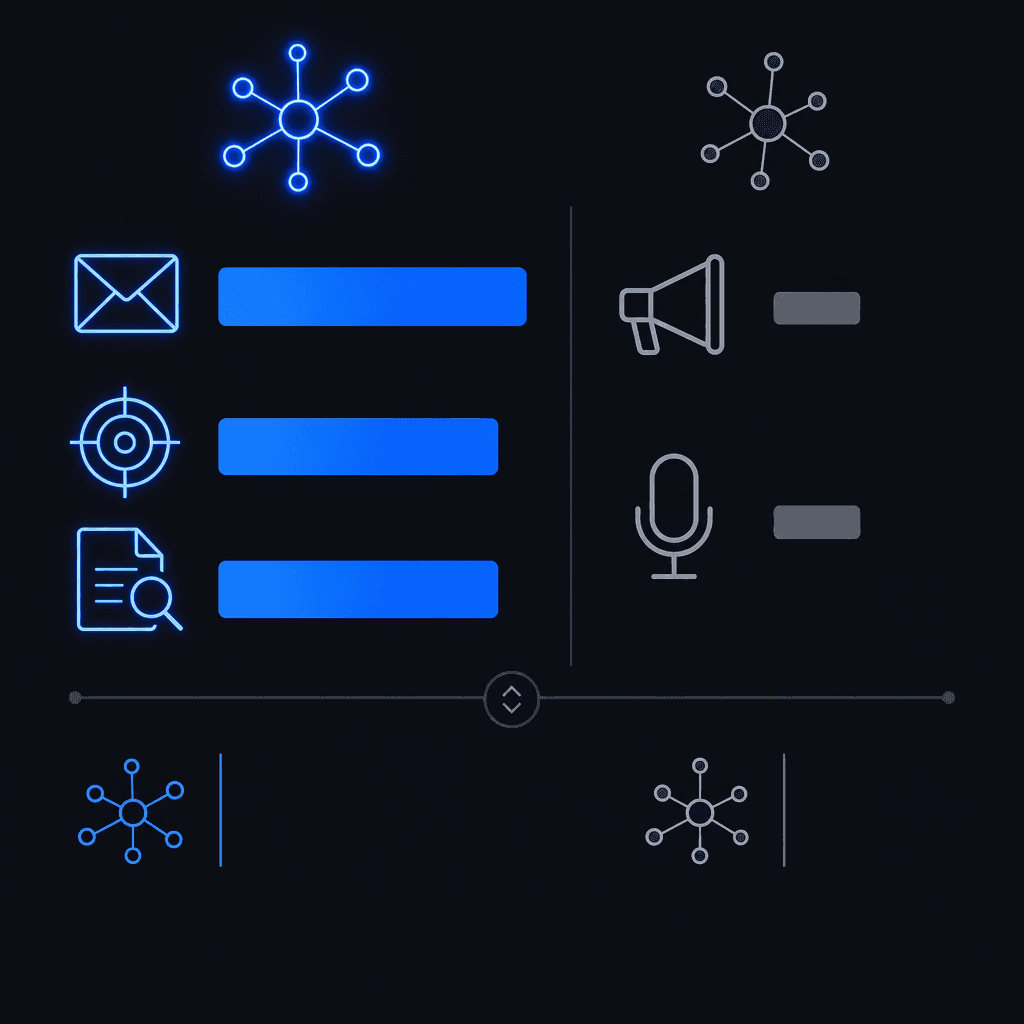
The workflow design question — what to hand to AI versus what to keep under human control — is where the 87%/19%/6% gap actually lives. Most teams that have not crossed into meaningful AI integration have automated the easy, low-stakes tasks and left the high-leverage, high-judgment tasks untouched. The framework below is drawn from Prospeo's practitioner guidance and TechnologyAdvice's governance recommendations.
| Task | Automate | Keep Human | Rationale |
|---|---|---|---|
| Campaign briefs | Yes | Review | AI can generate structure and initial angles; human validates strategic alignment |
| A/B test setup and variant generation | Yes | Approve test design | AI generates variants efficiently; human sets hypothesis and success criteria |
| Scheduling and send-time optimization | Yes | No review needed | Low brand risk, clear optimization signal |
| Basic reporting and dashboard population | Yes | Interpret findings | AI aggregates data; human draws strategic conclusions |
| Lead routing and scoring | Yes | Audit quarterly | AI applies defined logic; human audits for model drift and ICP changes |
| Cadence sequencing (mid-funnel) | Yes | Review sequence design | AI executes defined sequences; human designs the sequence logic |
| First-touch outbound copy | Draft only | Human approves before send | Brand and relationship risk is high; errors damage sender reputation |
| Messaging and positioning | No | Human-owned | Strategic and brand-critical; AI can inform but not decide |
| Customer and prospect research | Assist | Human-led | AI surfaces signals; human interprets context and nuance |
| Creative direction | No | Human-owned | Brand voice, campaign concept, and strategic narrative require human judgment |
| Stakeholder communications | No | Human-owned | Internal advocacy and executive communication require relationship context |
| ICP definition and account selection | Assist | Human-approved | AI can surface patterns; human validates against strategic priorities |
Stack and Budget by Company Size
The following budget tiers and tool categories are drawn from Prospeo's AI in B2B Marketing stack guidance. These are starting-point frameworks, not prescriptive recommendations — the right stack depends on your data quality infrastructure, existing MAP and CRM investments, and the channels you are prioritizing based on the channel selection framework earlier in this guide.
| Company Stage | Monthly AI Budget | Priority Tool Categories | Starting Channels |
|---|---|---|---|
| SMB (<$10M ARR) | $200–500/month | Email personalization, contact enrichment, basic intent signals, AI writing assistant | Outbound email + GEO/AEO content |
| Mid-Market ($10M–$100M ARR) | $2,000–5,000/month | ABM platform (entry tier), intent data layer, conversational AI, AI SDR assist, nurture automation | Email + ABM + content syndication |
| Enterprise ($100M+ ARR) | $5,000–15,000+/month | Full ABM platform, revenue intelligence, AI agent orchestration, advanced analytics, identity graph | Full multi-channel with agent orchestration |
Measuring What Actually Matters: Moving Beyond MQL Volume
MQL volume is a lagging indicator of campaign activity, not a leading indicator of pipeline health. The industry's documented shift away from MQL-centric reporting reflects a structural problem: MQL optimization produces leads that look good in a dashboard but do not convert to revenue at the rates that justify the program cost.
AI demand gen programs require a different measurement frame because they operate across longer time horizons and multiple signals simultaneously. The metrics that actually reflect AI's impact on pipeline are:
- Pipeline velocity: Average time from first AI-sourced signal to closed deal. This captures the sales-cycle compression that revenue intelligence platforms produce — the ~55% cycle shortening McKinsey documents is only visible in velocity metrics, not MQL counts.
- Account-level engagement signals: Buying committee coverage (how many decision-maker contacts are engaged per target account), multi-channel touch depth, and content consumption patterns by persona.
- CAC-to-LTV ratio by channel: AI-sourced pipeline may have higher CAC in some channels (ABM) but significantly higher LTV if it is generating better-fit accounts. Measuring CAC alone without LTV context misrepresents ABM's economics.
- Sales-cycle compression rate: Compare average sales cycle length for AI-nurtured accounts versus non-nurtured accounts. LeadSpot's 23% faster sales cycle benchmark for AI-nurtured syndication leads is only measurable if you are tracking cycle length by lead source.
- AI-influenced pipeline attribution: Track the percentage of closed-won deals that had at least one AI-driven touchpoint (AI-personalized email, AI-scored account flag, chatbot conversation, AI-nurtured content sequence). This is a softer metric but establishes the business case for continued AI investment.
Gartner's projection that 60% of lead-scoring decisions will be made by AI by 2028 is relevant here not as a prediction to act on directly, but as a signal that measurement infrastructure needs to evolve alongside AI adoption. If AI is making scoring decisions, your reporting systems need to be able to audit those decisions — not just count their outputs.
Common Mistakes and Anti-Patterns
The following failure modes are drawn directly from the research and practitioner evidence in this guide. They are the patterns that explain why 87% claim AI adoption while only 6% achieve meaningful bottom-line results.
- Skipping data quality infrastructure before deploying AI. AI personalization, scoring, and agent workflows all depend on clean, current data. Deploying AI on top of a CRM with 30% stale contacts produces confident-sounding errors at scale, not efficiency gains.
- Treating GEO/AEO as an SEO plugin. Adding an AI overview optimization checklist to your existing content workflow is not GEO/AEO. Passage-level content engineering requires restructuring how content is written from the brief stage — it is a separate workflow, not an add-on.
- Deploying agents without governance thresholds. Agents that can send outbound email, route leads, or adjust nurture sequences without defined escalation rules and human review checkpoints create brand and compliance risk. Define the logic before you deploy.
- Using AI output as final copy without human review. This applies especially to first-touch outbound, personalized account outreach, and any communication that references specific prospect details. Factual errors in personalized outreach are more damaging than generic copy.
- Prioritizing programmatic display AI over email and ABM. Programmatic display AI tooling is more visible in vendor marketing than its actual B2B pipeline impact warrants. If you are resource-constrained, the documented ROI evidence strongly favors email and ABM investment first.
- Measuring AI demand gen success with MQL volume alone. AI-driven programs that optimize for MQL volume will produce more MQLs. That is not the same as producing more pipeline. Measure pipeline velocity, account-level engagement, and sales-cycle compression from the start.
- Targeting only late-stage intent signals. 80% of B2B buyers have a preferred vendor before first sales contact. A demand gen program that activates only when intent signals appear in your MAP is competing for buyers who have already formed preferences. GEO/AEO content and AI-driven thought leadership are the tools for the preference-formation phase — invest in them proportionally.
Comments
Join the discussion with an anonymous comment.