

FTC AI Disclosure Rules 2026: Role-by-Role Compliance Checklist Before the June 9 and August 2 Deadlines
Two hard legal deadlines are weeks away — the NY Synthetic Performer Law (June 9) and EU AI Act Article 50 (August 2) — and this guide gives content, paid media, influencer, and demand gen teams the function-specific checklists, platform mechanics, and ready-to-copy disclosure templates they need to make active campaigns compliant before exposure occurs.

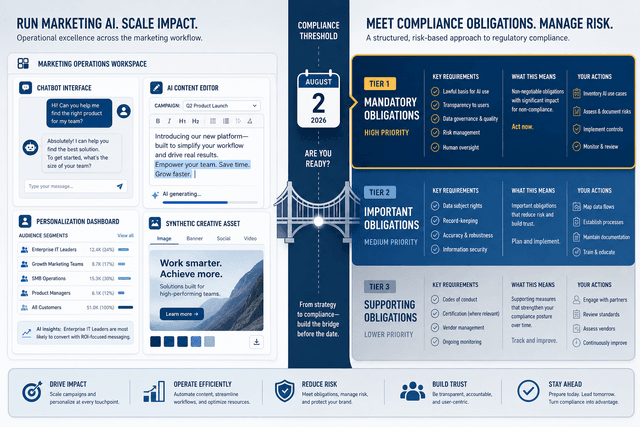
Two Deadlines, One Compliance Window
Two statutory deadlines are now weeks apart, and both have direct consequences for marketing teams actively using AI tools in campaigns. Neither is a proposal or a guidance document — they are enforceable law.
The first is New York A8887-B (the Synthetic Performer Law), effective June 9, 2026. It requires anyone who produces or creates an advertisement to conspicuously disclose the use of a synthetic performer when they have actual knowledge of its use. The obligation runs to the producer of the ad — the agency, the brand, or the creator — not to the platform that publishes it.
The second is EU AI Act Article 50, entering into force August 2, 2026. Deployers of AI systems that generate synthetic audio, image, video, or text content must disclose that content to end users in a clear, distinguishable manner — and AI-generated outputs must carry machine-readable markings. Brands and agencies publishing AI-generated content are deployers, regardless of where they are based, if they are advertising into the EU.
| Law | Effective Date | Who Is Obligated | Penalty Exposure |
|---|---|---|---|
| NY A8887-B (Synthetic Performer Law) | June 9, 2026 | Ad producers and creators (agencies, brands, influencers) | $1,000 first violation / $5,000 each subsequent violation; no private right of action |
| EU AI Act Article 50 | August 2, 2026 | Deployers of AI systems generating synthetic content (brands, agencies publishing into EU) | Up to €15M or 3% of global annual turnover for non-compliance with transparency obligations |
FTC enforcement against deceptive AI marketing claims remained active through the first half of 2026. In May 2026, the FTC required Cox Media Group and two marketing firms to pay a combined $930,000 to settle charges that their AI "Active Listening" service did not function as advertised. In March 2026, Air AI was banned from marketing business opportunities following an $18 million judgment. These cases confirm the agency is using Section 5 actively — the statutory deadlines below add state and international obligations on top of that baseline.
What Each Law Actually Covers: NY Synthetic Performer Law and EU Article 50
The NY law's key defined term is "synthetic performer": a digitally created asset using generative AI or a software algorithm that is intended to create the impression it is a human performer, and who is not recognizable as any identifiable natural person. If your video ad features an AI-generated human figure who is not based on a real, named person, that is a synthetic performer under the law.
Three carveouts narrow the law's scope. It does not apply to:
- Audio-only advertisements (no visual synthetic performer present)
- Language translation of a human performer (AI dubbing or voice translation of a real person's performance)
- Promotional materials for expressive works — such as a film trailer — where the synthetic performer's use in the ad is consistent with its use in the underlying work
For EU Article 50, the operative obligation for marketing teams is the deployer disclosure requirement. Deployers of AI systems generating synthetic outputs must disclose deepfakes and AI-generated public-interest content to end users in a clear and distinguishable manner at the time of first interaction or exposure. Outputs must also carry machine-readable markings. The draft Code of Practice published in early 2026 points toward prominent user-facing disclosure — not disclosure buried in back-end metadata alone.
What Triggers Disclosure by Marketing Function
The disclosure obligation is not triggered by the fact that you used AI — it is triggered by what the AI produced and how it appears in the final asset. The table below maps common AI use cases to disclosure requirements across the four marketing functions most directly affected.
| Marketing Function | AI Use Case | NY Law Triggered? | EU Art. 50 Triggered? | FTC Disclosure Required? |
|---|---|---|---|---|
| Content creation | AI-written blog copy, email body text | No (no synthetic performer) | Yes, if published to EU users | Yes, if sponsored content |
| Content creation | AI-generated images in editorial or sponsored posts | No (not a human performer) | Yes, if published to EU users | Yes, if sponsored content |
| Content creation | AI-generated video with synthetic human figure | Yes — synthetic performer | Yes | Yes, if sponsored content |
| Content creation | AI language translation of human performer | No — carveout applies | Assess case by case | Yes, if sponsored content |
| Paid media | AI-generated creative assets (static display) | No (no human performer) | Yes, if EU-targeted | Yes |
| Paid media | Synthetic performer in display or video ad | Yes — core NY obligation | Yes | Yes |
| Paid media | AI-generated product imagery in shopping ads | No (product, not human performer) | Yes, if EU-targeted | Yes |
| Influencer / creator | Creator-produced ad with synthetic performer | Yes — NY obligation runs to the creator as producer | Yes, if EU audience | Yes — brand faces independent FTC liability |
| Influencer / creator | AI-generated testimonials | Assess | Yes | Categorically prohibited — no disclosure cures this |
| Demand generation | AI chatbot in marketing context | No | Yes, if EU users — must disclose AI system interaction | Yes, if commercial purpose |
| Demand generation | AI-generated personalized email sequences | No (no synthetic performer) | Yes, if EU recipients | Yes, if sponsored/commercial |
Role-Specific Pre-Launch Checklists
Run the checklist for your function before any new campaign launches and before the June 9 deadline for assets already in flight. These are minimum compliance steps — not a substitute for legal review of your specific programs.
Content Team
- Inventory every active and scheduled AI-assisted content asset: identify which tools were used and what role AI played (full generation, editing, translation, image creation).
- For any sponsored or paid content, confirm that both disclosures are present: commercial relationship (#ad, Paid Partnership) AND AI involvement ("Created using AI tools" or equivalent) — as separate, explicit statements.
- For AI-generated video assets containing synthetic human figures, apply the NY synthetic performer carveout test: is this audio-only? Is it language translation of a real person? Is it a promotional material for an expressive work where the synthetic performer appears consistently? If none of the carveouts apply, disclosure is required before June 9.
- Confirm that AI-generated images being published to EU audiences carry machine-readable C2PA metadata and that a visible disclosure label or caption is present.
- Update your content brief template to include a mandatory AI tool documentation field so every asset produced from this point has a record of what was AI-generated.
- Review the FTC disclosure requirements for AI-generated marketing content to confirm which content types require AI disclosure under FTC material connection rules.
Paid Media Team
- Audit every active ad set: identify which creative assets contain AI-generated visual human performers (synthetic performers under NY law). Flag each one for disclosure review before June 9.
- Apply the NY carveout test to each flagged video and display asset. If no carveout applies, the disclosure requirement is active now.
- Verify that platform native AI labels are enabled for applicable assets: Meta 'Made with AI,' TikTok 'synthetic media' label (via the native labeling tool, not caption-only), YouTube 'Altered or synthetic content' checkbox.
- Confirm that text disclosures are present in addition to platform labels — platform labels do not satisfy the FTC commercial relationship disclosure requirement. Both must appear.
- For video ads, verify that the disclosure appears in the first 3–5 seconds, not buried at the end or in a description field.
- Check that AI-generated image assets were exported with C2PA metadata intact and that post-processing steps (resizing, format conversion) did not strip the metadata.
- For EU-targeted campaigns, confirm all AI-generated content assets carry both machine-readable markings and visible user-facing disclosures before August 2.
Influencer and Creator Team
- Brief all active creator partners: under NY A8887-B, the disclosure obligation runs to the producer of the ad — which includes the creator when they produce the sponsored content. The creator bears direct legal exposure, not just the brand.
- Confirm in writing (email or updated contract addendum) that each creator understands the double disclosure requirement: one disclosure for the commercial relationship, a separate disclosure for AI involvement in the content.
- Review creator content already published or scheduled: identify any posts where AI-generated synthetic performers appear and ensure the NY disclosure has been or will be added before June 9.
- Update creator briefs and contracts to prohibit AI-generated testimonials and require explicit AI tool disclosure in deliverables.
- Document all creator briefing communications — these records are part of your FTC audit defense.
- Remember that the brand faces independent FTC liability for creator content even when the creator is the one who produced it. Your review of creator posts before they go live is not optional.
Demand Generation Team
- For AI chatbots used in marketing contexts: ensure any chatbot interacting with EU users discloses that it is an AI system at the start of the interaction. This is a direct Article 50 requirement effective August 2.
- For AI-generated email sequences: add a visible disclosure in the email body or footer if the email is commercial and AI-generated the substantive content. 'Optimized by AI' is not sufficient — use clear language such as 'This email was written using AI tools.'
- For AI-personalized landing pages or content recommendations served to EU users: confirm that the AI-generated nature of the content is disclosed to users at or before first exposure.
- Audit your marketing automation stack: identify every touchpoint where AI generates the content a prospect or customer receives, and map each one against the EU Article 50 deployer requirement.
- Document which AI tools are generating content in each automated flow — this is the baseline record you need for both compliance and audit defense.
Platform Disclosure Mechanics: What Native Labels Cover and What They Don't
Platform native AI labels are a real compliance mechanism — but they operate on a separate track from FTC and statutory disclosure obligations. Understanding what each label does and does not cover is essential before relying on them as your primary compliance step.
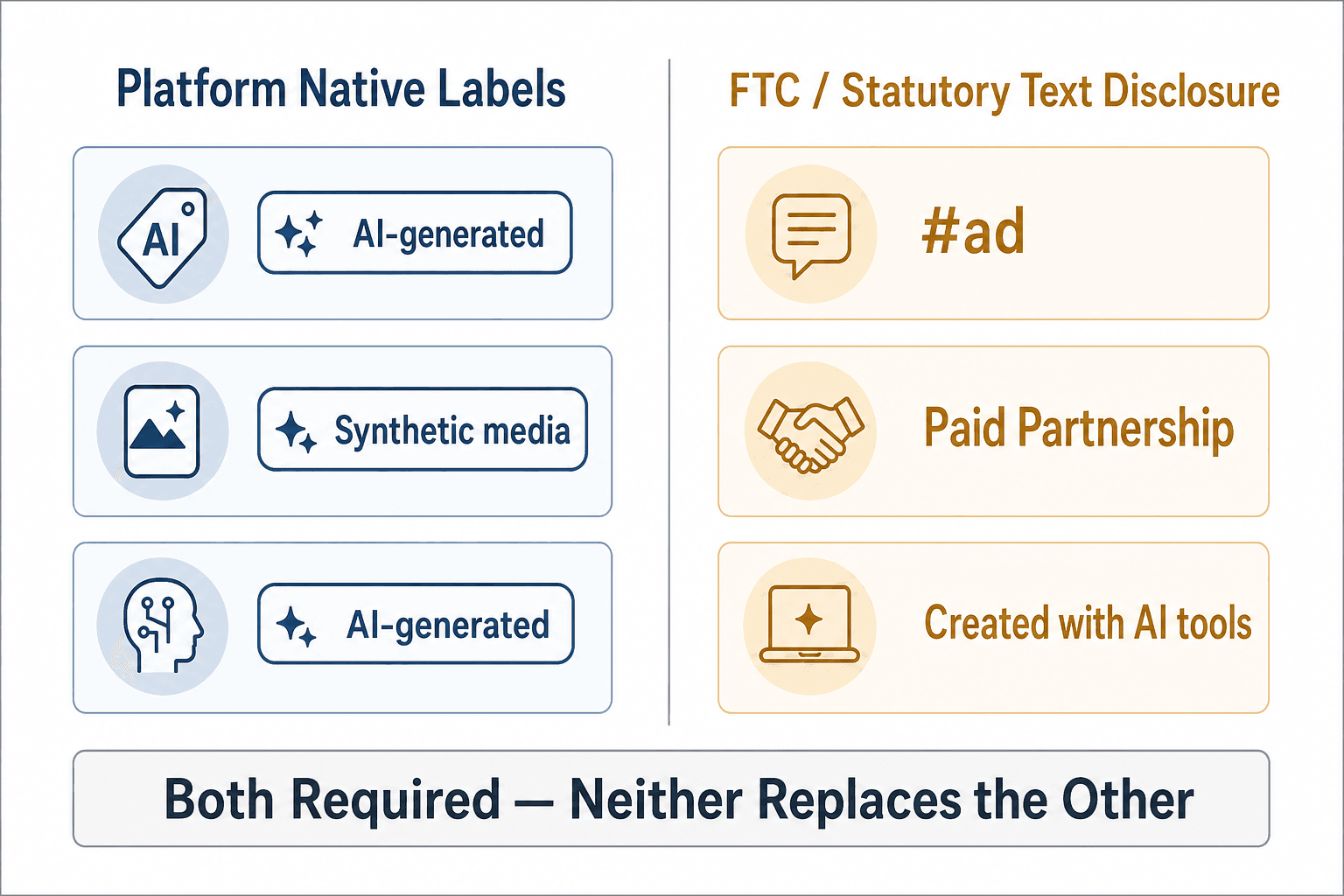
| Platform | Native Label | How Triggered | What It Covers | What It Does NOT Cover |
|---|---|---|---|---|
| Meta (Instagram, Facebook) | 'Made with AI' label | Automatic via C2PA metadata detection; manual option also available | Signals to users that the content was AI-generated or significantly edited with AI | Does not satisfy FTC commercial relationship disclosure (#ad / Paid Partnership) — text disclosure still required |
| TikTok | 'AI-generated content' / 'Synthetic media' label | Mandatory for realistic AI content; must use the native labeling tool — caption-only disclosure is insufficient | Platform-level transparency signal to viewers | Does not satisfy FTC commercial relationship or AI involvement disclosure requirements — text disclosure in caption also required |
| YouTube | 'Altered or synthetic content' label | Manual checkbox in video details; verbal or on-screen text overlay also required | Informs viewers that the content contains AI-generated or significantly altered material | Does not satisfy FTC disclosure for sponsored content — verbal or on-screen disclosure still required |
| Content Credentials via C2PA | Detected from embedded C2PA metadata in uploaded assets | Surfaces AI provenance information to users who inspect the content | Does not satisfy FTC or Article 50 visible disclosure requirements on its own |
For video content, the placement standard matters. Disclosures placed at the end of a video or in the description field are not considered clear and conspicuous. Place both the commercial relationship disclosure and the AI disclosure in the first 3–5 seconds of the video, either as an on-screen text overlay or as part of the opening verbal statement.
C2PA Metadata: The Parallel Compliance Mechanism
C2PA (Coalition for Content Provenance and Authenticity) Content Credentials are embedded metadata that record how a piece of content was created and edited. They function as a provenance record attached to the asset itself — not to a caption or label that can be removed.
Google, Meta, TikTok, and LinkedIn now detect C2PA metadata in uploaded assets and surface that provenance information to users. When you upload an AI-generated image with C2PA metadata intact, the platform can automatically identify and label it — which supports your compliance posture without requiring manual labeling for every asset.
Google has integrated Content Credentials into Google Images, Lens, and Circle to Search, and has stated that its ad systems are starting to incorporate C2PA signals into policy enforcement. This makes metadata embedding a practical compliance step, not just a best practice.
- Embed C2PA metadata when exporting AI-generated assets from your creation tools. Many AI image generators now support this natively or via export settings.
- Do not strip C2PA metadata during post-processing. Resizing, format conversion, or compression in tools that do not preserve metadata will remove the provenance record. Check your workflow for metadata-stripping steps.
- C2PA metadata supports platform auto-labeling — but it does not replace your text disclosure obligations under FTC rules or Article 50. Both are required.
- For assets generated in tools that do not yet embed C2PA, add metadata manually using a C2PA-compatible tool before uploading to platforms.
Ready-to-Copy Disclosure Templates
The templates below cover the most common placement scenarios. Each template includes both the commercial relationship disclosure and the AI involvement disclosure as separate statements — because they must be separate. Adapt the bracketed fields to your specific context.
Short Format: X (Twitter) and TikTok Caption
Addresses: commercial relationship + AI involvement
- Template: #ad | AI-assisted content | [Post text]
- Template (AI-generated image): #ad | Image created with AI | [Post text]
Medium Format: Instagram Caption
Addresses: commercial relationship + AI involvement (both required even when using Meta's Paid Partnership label)
- Template: Paid partnership with @[Brand]. This post was created using AI tools for [copywriting / image generation / video production]. [Post text]
Long Format: YouTube Description and Blog Post
Addresses: commercial relationship + AI involvement + specificity about which tools and what they did
- Template: DISCLOSURE: This [video / post] is sponsored by [Brand]. [Portions of the script / The visual assets / The written copy] were created using AI tools ([specific tool] for [specific task]). All claims reflect genuine product experience and have been verified.
Video Overlay: First 3 Seconds
Addresses: both commercial relationship and AI involvement — must appear on screen within the first 3–5 seconds
- Template: Ad | AI-generated content
- Expanded version: Sponsored by [Brand] | Created with AI tools
For additional context on which content types require AI disclosure under FTC material connection rules, see the site's coverage of FTC disclosure requirements for AI-generated marketing content.
Auditing Active Campaigns Before June 9
The June 9 deadline applies to campaigns already running, not just new ones. If you have active ads, creator content, or scheduled posts that use AI-generated synthetic performers, you need to act before that date. Treat this as a time-bounded sprint, not a process redesign.
- Pull a complete inventory of active campaigns. For each campaign, list the creative assets in use and identify which were produced using AI tools.
- Apply the NY synthetic performer carveout test to every video and display asset. Ask: does this asset contain an AI-generated visual human figure who is not a real, identifiable person? If yes, is it audio-only, a language translation of a real performer, or an expressive work promotion? If none of the carveouts apply, the disclosure obligation is active.
- Verify platform labels and text disclosures for every flagged asset. Check that the platform native label is enabled AND that a separate text disclosure is present in the caption, overlay, or description.
- Contact active creator partners directly. Brief them on the NY producer obligation and confirm that any sponsored content they have published or have scheduled that features AI-generated synthetic performers will carry the required disclosure before June 9. Get this confirmation in writing.
- For assets that cannot be updated in time, assess whether they should be paused. Running a non-compliant asset past June 9 is the exposure — pausing it eliminates the risk while you add the required disclosure.
- Document every step of this audit. The audit record itself is part of your compliance evidence.
Documentation: What to Retain for FTC Audit Defense
If the FTC or a state regulator investigates a campaign, the documentation you have on file is the evidence they examine. Assembling it after the fact is difficult and signals to investigators that compliance was not a real operating practice. Build the documentation habit now, with the June 9 audit as your starting point.
| Document Type | What to Record | Retention Period |
|---|---|---|
| AI tool inventory per campaign | Name of each AI tool used, version if available, which specific assets it produced or assisted with | Minimum 3 years |
| Disclosure text applied | The exact disclosure language used in each asset or post, with a record of where it appeared (caption, overlay, description) | Minimum 3 years |
| Platform labels enabled | Screenshot or export confirmation that the native AI label was activated for each applicable asset on each platform | Minimum 3 years |
| Creator briefing records | Written communication (email or contract addendum) confirming that each creator partner was briefed on double disclosure requirements and the NY producer obligation | Minimum 3 years |
| NY carveout assessment | For each video or display asset, a documented determination of whether a NY synthetic performer carveout applies and why | Minimum 3 years |
| State-specific compliance notes | Any state-level compliance decisions made (e.g., Colorado AI ad targeting law status — currently paused pending DOJ litigation — should be flagged as 'monitor' rather than active obligation) | Minimum 3 years |
| EU Article 50 compliance record | For EU-targeted campaigns, documentation that AI-generated assets carried machine-readable markings and visible user-facing disclosures before August 2, 2026 | Minimum 3 years |
- Store documentation in a centralized, searchable location — not in individual team members' email inboxes.
- Tie documentation to campaign IDs or asset names so records can be retrieved by campaign, date, or platform.
- Assign ownership: one person per team should be responsible for ensuring the documentation record is complete before a campaign goes live.
- For creator partnerships, retain the actual briefing email or contract addendum — not just a note that a briefing occurred.
For context on why consumers increasingly expect disclosure and what the trust evidence actually shows, see the site's analysis of consumer trust in AI-labeled marketing content — compliance and trust-building are aligned objectives, not competing ones.
Comments
Join the discussion with an anonymous comment.