
2026 AI Marketing Adoption Benchmarks and Statistics: A Multi-Source Reference for Practitioners
A sourced synthesis of AI marketing adoption data for 2026, drawing on McKinsey, HubSpot, CMI, and Marketing AI Institute research — built for marketing leaders who need credible benchmarks to assess where their teams stand and build defensible internal cases for AI investment, not another vendor-generated statistics roundup.
Why Most Published AI Marketing Stats Mislead
Search for "AI marketing statistics 2026" and you will find dozens of roundups, most citing the same handful of figures, often without naming the survey, the sample size, or the date the data was collected. A statistic that originated in a 2023 IBM survey gets recycled into a 2026 listicle. A vendor-commissioned study with a self-selected sample of its own customers gets treated as industry-wide evidence. A percentage from one research product gets conflated with a percentage from a different product by the same company, measured at a different sample size.
The result is a body of circulating statistics that is technically sourced but practically unreliable. Marketing leaders who use these figures in board presentations or budget proposals are building on foundations they cannot defend when questioned.
This article takes a different approach. Every figure cited here is attributed to a specific research organization, a specific report, a specific sample size, and a specific date. Where sources corroborate each other, that convergence is noted. Where a figure comes from a single source with known methodology limitations, that is flagged explicitly. The goal is a reference you can actually use in internal discussions — not another list of impressive-sounding numbers stripped of context.
Top-Line Adoption Numbers for 2026: What the Data Actually Shows
The headline adoption figures are real. Across multiple independent research programs, AI use in marketing has crossed a threshold in 2026 where non-adoption is the exception rather than the norm. But the same data that shows high adoption also reveals a persistent and significant gap between using AI and deriving measurable business value from it.
| Statistic | Figure | Source | Sample / Date |
|---|---|---|---|
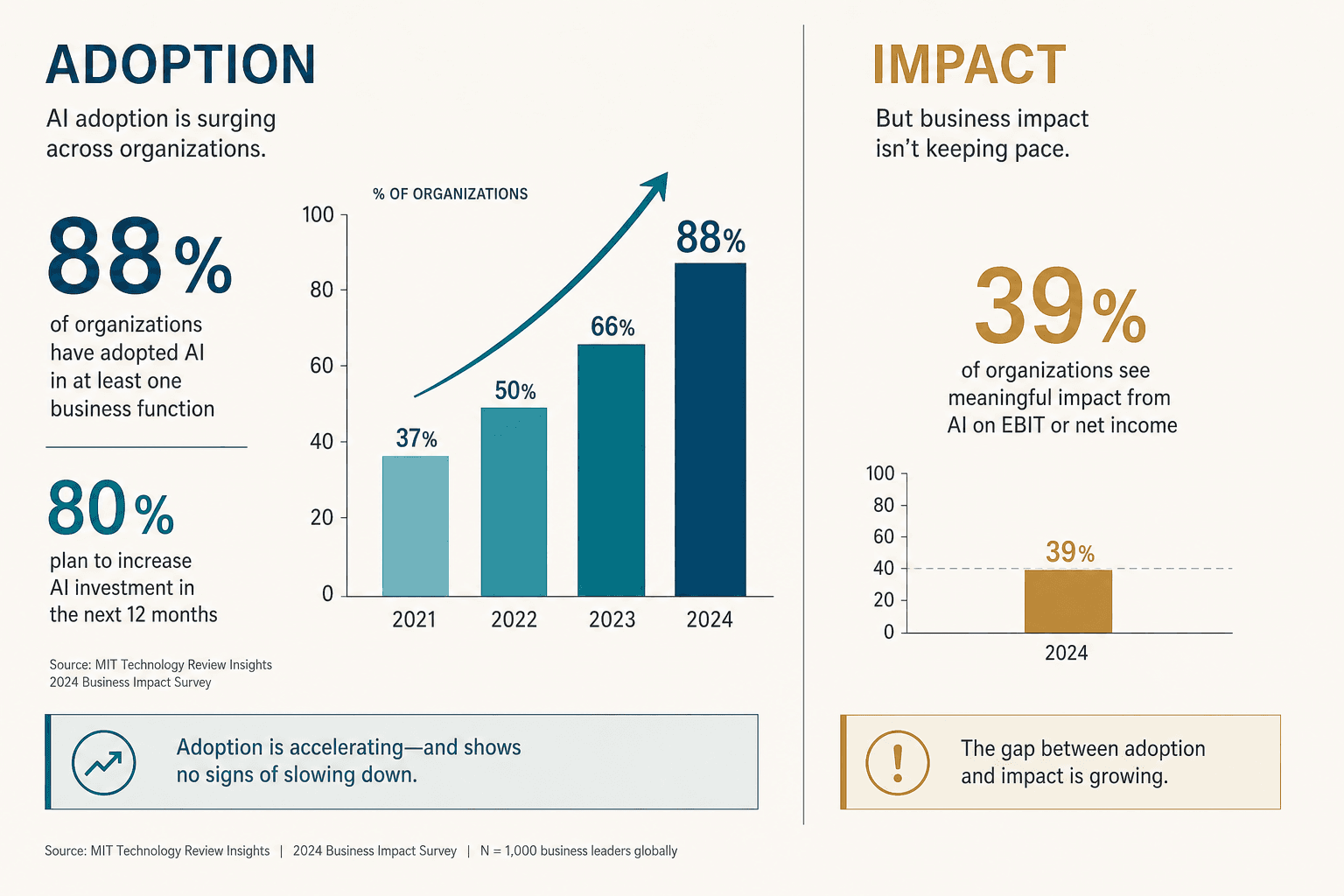
| Organizations using AI in at least one function | 88% | McKinsey Global Survey on AI | n=1,993, 105 nations; fielded Jun–Jul 2025, published Nov 2025 |
| Prior-year baseline (same McKinsey measure) | 78% | McKinsey Global Survey on AI | Prior survey cycle |
| Marketers using AI for content creation | 80% | HubSpot State of Marketing 2026 | n=3,400 marketers globally |
| Marketers using AI for media production | 75% | HubSpot State of Marketing 2026 | n=3,400 marketers globally |
| Marketers planning to use AI in content creation in 2026 | 94% | HubSpot State of Marketing 2026 | n=3,400 marketers globally |
| Organizations reporting any positive EBIT impact from AI | 39% | McKinsey Global Survey on AI | n=1,993, 105 nations; Nov 2025 |
| Marketers who believe marketing is experiencing its biggest disruption in 20 years | 61% | HubSpot State of Marketing 2026 | n=3,400 marketers globally |
The critical pairing is the first and fifth rows. 88% of organizations use AI in at least one function — but only 39% report any positive impact on earnings. That gap is not a rounding error or a measurement artifact. It is the defining condition of AI marketing in 2026: broad adoption, shallow impact. Every adoption figure in this article should be read against that backdrop.
What Marketers Actually Use AI For: Use-Case Adoption Breakdown
Aggregate adoption rates obscure significant variation by function. The 80% figure for AI in content creation does not mean 80% of marketing budgets are AI-driven, or that 80% of content is AI-generated. It means four in five marketers report using AI tools in some capacity for content-related work — a category that spans everything from grammar checking to full-draft generation.
HubSpot's 2026 State of Marketing data (n=3,400 marketers globally) provides the most granular function-level breakdown currently available from a large-sample survey:
| Marketing Function | AI Adoption Rate | Notes |
|---|---|---|
| Data analysis and reporting | 92% | Highest adoption rate across all functions surveyed |
| Administrative tasks | 93% | Includes scheduling, summarization, and workflow automation |
| Content creation | 80% | Includes drafting, editing, repurposing |
| Media production | 75% | Includes image, video, and audio generation or editing |
| Audience segmentation refinement | 51% | |
| Conversion rate optimization | 50% | |
| Marketing process efficiency / automation | 47% | |
| Message timing optimization | 40% |
The 92% data analysis and reporting figure is worth pausing on. It is the highest adoption rate in the dataset and reflects a function where AI augmentation (automated dashboards, anomaly detection, natural-language query interfaces) is deeply embedded in mainstream tools marketers already use — not a separate AI workflow they had to build. This is a different adoption pattern than, say, the 40% using AI for message timing optimization, which typically requires dedicated configuration and data integration.
For readers who want to go beyond adoption rates into channel-specific implementation guidance — what AI actually does in each function, what failure modes to anticipate, and how to sequence adoption — the AI in Digital Marketing function-by-function guide covers that layer in depth. The figures above are benchmarks for where the industry stands; that guide addresses what to do with the knowledge.
For readers specifically focused on the content creation function and the quality-control questions that come with it, the AI-Generated Marketing Content taxonomy and QC framework addresses content governance directly.
Productivity Benchmarks: Time Savings, Output Volume, and Traffic Shifts
The productivity case for AI in marketing is the strongest part of the evidence base, though it rests primarily on self-reported survey data rather than controlled measurement. With that caveat stated upfront, the figures are consistent across sources and large enough in magnitude to be directionally reliable.
- 67% of marketing teams report saving 10 or more hours per week with AI (HubSpot, 1,500+ U.S. professionals). For a team of five, that is roughly 50 hours per week — equivalent to adding more than a full-time role in recovered capacity.
- 68% say AI meaningfully increased their productivity, with content creators reporting approximately 3 hours saved per piece of content produced (HubSpot).
- 49% of marketers report decreased web traffic from search due to AI-generated answers (HubSpot 2026). This is the search traffic displacement effect from AI Overviews and LLM-based search interfaces.
- AI referral traffic from LLMs converts 3x better than traditional search traffic (HubSpot). HubSpot's own data shows LLM-generated leads increased 1,850% even as blog traffic declined — a pattern suggesting that while top-of-funnel volume from search is compressing, the quality of AI-referred visitors is materially higher.
The search traffic dynamic deserves particular attention for teams whose pipeline depends on organic search. The coexistence of declining blog traffic and dramatically higher-converting LLM referral traffic suggests a structural shift in how audiences discover and evaluate content — not simply a traffic loss. Teams optimizing only for traditional search volume metrics may be measuring the wrong thing. For a deeper treatment of the analytics and measurement dimension, the AI Marketing Analytics practitioner reference guide covers measurement frameworks in this environment.
The Implementation Gap: Why Only 39% Report Real Business Impact
This is the number that should anchor every conversation about AI marketing investment in 2026.
According to the McKinsey Global Survey on AI (n=1,993 respondents across 105 nations, fielded June–July 2025, published November 2025): 88% of organizations use AI in at least one business function. Only 39% attribute any positive EBIT impact to AI. And most of that 39% report less than 5% of EBIT attributable to AI — a positive signal, but a modest one. The cohort McKinsey classifies as high performers — those attributing 5% or more of EBIT to AI — represents approximately 6% of respondents.
Put plainly: the majority of organizations using AI are not yet generating measurable business returns from it. This is not a reason to stop investing — it is a diagnostic signal about where most organizations are in the adoption curve and what is holding them back.
Robert Rose's analysis at the Content Marketing Institute (published June 2, 2026), drawing on his work with 500+ agentic AI use cases across client organizations over 18 months, offers a complementary qualitative lens on why the gap exists. Rose identifies that approximately 45% of the AI use cases teams are attempting fall into what he calls the "supplement quadrant" — existing capabilities being executed with AI, but often less efficiently than before.
"What work deserves our time? And for that work, should AI help us do it deeper or just faster?"
Rose's framing matters because supplement-quadrant use cases are often labeled as AI failures — the team tried AI on a task, it was slower or produced lower-quality output, and the conclusion was that AI doesn't work for that function. But Rose's argument is that these aren't failures of AI; they are failures of use-case selection. Teams are applying AI to tasks where it adds friction rather than value, then drawing the wrong lesson from the result.
Barriers to Adoption: Training Gaps, Confidence Deficits, and Over-Reliance Concerns
Understanding why the implementation gap is so wide requires looking at what is actually blocking effective AI adoption inside marketing teams. The evidence points to three distinct but overlapping barriers.
The Training Gap
According to the Marketing AI Institute's 2024 State of Marketing AI Report (cited via Influencer Marketing Hub), 67% of marketers cite lack of education and training as the number-one barrier to AI adoption — and this was also the top barrier in 2023. The percentage has barely moved despite two years of AI tool proliferation. Nearly half of organizations offer no internal AI training at all, and only 26% have internal AI-focused education programs.
The Confidence Deficit
High tool adoption does not translate to strategic confidence. Only 47% of marketers say they feel confident incorporating AI into their marketing strategy, according to HubSpot's 2026 State of Marketing data. The majority of practitioners who report using AI tools regularly do not feel equipped to make strategic decisions about where and how to deploy them.
The Over-Reliance Concern
Among marketers who actively avoid AI, 43% cite over-reliance as their primary concern — not quality, not cost, not capability gaps (HubSpot). This is a different kind of barrier than training or confidence: it reflects a deliberate choice to limit AI use based on a judgment about dependency risk.
There is an additional layer here worth noting. Research cited in the Content Marketing Institute's June 2026 analysis references a Harvard Business Review finding that 80% of employees have strong concern about at least one AI-related threat — but that 65% of those with the highest AI anxiety are also among the heaviest AI users. This pattern suggests that for many practitioners, AI use is driven by self-protective logic ("I need to know this to stay relevant") rather than genuine confidence in the technology. The adoption numbers are real; the confidence behind them is more fragile than they imply.
- 67% of marketers cite lack of education and training as the #1 adoption barrier (Marketing AI Institute 2024 State of Marketing AI, via Influencer Marketing Hub)
- Only 26% of organizations have internal AI-focused education programs; nearly half offer no training at all
- Only 47% of marketers feel confident incorporating AI into their strategy (HubSpot State of Marketing 2026, n=3,400)
- 43% of marketers who avoid AI cite over-reliance as their primary concern (HubSpot)
- 80% of employees have strong concern about at least one AI-related threat; 65% of those with highest AI anxiety are among the heaviest users (HBR, cited in CMI June 2026)
What Separates AI High Performers from the Rest
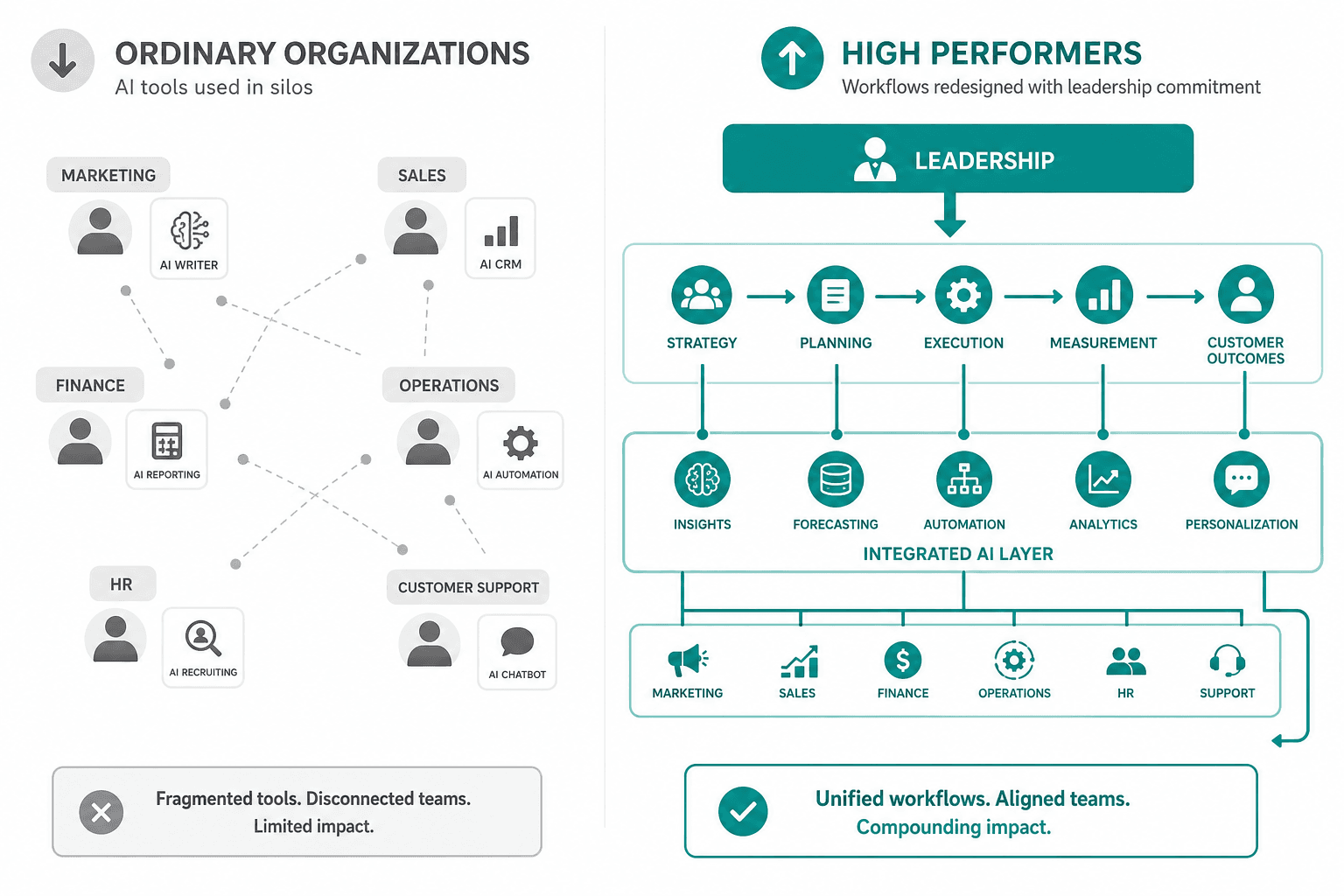
The McKinsey data does not just identify the implementation gap — it profiles the organizations that have crossed it. The roughly 6% of respondents classified as high performers (5%+ EBIT attributable to AI) share a set of structural characteristics that distinguish them from the broader cohort. Critically, these differences are not primarily about which tools they use or which use cases they have prioritized. They are about how AI is governed, funded, and embedded in how work actually gets done.
| Characteristic | High Performers vs. Rest | Source |
|---|---|---|
| Senior leadership ownership of AI initiatives | 3x more likely | McKinsey Global Survey on AI, Nov 2025 |
| Fundamentally redesigned workflows (vs. layering AI onto existing processes) | Nearly 3x more likely | McKinsey Global Survey on AI, Nov 2025 |
| Primary AI objective is growth and innovation (not just efficiency) | Significantly more likely | McKinsey Global Survey on AI, Nov 2025 |
| Digital budget allocation to AI (20%+) | More than one-third commit at this level | McKinsey Global Survey on AI, Nov 2025 |
| Scaling AI agents (vs. piloting or experimenting) | At least 3x more likely | McKinsey Global Survey on AI, Nov 2025 |
The workflow redesign finding is particularly important. High performers are not using AI to do the same work faster — they have restructured the work itself around AI capabilities. This is a qualitatively different intervention than deploying a content generation tool inside an existing editorial process. It requires organizational authority (hence the leadership ownership correlation) and a willingness to accept short-term disruption for longer-term structural gains.
The budget commitment data reinforces this. More than one-third of high performers commit over 20% of digital budgets to AI. Most organizations in the broader cohort are treating AI as a tool-level line item rather than a strategic infrastructure investment. The financial commitment gap maps directly onto the impact gap.
Using These Benchmarks to Assess Your Own Team
The data above is most useful not as a set of industry averages to cite in presentations, but as a diagnostic framework for locating where your team sits on the adoption-to-impact spectrum. The following questions map directly to the evidence.
- Adoption vs. impact: Is your team in the 88% (using AI in at least one function) or the 39% (reporting measurable business impact)? If you are in the former but not the latter, what is the gap — use-case selection, workflow integration, measurement, or leadership commitment?
- Use-case distribution: Which of the function-level adoption rates above does your team match or exceed? Where are you below the industry median? Functions with low adoption relative to peers represent either untapped opportunity or a deliberate choice that deserves articulation.
- Supplement vs. enhancement: Apply the Rose framework to your current AI use cases. Are you primarily using AI to do existing work with existing capabilities — the 45% supplement quadrant — or are you using it to do work that was previously impractical or to reach materially higher quality thresholds?
- High-performer characteristics: Of the five McKinsey high-performer traits — leadership ownership, workflow redesign, growth objectives, budget commitment, agent scaling — how many does your organization currently exhibit? The gap between your current state and the high-performer profile is a concrete agenda for leadership conversations.
- Training and confidence: Does your organization have internal AI training? If 47% of marketers industry-wide lack strategic confidence in AI, what is your team's actual confidence level — and is it based on structured capability building or ad hoc experimentation?
These questions do not have universal right answers. A team that has made a deliberate choice to limit AI use in certain functions for quality or brand-risk reasons is in a different position than a team that simply hasn't gotten around to it. The benchmarks are useful precisely because they separate those two situations — one is a strategic choice, the other is a gap.
Source Index and Methodology Notes
The following notes cover the methodology, sample, publication date, and key limitations of each primary source used in this article. Readers building internal reports or proposals should cite the original sources, not this synthesis.
| Source | Methodology | Sample | Date | Key Limitations |
|---|---|---|---|---|
| McKinsey Global Survey on AI ("The state of AI in 2025") | Online survey, quantitative | 1,993 respondents, 105 nations | Fielded Jun 25–Jul 29, 2025; published Nov 5, 2025 | Data is ~7 months old as of June 2026. Survey respondents are not a random population sample — McKinsey panels skew toward senior managers and executives. EBIT attribution is self-reported. |
| HubSpot State of Marketing 2026 | Survey, quantitative | 3,400 marketers globally | 2026 (exact fieldwork dates not confirmed in public sources) | Report is gated; statistics cited here come from HubSpot's public marketing-statistics page, which cites the gated report extensively. Full methodology not independently verifiable without report access. |
| HubSpot State of Generative AI (blog post) | Survey, quantitative | 1,500+ U.S. professionals | Updated February 2026 | U.S.-only sample. Distinct from the 3,400-person global State of Marketing report. Do not conflate the two sample sizes or treat them as a single research product. |
| Marketing AI Institute 2024 State of Marketing AI | Survey, quantitative | Not confirmed in secondary citation | 2024 | 2024 data; cited here via Influencer Marketing Hub secondary citation. 2025 edition URL returned 404 at time of research. Writers should verify directly with Marketing AI Institute for 2025 update. |
| CMI / Robert Rose ("Mid-Year AI Reality Check") | Practitioner synthesis / qualitative analysis | 500+ agentic AI use cases from client engagements over 18 months | Published June 2, 2026 | This is expert practitioner analysis, not a formal survey. The 45% supplement-quadrant figure reflects Rose's categorization of client use cases — it is not a population-level survey statistic. Frame accordingly. |
| Influencer Marketing Hub AI Marketing Statistics | Curated secondary compilation | Varies by underlying source | Updated December 2025 | Aggregates statistics from multiple surveys (IBM, Semrush, Marketing AI Institute) spanning 2023–2025. Date-stamp each statistic individually; do not treat the compilation date as the data date. |
Comments
Join the discussion with an anonymous comment.