
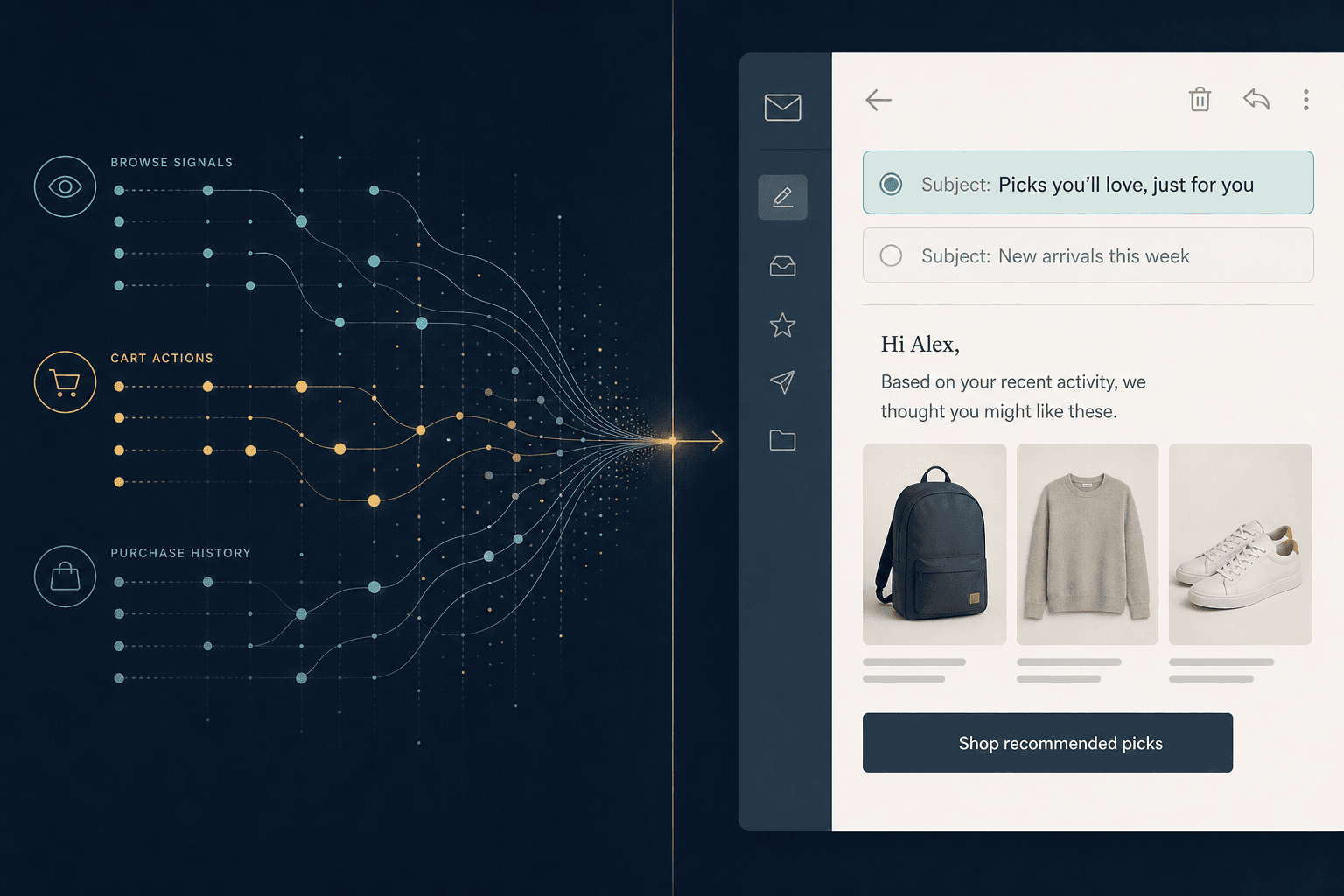
Huda Beauty, Jenni Kayne, Ruroc, Little Sleepies, ILIA Beauty, Frye Company
A schema-driven analysis of six documented ecommerce email personalization programs — spanning Klaviyo and Attentive implementations across apparel, beauty, and sports gear brands — examining what the sourced outcomes actually show, what conditions produced them, and what vendor-reported figures honestly do and don't prove.
Outcome
Across six vendor-sourced cases, AI-assisted email personalization delivered lifts ranging from 14.5% email revenue growth (Jenni Kayne, Klaviyo) to 280% median purchase lift (ILIA Beauty, Attentive) — all figures are vendor-reported with platform-defined attribution windows.
AI Tools Used
This outcome is independently verified via the primary source linked above.
What This Article Is and Who It Serves
This is a schema-driven case study library entry, not a tool listicle or a platform feature comparison. It documents six real ecommerce brands that ran AI-assisted email personalization programs, presents their sourced outcomes in a consistent format, and then synthesizes the conditions that appear to drive results across those cases.
The intended reader is a mid-level ecommerce marketing manager, retention lead, or demand generation professional who is evaluating whether to invest in AI email personalization — or who needs to justify an existing investment to leadership. That reader has seen enough vendor case study pages to be appropriately skeptical of headline metrics. This article tries to be useful to that skepticism, not to override it.
How to Read Vendor-Sourced Case Study Data
Every primary source cited in this article is vendor-published — either by Klaviyo or Attentive. None have been independently verified by a third party. Before reading any metric in this piece, the following caveats apply to all six cases.
- Attribution windows are platform-defined. Journey-attributed revenue and campaign-attributed revenue figures reflect each platform's own attribution logic, which typically includes a multi-day click and open window. These figures may not match multi-touch or incrementality-based measurement.
- No control groups exist in any of these cases. There is no counterfactual — no version of the brand that did not implement the tactic — so causal attribution to specific AI features cannot be confirmed.
- Survivorship bias applies. Vendors publish case studies from programs that worked. Failed or underperforming implementations are not represented in this sample.
- ROI figures, especially for automated journeys, can appear dramatically large because the denominator (send cost) is low and the attribution window is generous. A 31x or 225x ROI figure does not mean the program generated 31 or 225 times its total investment — it reflects platform-attributed revenue divided by the cost of the specific channel.
- Some of the Klaviyo cases predate the platform's explicit AI feature branding. The tactics described — engagement-track segmentation, behavioral triggers, interest-based filtering — are now marketed under Klaviyo's AI umbrella, but the case studies do not reference branded AI features by name. They are accurately described as data-driven behavioral personalization.
Case Study Schema: Six Ecommerce Email Personalization Programs
The table below presents all six brands in a consistent schema before the narrative detail. Two brands (Ruroc, Feel Good Contacts) are UK-based; the remainder are US-based. Three cases use Klaviyo's behavioral segmentation capabilities; three use Attentive's explicitly AI-branded feature suite. That distinction matters for interpretation and is discussed in the case sections below.
| Brand | Industry | Size | Platform | Primary AI Tactic | Primary Outcome Metric | Sourced Outcome | Source |
|---|---|---|---|---|---|---|---|
| Huda Beauty | Beauty / cosmetics | Enterprise | Klaviyo | Engagement-track segmentation + list hygiene | YoY Klaviyo-attributed revenue | 2x+ YoY growth | Klaviyo case study |
| Jenni Kayne | Apparel / home | Mid-market | Klaviyo | Interest-based behavioral segmentation | YoY email revenue (Q1 2023) | +14.5% YoY while cutting sends 43.8% | Klaviyo case study |
| Ruroc | Sports gear (motorcycle / snow) | Mid-market | Klaviyo | Product-line tagging + multilingual segmentation + behavioral triggers | YoY email-attributed revenue | +80% YoY; 38% of total revenue from email | Klaviyo UK case study |
| Little Sleepies | Children's apparel | Mid-market | Attentive AI Pro | Identity AI + Audiences AI + Send Time AI | Journey revenue lift | +31% journey revenue; +43% site visitors identified | Attentive blog |
| ILIA Beauty | Clean beauty | Mid-market | Attentive AI Journeys + Identity AI | VIP-first lifecycle + AI abandonment journeys | Median purchase lift | +280% median purchase lift; 31x total program ROI | Attentive blog |
| Frye Company | Leather goods / apparel | Mid-market | Attentive AI Pro (SMS + email) | Full AI Pro suite post-ESP migration | Campaign attributable revenue growth | +576% campaign revenue (post-migration baseline) | Attentive case study |
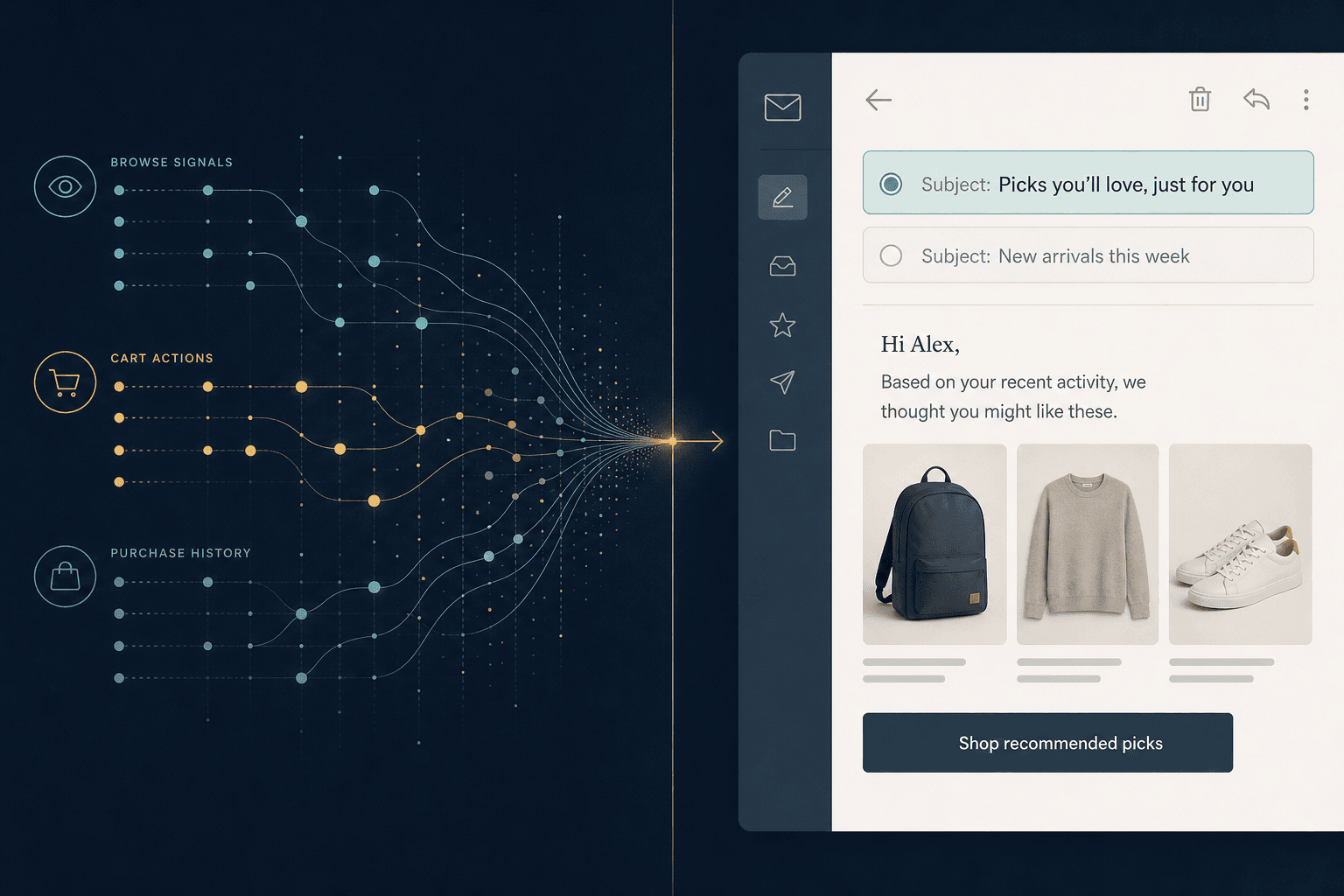
The Klaviyo Cases: Behavioral Segmentation as the Foundation
The three Klaviyo cases share a common structural feature: the measurable lift came from fixing the fundamentals — list quality, send relevance, and behavioral triggers — before any advanced AI feature entered the picture. Klaviyo now markets these capabilities as part of its AI platform, and that framing is fair. But reading these cases as evidence that turning on an AI toggle produces the results misses what actually happened.
Huda Beauty: List Hygiene Before AI Ambitions
Huda Beauty's email program had a deliverability problem before it had a personalization opportunity. The brand's CRM team restructured its send logic around a 120-day engagement window: subscribers who had engaged within that window received regular campaign sends; less-engaged subscribers were suppressed from most campaigns and only re-engaged during high-stakes moments like Black Friday.
The result, according to the Klaviyo case study, was 2x+ YoY growth in Klaviyo-attributed revenue, a 50%+ YoY increase in placed order rate on emails, and 55%+ YoY growth in subscribers. The mechanism was not a new feature — it was a send-cadence restructure and a list scrub.
"With simple Klaviyo segmentation, we were able to clean up a lot of the deliverability issues that we had previously. It was something small that created a really big lift." — Phuong Ngo, CRM and Loyalty Manager, Huda Beauty
Jenni Kayne: Less Volume, More Relevance
Jenni Kayne's retention team operated from a conviction that email frequency was harming the brand's positioning as a luxury lifestyle label. In Q1 2023, they restructured campaigns around interest-based segmentation: apparel shoppers and home goods shoppers received distinct content based on purchase history, browsing behavior, and self-reported preferences collected at sign-up.
They also integrated Yotpo loyalty program data to surface dynamic banners showing each subscriber's current points balance and redemption options. A triggered notification was added for high-value cart abandoners near a physical store location.
The documented outcome: a 43.8% YoY reduction in total emails sent, a 14.5% YoY increase in email revenue, and a 35% YoY increase in campaign click rate — all in the same quarter.
"I've always advocated for less email. It doesn't feel like a luxury experience to be getting 3 emails a day." — Melissa Smith, Retention Director, Jenni Kayne
Ruroc: Product-Line Segmentation Across Languages and Geographies
Ruroc, a UK-based helmet and gear brand operating across motorcycle and snow sport markets, migrated from MailChimp to Klaviyo and integrated its Magento platform to unlock customer-level behavioral data. The core personalization architecture was built around product-line tagging: every customer profile was tagged by primary interest (motorcycle or snow sport), and content was separated accordingly.
The brand also translated all communications into eight languages and segmented by language preference — a meaningful investment for a brand with a global customer base. Behavioral automation (cart abandonment and browse abandonment) was layered on top of the segmented list structure.
Per the Klaviyo UK case study, Ruroc grew email-attributed revenue 80% YoY and now drives 38% of total revenue through email. Automated emails achieve an average 31% CTR.
"Customers don't have the patience for messaging that isn't relevant to them, so we use all the data we have — geography, onsite behavior, product interest, and more — to tailor our interactions to an incredible level." — Paul Cartwright, Head of CRM, Ruroc
The Attentive Cases: Explicitly AI-Branded Feature Activation
The three Attentive cases differ from the Klaviyo cases in one important respect: they explicitly reference named AI product features — Identity AI, Audiences AI, AI Journeys, Send Time AI — rather than describing behavioral segmentation practices that have since been rebranded as AI. The outcomes attributed to these features are more granular and, in some cases, more dramatic. They also carry the same vendor-attribution caveats as the Klaviyo cases, with the additional complexity that two of the three brands (Frye, ILIA) run unified SMS and email programs, making email-specific attribution harder to isolate.
Little Sleepies: Identity Resolution Closes the Cookie Gap
Little Sleepies, a children's apparel brand with a subscriber base exceeding 500,000 SMS contacts, deployed Attentive's AI Pro suite — specifically Identity AI, Audiences AI, and Send Time AI. The strategic problem the brand was solving was familiar: a significant share of site visitors were not identifiable via cookie-based tracking, meaning behavioral triggers (abandonment flows, browse triggers) were not reaching them.
Identity AI addressed this by matching more site visitors to known subscriber profiles. According to the Attentive AI marketing examples post, the brand identified 43% more site visitors and re-targeted them through existing journeys. Journey revenue increased 31% and campaign revenue increased 27%. Send Time AI contributed a 6% lift in engagement.
The most striking figure from the Little Sleepies case is not a percentage lift — it is a revenue concentration stat. During a 'Play' product line launch, the AI-augmented segment (visitors identified via Identity AI who would not have been reached otherwise) accounted for 85% of total campaign revenue from that launch.
ILIA Beauty: Brand Voice as a Prerequisite, Not an Afterthought
ILIA Beauty's case is notable not just for its outcome figures but for what its lifecycle marketing director described as the primary barrier to AI Journeys adoption: brand voice control. For a clean beauty brand whose positioning depends on a specific editorial tone, the concern was whether AI-generated journey messages would sound like the brand or like a generic email template.
The team implemented a VIP-first SMS strategy alongside AI Journeys and layered Identity AI abandonment flows into the email program. The results, per the Attentive blog, include a 280% median purchase lift with AI Journeys, a 49% lift in clicks, 13–14% weekly revenue lift from Identity AI abandonment journeys, and a 31x total program ROI. Automated journeys alone are cited at 225x ROI.
"AI Journeys was a huge unlock — it was initially nerve-wracking because of brand voice control, but it was quickly validated by performance." — Alexandra Salai, Director of Lifecycle Marketing, ILIA Beauty
Frye Company: Migration Context Is Not Optional Context
The Frye Company's headline figures are the largest in this set: 576% campaign attributable revenue growth, 562% journey attributable revenue growth, 124% journey conversion rate improvement. These numbers require the migration context to be meaningful.
Frye migrated its entire email program from a prior ESP to Attentive under time pressure ahead of Q3 peak season. The baseline for comparison is a period of disrupted sending — a program in transition, not a stable prior-state program. The growth figures compare post-migration performance (with Attentive AI Pro active) against a baseline that was operationally compromised.
The AI Pro-specific figures are more interpretable in isolation: 13% overall revenue lift attributed to AI Pro, 21% email Audiences AI revenue lift, 16% email Identity AI abandonment flow lift. The Audiences AI ROI is cited at 8–9x in the Attentive case study.
Cross-Case Pattern Analysis: What the Winners Actually Share
Across all six cases — and supported by comparable results from Emarsys-platform brands including Total Tools (12% revenue uplift from AI product recommendations), Feel Good Contacts (22% email revenue jump), and PUMA (5x revenue increase within six months) documented in the SAP Engagement Cloud case examples — four conditions appear consistently in the programs that produced meaningful, documented lifts.
- Data hygiene precedes AI activation gains. Huda Beauty's most significant lift came from list scrubbing and engagement-window restructuring before any advanced feature was involved. Ruroc's 80% revenue growth followed a platform migration that gave the team access to clean, integrated customer data for the first time. Brands that attempted AI personalization on top of dirty or fragmented data did not appear in the published case study set — which is itself a form of evidence.
- Behavioral triggers outperform batch-and-blast sends regardless of platform. Every case in this set involves some form of triggered or behavioral automation — cart abandonment, browse abandonment, post-purchase flows, or engagement-based suppression. The consistent high CTRs on automated emails (Ruroc's 31% average) and the outsized journey ROI figures (ILIA's abandonment flows) reflect a structural advantage of triggered sends: they reach people at a moment of demonstrated intent.
- Identity resolution closes a real revenue gap. Little Sleepies and ILIA both demonstrate that a meaningful share of site visitors who would have received no triggered communication — because they were not cookied or identifiable — can be reached through identity-matching. The 43% more visitors identified by Little Sleepies is a proxy for the size of that gap. Brands with significant unidentified traffic have more to gain from identity AI features than brands with smaller gaps.
- Program maturity matters more than tool choice. Jenni Kayne's results came from a retention team that had already built a clear philosophy about email frequency and audience relevance — the platform enabled execution, but the strategic clarity preceded it. ILIA's team had a defined brand voice requirement before activating AI Journeys. The Emarsys-platform brands show the same pattern holds outside the Klaviyo and Attentive ecosystems.
Conditions Matrix: When AI Email Personalization Works vs. Underperforms
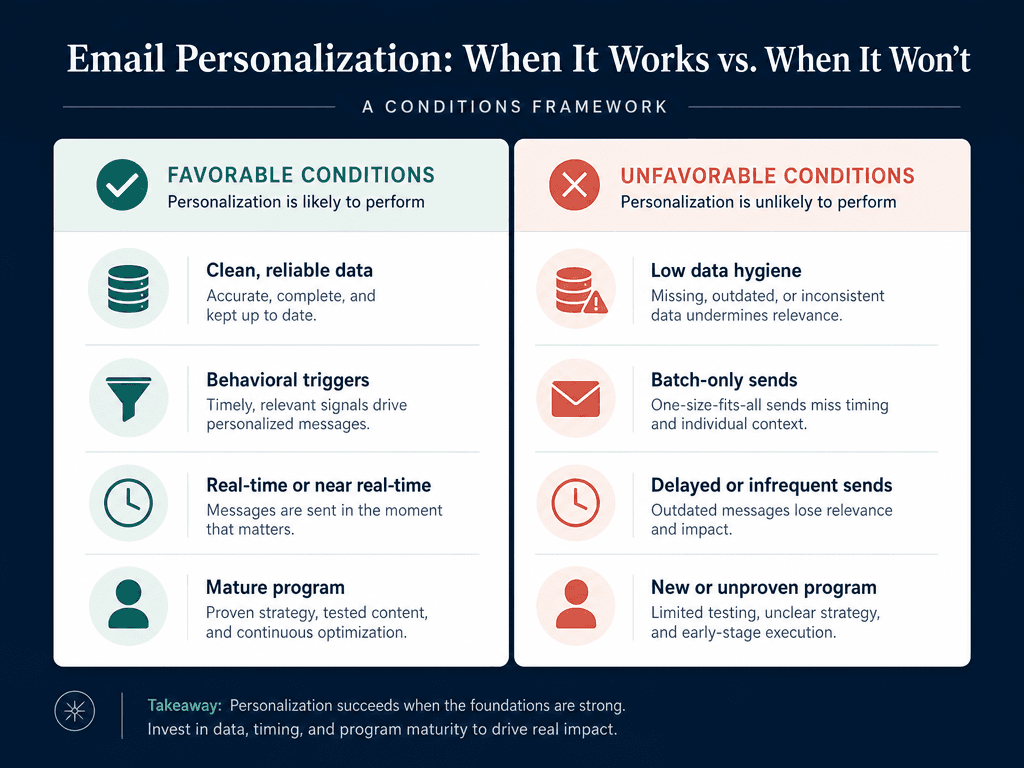
| Condition | Favorable | Unfavorable |
|---|---|---|
| List data quality | Clean, regularly scrubbed list with engagement segmentation in place | High proportion of inactive, unengaged, or unverified contacts |
| Behavioral trigger infrastructure | Cart, browse, and post-purchase automations already running | Batch-and-blast only; no triggered flows active |
| Customer data integration | ESP connected to ecommerce platform, loyalty data, and onsite behavior | Siloed data; ESP not integrated with platform or CRM |
| Audience data volume | Sufficient historical purchase and browsing data to build behavioral segments | Early-stage program with thin behavioral history |
| Identity resolution opportunity | Significant unidentified site traffic; large subscriber base relative to identified visitors | Most visitors already cookied and identifiable; smaller gap to close |
| Program maturity | 6+ months of consistent sending; established lifecycle stages | Newly launched program; no stable baseline for comparison |
| Platform migration status | Stable on current platform; clean historical baseline available | Mid-migration or recently migrated; disrupted baseline complicates measurement |
| Brand voice requirements | Voice guidelines documented and testable; team has capacity to review AI output | No documented brand voice standards; AI output cannot be reviewed at scale |
Honest Limitations: What These Six Case Studies Do and Don't Prove
The six cases in this article are the best publicly available, named-brand evidence for AI email personalization in ecommerce. They are also a limited and structurally biased sample. Here is what the evidence cannot support.
- No causal isolation of AI features. None of these cases isolate the contribution of a specific AI feature from the contribution of platform migration, improved list hygiene, or broader program maturity. The Frye case is the clearest example, but the problem applies to all six.
- No control groups. There is no version of any of these brands that did not implement the tactic. The before-after comparisons reflect all changes that happened in the relevant period, not just the AI personalization intervention.
- Survivorship bias is structural. Klaviyo and Attentive publish case studies from programs that produced results worth publishing. The distribution of outcomes across all brands on these platforms — including those that saw minimal lift or negative results — is not visible in this data set.
- Attribution methodology varies and is platform-defined. Klaviyo-attributed revenue and Attentive journey-attributed revenue are calculated differently and may use different attribution windows. Cross-platform percentage comparisons are not apples-to-apples.
- The Klaviyo cases predate explicit AI feature branding. Huda Beauty, Jenni Kayne, and Ruroc are accurately described as data-driven behavioral personalization programs. Calling them AI case studies reflects how Klaviyo now markets these capabilities — not how the brands described their own implementations at the time.
- UK-based brands may not reflect US market conditions. Ruroc is a UK brand. Feel Good Contacts and Total Tools (referenced in the cross-case section) are also UK-based. Email engagement rates, data privacy norms, and consumer behavior differ across markets.
- Very large ROI multiples (31x, 225x) reflect the economics of triggered email, not total program economics. They compare platform-attributed revenue against the direct cost of sending triggered messages — not against total program investment, headcount, or technology cost.
Practitioner Takeaways
These conclusions are drawn from the patterns across all six cases, not from any single brand's headline metric.
- Audit list hygiene before evaluating AI features. The most consistent predictor of a strong AI personalization outcome is a clean, well-segmented list. If your engagement rates are suppressed by inactive contacts or your deliverability is inconsistent, fixing those problems will likely produce more lift than activating a new AI feature tier.
- Build behavioral trigger infrastructure first. Cart abandonment, browse abandonment, and post-purchase flows are the highest-ROI email automations in this data set. If these are not running reliably on your current platform, that is the higher-priority investment before upgrading to an AI feature tier.
- Understand your platform's attribution methodology before reporting ROI internally. Ask your ESP what attribution window it uses for journey revenue and campaign revenue. Understand whether that matches how your organization measures multi-touch contribution. Presenting a 31x journey ROI to a CFO without that context will create credibility problems when the figure is cross-referenced against other measurement tools.
- Treat vendor case study metrics as directional signals, not benchmarks. A 280% median purchase lift at ILIA Beauty or an 80% email revenue increase at Ruroc tells you the direction of effect is real and the magnitude can be significant. It does not tell you what your program will produce. Use these figures to establish that the investment is worth testing — not to set internal targets.
- Match the AI feature tier to your program maturity stage. Identity AI and Audiences AI produce the most incremental value for programs that already have behavioral triggers running and sufficient data volume to build meaningful segments. Activating these features on a program with thin behavioral history or a recently migrated list will produce weaker results and make it harder to measure what is actually working.
- Document brand voice requirements before activating AI content generation. ILIA Beauty's team identified brand voice control as the primary barrier to AI Journeys adoption — and resolved it before launch. If your brand has a distinctive editorial voice, define what that means in testable terms (tone, vocabulary, sentence structure) before AI-generated copy goes into live journeys. Review the first wave of AI output manually before scaling.


Comments
Join the discussion with an anonymous comment.