
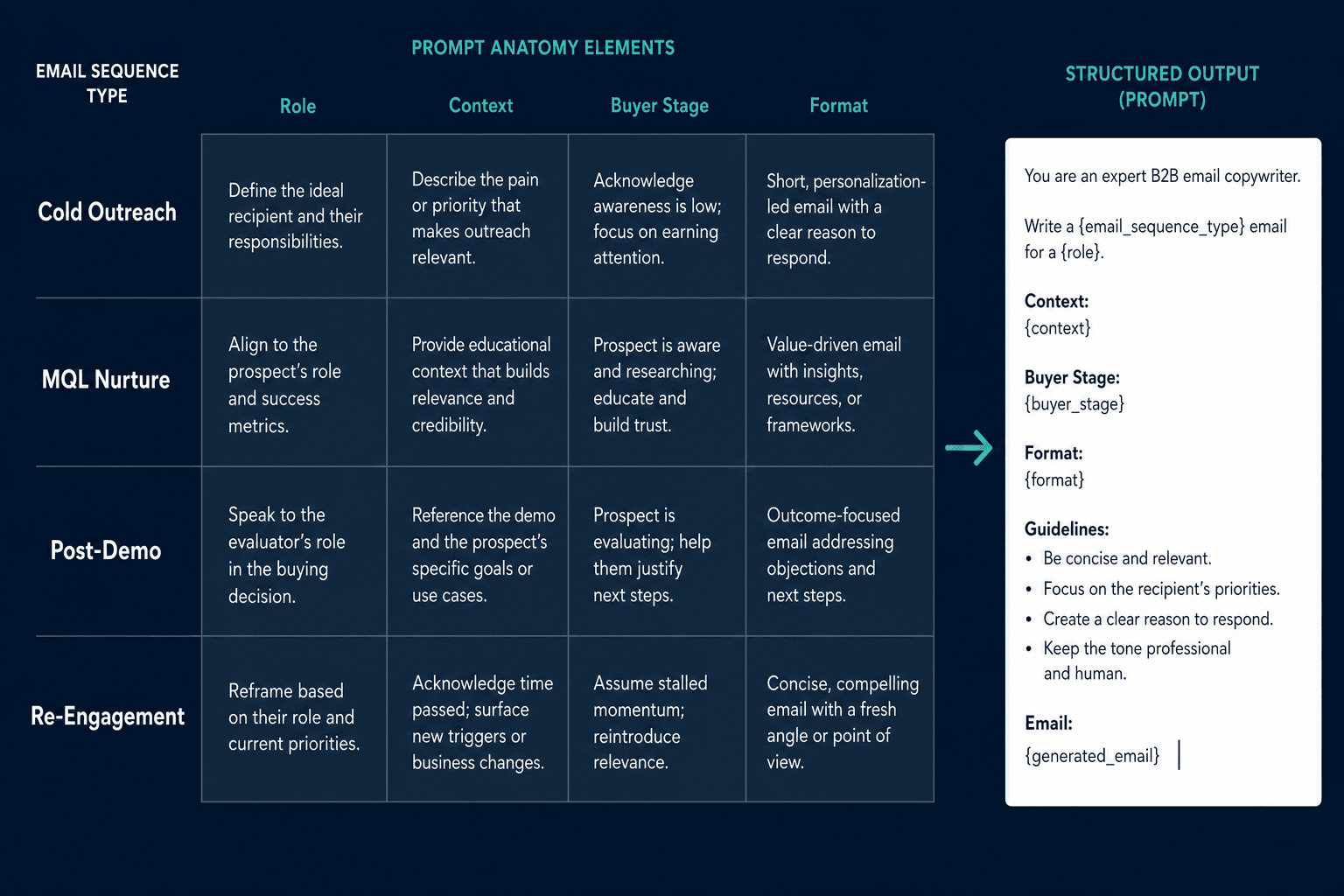
Email Sequence Prompt Templates for B2B Marketers: Organized by Sequence Type, Not Just Use Case
Generic AI email prompts fail B2B marketers because they ignore the most important variable: where the buyer actually is in the sales process. This guide provides prompt templates structured by sequence type — cold outreach, MQL nurture, post-demo follow-up, and re-engagement — each built with the four elements that make AI output usable without heavy rewriting.
Why Generic AI Email Prompts Produce Generic B2B Email Copy
If you've spent any time prompting an AI writing tool to draft B2B emails, you've likely run into the same problem: the output is technically coherent but functionally useless. It reads like a composite of every cold email ever sent — vaguely professional, moderately personalized, and requiring a complete rewrite before it can go anywhere near your CRM.
The reason isn't the AI. It's the prompt. And the specific failure is almost always the same: the prompt doesn't tell the AI what kind of email it's writing or where the recipient actually sits in the sales process.
Most published AI email prompt guides treat every B2B email as interchangeable. They give you a list of prompts organized by goal ("write a follow-up email," "write a re-engagement email") without distinguishing between a prospect who has never heard of your company and one who just sat through a 45-minute product demo. Those are fundamentally different communication situations. They require different email structures, different tones, different calls to action — and therefore different prompts.
This guide doesn't start from zero. You already know how to use AI writing tools. What you need are prompts built around the variable that generic guides ignore: sequence type. Every template here is anchored to a specific sequence arc and a specific position within that arc — because that's what makes the difference between output you can refine in two minutes and output you delete and rewrite from scratch.
The Four-Element B2B Email Prompt Anatomy
Every prompt in this guide is built from the same four elements. They're not a published framework — they're a synthesis of what consistently separates prompts that produce usable B2B email drafts from prompts that don't.
- Role assignment: Tell the AI who it is. Not "you are a helpful assistant" — tell it the specific professional context. "You are a B2B demand generation manager at a mid-market SaaS company" produces structurally different output than no role assignment at all.
- Sequence type declaration: Name the sequence. Cold outreach, MQL nurture, post-demo follow-up, and re-engagement are not interchangeable. Declaring the sequence type tells the AI which communication logic to apply — awareness-building versus education versus objection handling versus reactivation.
- Buyer stage signal: Describe what the recipient has or hasn't done. Have they downloaded a guide? Attended a demo? Gone dark after a proposal? The AI cannot infer this. State it explicitly.
- Output format constraint: Specify structure. Word count, subject line inclusion, CTA type, tone, and whether you want one version or three variants. Without this, the AI defaults to its own interpretation of what an email looks like — which is rarely what you need.
Here's what a fully assembled prompt looks like with all four elements labeled:
[ROLE] You are a senior demand generation manager at a B2B SaaS company selling project management software to operations teams at mid-market manufacturing companies.

[SEQUENCE TYPE] You are writing email 1 of a 5-email cold outreach sequence. This is an awareness-stage email — the recipient has had no prior contact with your company.

[BUYER STAGE SIGNAL] The prospect is a VP of Operations at a 200–500 person manufacturer. They have not interacted with any of your content. They are likely managing project tracking in spreadsheets or a legacy tool and may not be actively evaluating alternatives.

[FORMAT CONSTRAINT] Write one email with: a subject line under 8 words, an opening line that references a specific operational challenge (not a compliment), a body of 80–100 words maximum, and a single low-friction CTA (offer a relevant resource, not a meeting request). Do not use "I hope this finds you well" or similar openers.
Notice what this prompt does: it gives the AI a specific professional identity, names the sequence type and the email's position in it, describes the recipient's likely situation without assuming active buying intent, and constrains the output format precisely enough that the result is usable rather than generic.
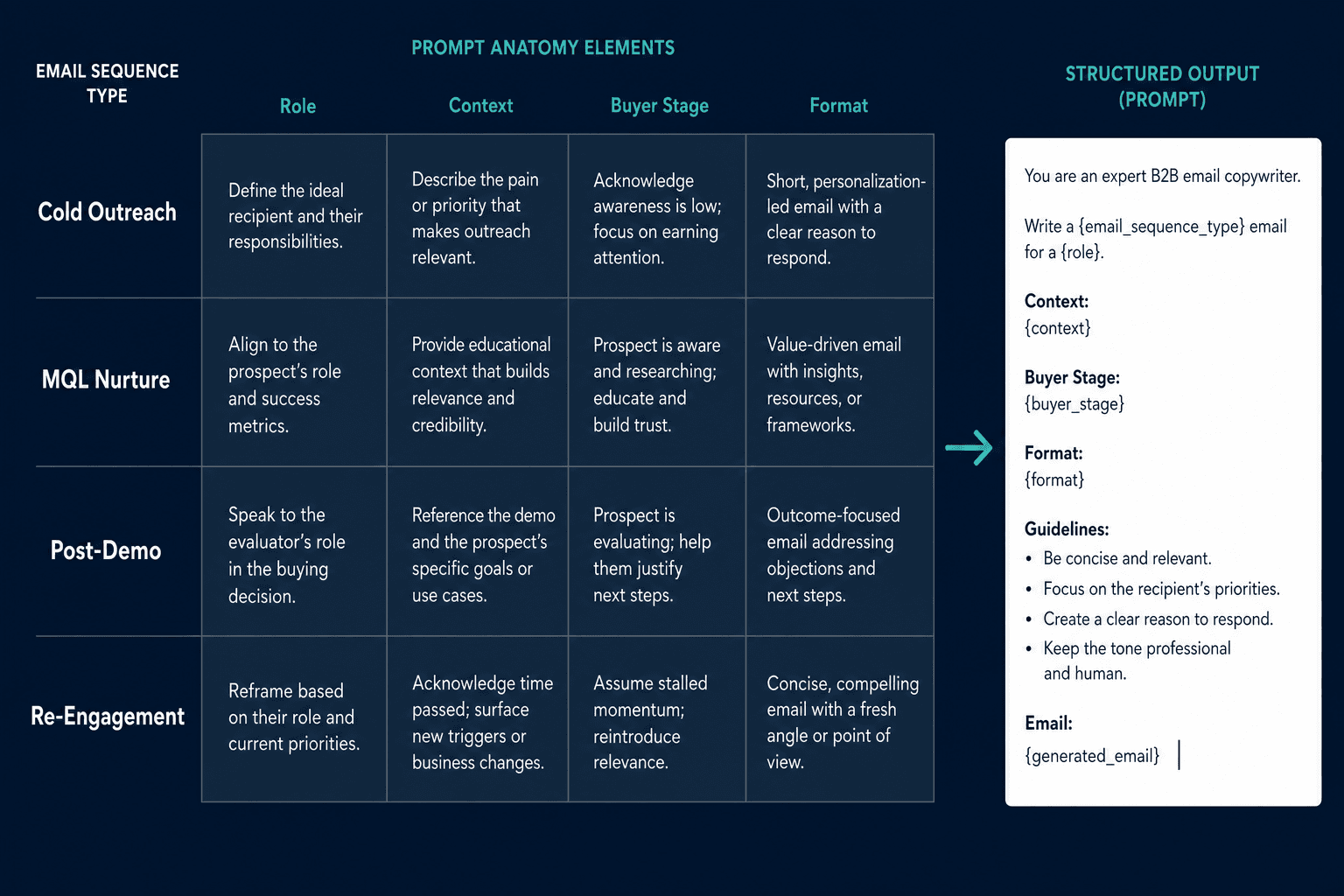
Cold Outreach Sequence Prompts: Awareness-Gap Architecture
Cold outreach prompts require awareness-gap architecture because the recipient has no prior relationship with you and may not be actively looking for a solution. The AIDA structure (Attention, Interest, Desire, Action) and the 3x3 format (three sentences on three relevant points) both work well here because they force the email to earn attention before asking for anything.
A practical calibration point: according to sequence performance data from Outreach's customer base, cold outbound sequences see an 8–15% reply rate and a 1–3% meeting rate. These are Outreach platform-specific figures, not universal benchmarks, but they're useful for calibrating sequence length expectations. Most replies arrive at emails 3–5, not email 1 — which means the first email's job is to open a door, not close a deal. The breakup email (email 5) frequently generates the highest reply rate of the sequence.
The five-email arc below covers: initial contact, value-add, social proof, angle-shift, and breakup. Each prompt is anchored to its position in the arc.
Email 1 — Initial Contact (Day 0)
[ROLE] You are a B2B SaaS demand generation manager writing on behalf of [your name and company].

[SEQUENCE TYPE] This is email 1 of a 5-email cold outreach sequence using AIDA structure. The goal is to earn a second read, not to book a meeting.

[BUYER STAGE SIGNAL] The recipient is [job title] at a [company size and industry] company. They have had no prior contact with us. They are likely experiencing [specific operational pain point relevant to your product] but are not actively evaluating solutions.

[FORMAT] One email. Subject line under 8 words. Opening line references a specific challenge — no compliments, no "I hope this finds you well." Body: 80–100 words. CTA: offer a single useful resource (a guide, a relevant case study, or a short article) — not a meeting request. No bullet points.
Email 2 — Value-Add (Day 3)
[ROLE] You are a B2B SaaS demand generation manager following up on a cold outreach email sent 3 days ago.

[SEQUENCE TYPE] This is email 2 of a 5-email cold outreach sequence. The first email introduced a challenge; this email delivers standalone value without referencing the prior email directly.

[BUYER STAGE SIGNAL] The recipient is [job title] at a [company size and industry] company. They did not reply to email 1. Assume they saw it but were not compelled to respond. They are still unaware of our solution.

[FORMAT] One email. Subject line under 8 words (different angle from email 1). Body: 80–100 words. Lead with a specific insight, data point, or short observation relevant to their role — not a product pitch. CTA: invite a reaction or ask a single yes/no question. No bullet points.
Email 3 — Social Proof (Day 7)
[ROLE] You are a B2B SaaS demand generation manager on the third touch of a cold outreach sequence.

[SEQUENCE TYPE] This is email 3 of a 5-email cold outreach sequence. The goal is to introduce credibility through a relevant customer outcome — not to pitch features.

[BUYER STAGE SIGNAL] The recipient is [job title] at a [company size and industry] company. They have not replied to two prior emails. They are still in an unaware or passive stage. Introduce social proof from a similar company or role.

[FORMAT] One email. Subject line under 8 words. Body: 80–100 words. Lead with a one-sentence customer outcome from a similar company or role (do not fabricate — use a real customer name or describe the company type). CTA: offer to share the full case study or a 2-minute overview. No bullet points.
Email 4 — Angle Shift (Day 10)
[ROLE] You are a B2B SaaS demand generation manager on the fourth touch of a cold outreach sequence.

[SEQUENCE TYPE] This is email 4 of a 5-email cold outreach sequence. The prior three emails addressed [primary pain point]. This email shifts to a secondary pain point or a different stakeholder angle — the goal is to find the frame that resonates.

[BUYER STAGE SIGNAL] The recipient has not replied to three emails. They may have a different priority than what was assumed. Shift the frame to [secondary pain point or alternative business impact angle].

[FORMAT] One email. Subject line under 8 words — different from all prior subjects. Body: 60–80 words. Acknowledge the shift in angle briefly ("I've been coming at this from [angle] — let me try a different one"). CTA: ask a direct yes/no question about whether the new angle is relevant. No bullet points.
Email 5 — Breakup (Day 14–28)
[ROLE] You are a B2B SaaS demand generation manager sending the final email in a cold outreach sequence.

[SEQUENCE TYPE] This is email 5 of a 5-email cold outreach sequence — the breakup email. The goal is to close the loop respectfully and leave a positive impression. This email frequently generates the highest reply rate in the sequence.

[BUYER STAGE SIGNAL] The recipient has not replied to four prior emails. They may be uninterested, or the timing may be wrong. Do not assume disinterest — assume bad timing.

[FORMAT] One email. Subject line under 6 words — make it honest (e.g., "Closing the loop" or "Last one from me"). Body: 50–70 words. State clearly that this is the last email. Leave the door open without pressure. Offer one final resource or observation. No CTA beyond "let me know if timing changes." No bullet points.| Position | Architecture Goal | CTA Type | |
|---|---|---|---|
| 1 — Initial Contact | Day 0 | Open a door; reference a specific challenge | Resource offer |
| 2 — Value-Add | Day 3 | Deliver standalone value; no product pitch | Reaction invite or yes/no question |
| 3 — Social Proof | Day 7 | Introduce credibility through customer outcome | Case study or overview offer |
| 4 — Angle Shift | Day 10 | Try a different pain point or stakeholder frame | Direct yes/no relevance check |
| 5 — Breakup | Day 14–28 | Close the loop; leave door open without pressure | Passive — "let me know if timing changes" |
MQL Nurture Sequence Prompts: Education-First Architecture
MQL nurture prompts operate on completely different logic than cold outreach. The prospect has already demonstrated interest — they downloaded a guide, attended a webinar, or engaged with content. They are problem-aware but not yet solution-ready. Pushing for a sales conversation too early will kill the relationship.
Education-first architecture (sometimes called the Problem-Aware Nurture framework) structures the sequence as a content series rather than a drip campaign. Each email should stand alone — a reader who misses email 2 should still get full value from email 3. The practical calibration is a 70/30 split: 70% educational content, 30% product-adjacent framing. Flip that ratio and the sequence starts to feel like a sales drip.
Nurture sequences typically run longer than cold outreach — Cognism's sequence guidance suggests 7–10 emails for lead nurture versus 4–5 for cold outreach. The five-email arc below covers the core structure; you can extend it with additional educational emails before the conversion CTA.
Email 1 — Content Delivery + Quick Win (Day 0)
[ROLE] You are a B2B content strategist writing on behalf of [company name]. Your tone is consultative and educational — not salesy.

[SEQUENCE TYPE] This is email 1 of a 5-email MQL nurture sequence triggered by a content download. The goal is to deliver the promised resource and give the reader one immediately actionable insight they can use today.

[BUYER STAGE SIGNAL] The recipient just downloaded [specific content asset name]. They are problem-aware — they know [problem category] is a challenge — but they are not evaluating solutions yet. They have had no sales contact.

[FORMAT] One email. Subject line: reference the content they downloaded. Body: 100–120 words. Deliver the resource link clearly. Add one "quick win" — a specific, actionable tip they can apply immediately without needing your product. Close with a soft mention of what the next email in the series will cover. No sales language. No CTA beyond "here's your resource."
Email 2 — Problem Deepening (Day 5–7)
[ROLE] You are a B2B content strategist continuing a nurture sequence for [company name].

[SEQUENCE TYPE] This is email 2 of a 5-email MQL nurture sequence. Email 1 delivered the content asset and a quick win around [specific topic]. This email deepens the problem — it goes one layer further into why [problem] is harder to solve than it looks.

[BUYER STAGE SIGNAL] The recipient downloaded [content asset] and received email 1. They are still in a research and education phase. They have not requested a demo or sales contact. Continue the conversation about [specific challenge from email 1] — reference it explicitly.

[FORMAT] One email. Subject line: frame it as a deeper look at the same topic. Body: 100–130 words. Introduce one complication or nuance that the original content didn't cover. This should feel like a follow-up from a knowledgeable peer, not a marketing email. No product pitch. Soft close: mention that the next email will introduce how other companies are approaching this.
Email 3 — Solution Introduction (Day 10–12)
[ROLE] You are a B2B content strategist continuing a nurture sequence for [company name].

[SEQUENCE TYPE] This is email 3 of a 5-email MQL nurture sequence. Emails 1 and 2 established the problem and deepened it. This email introduces the category of solution — not a product pitch, but a framing of how the problem is typically solved by companies that have addressed it successfully.

[BUYER STAGE SIGNAL] The recipient has been engaged with educational content about [problem area]. They are beginning to move from problem-awareness to solution-awareness. This is the first email in the sequence that mentions our product — briefly and in context, not as the main point.

[FORMAT] One email. Subject line: frame around how companies solve [problem]. Body: 110–130 words. Lead with how the problem is typically addressed (category-level, not product-level). Mention [company name] and what we do in one sentence — positioned as one approach among several. CTA: offer a relevant case study or a short explainer. Do not use "book a demo" or "schedule a call" as the CTA.
Email 4 — Case Study (Day 15–17)
[ROLE] You are a B2B content strategist continuing a nurture sequence for [company name].

[SEQUENCE TYPE] This is email 4 of a 5-email MQL nurture sequence. This email delivers social proof through a customer story relevant to the recipient's industry or role.

[BUYER STAGE SIGNAL] The recipient has received three educational emails and is now solution-aware. They may be beginning to evaluate options. The case study should feature a company similar to theirs in size, industry, or the specific challenge they face.

[FORMAT] One email. Subject line: reference the customer company or the outcome. Body: 100–120 words. Lead with the customer's situation before your product was involved. State the outcome in one specific sentence (use a real metric or qualitative result — do not fabricate). Mention the solution briefly. CTA: offer the full case study or a short video walkthrough. End with a soft availability mention: "Happy to share more if this is relevant to what you're working on."
Email 5 — Conversion CTA (Day 20–22)
[ROLE] You are a B2B content strategist and demand generation manager writing the conversion email in a nurture sequence for [company name].

[SEQUENCE TYPE] This is email 5 of a 5-email MQL nurture sequence — the first email with a direct conversion CTA. Prior emails have been educational; this email makes a clear ask.

[BUYER STAGE SIGNAL] The recipient has received four emails covering [problem], [deepened challenge], [solution category], and [customer case study]. They are now solution-aware and have had time to evaluate. This is the appropriate moment for a direct CTA.

[FORMAT] One email. Subject line: direct and specific — reference what you're offering. Body: 80–100 words. Briefly acknowledge the journey ("Over the past few weeks I've shared..."). Make a single, clear ask — a demo, a trial, or a specific conversation. Give them one reason why now is a good time. No bullet points. No list of features. One CTA only.| Position | Architecture Goal | Educational / Product Ratio | |
|---|---|---|---|
| 1 — Delivery + Quick Win | Day 0 | Deliver resource; build trust with immediate value | 100% educational |
| 2 — Problem Deepening | Day 5–7 | Deepen problem awareness; feel like a peer conversation | 100% educational |
| 3 — Solution Introduction | Day 10–12 | Introduce solution category; mention product briefly | 80% educational / 20% product |
| 4 — Case Study | Day 15–17 | Social proof from a similar company or role | 60% educational / 40% product |
| 5 — Conversion CTA | Day 20–22 | Direct ask — demo, trial, or specific conversation | 30% educational / 70% product |
Post-Demo Follow-Up Prompts: Objection-Preemption Architecture
Post-demo follow-up is the sequence type most commonly handled with generic templates — and the one where generic output does the most damage. A prospect who just sat through your demo is not at the beginning of their awareness journey. They're in an internal evaluation process, likely involving multiple stakeholders, and the emails you send after the demo either support that process or interfere with it.
The critical framing, supported by post-demo sequence guidance from Sequenzy: the goal of this sequence is to support the buyer's internal process, not to push for a close. Prompts that frame the AI as helping the buyer build their internal case produce structurally different output than prompts that frame the AI as pushing toward a decision.
The Objection-Preemption framework structures each email around one specific objection. Bundling multiple objections into a single email reduces conversion — the reader's attention splits and nothing gets resolved. One email, one objection, one resolution.
Email 1 — Same-Day Recap (Same Day)
[ROLE] You are an account executive or demand generation manager at [company name] following up immediately after a product demo.

[SEQUENCE TYPE] This is email 1 of a 5-email post-demo follow-up sequence. The goal is to confirm shared understanding from the demo and make it easy for the buyer to share the recap internally.

[BUYER STAGE SIGNAL] The recipient just completed a [duration] product demo. They are actively evaluating solutions. They may need to share the outcome of this demo with [finance / IT / their manager / other stakeholders]. This email should be easy to forward.

[FORMAT] One email. Subject line: reference the demo specifically ("Following up from today's demo"). Body: 100–120 words. Summarize the three main points discussed — use the actual topics from the demo, not generic placeholders. State the agreed next step clearly. Offer to provide any additional materials the buyer needs for internal review. No sales pressure. No urgency language.
Email 2 — Internal Champion Support (Day 2)
[ROLE] You are an account executive at [company name] supporting a prospect through their internal evaluation process.

[SEQUENCE TYPE] This is email 2 of a 5-email post-demo follow-up sequence. This email supports the internal champion — the person who attended the demo — in making the case to their colleagues or leadership.

[BUYER STAGE SIGNAL] The recipient attended the demo and is likely the internal advocate. They need to justify the evaluation to [finance / IT / their manager]. They may not have done this yet. This email gives them tools to do it.

[FORMAT] One email. Subject line: frame it as a resource for their internal process ("A few things that might help with your internal review"). Body: 100–120 words. Offer one or two specific assets: an ROI one-pager, a security overview, a competitive comparison, or a reference customer they can speak with. Frame each as "in case it's useful for your team." No sales pressure. No urgency. No "let me know when you're ready to move forward."
Email 3 — Objection Pre-Emption (Day 5)
[ROLE] You are an account executive at [company name] addressing a specific objection that commonly arises during the evaluation stage.

[SEQUENCE TYPE] This is email 3 of a 5-email post-demo follow-up sequence. This email addresses one specific objection — [choose one: implementation timeline / ROI justification / competitive comparison / security and compliance]. Do not address multiple objections in one email.

[BUYER STAGE SIGNAL] The prospect is in active evaluation. They have seen the demo and are likely encountering internal resistance around [chosen objection]. This email anticipates that objection and addresses it proactively — before they raise it.

[FORMAT] One email. Subject line: reference the concern directly but not alarmingly (e.g., "On implementation timelines" or "A note on ROI"). Body: 100–130 words. State the objection plainly in the first sentence. Address it with one specific piece of evidence — a timeline, a data point, a customer example. Offer to discuss further. No pressure language.
Email 4 — Progress Check (Day 10)
[ROLE] You are an account executive at [company name] checking in on an active evaluation.

[SEQUENCE TYPE] This is email 4 of a 5-email post-demo follow-up sequence. The goal is to stay visible without adding pressure — and to surface any new obstacles that have emerged in the evaluation process.

[BUYER STAGE SIGNAL] The prospect is approximately 10 days into their evaluation. Internal discussions may have introduced new questions or stakeholders. This email opens a door for them to share where things stand.

[FORMAT] One email. Subject line: neutral and direct ("Checking in" or "How's the evaluation going?"). Body: 60–80 words. Ask one open question about where they are in the process. Offer to help with anything that's come up. Do not recap the product. Do not introduce new features or offers. This email is about listening, not selling.
Email 5 — Decision Nudge (Day 14+)
[ROLE] You are an account executive at [company name] sending a gentle decision nudge at the end of a post-demo follow-up sequence.

[SEQUENCE TYPE] This is email 5 of a 5-email post-demo follow-up sequence. The goal is to surface a decision or a clear next step — without ultimatums or artificial urgency.

[BUYER STAGE SIGNAL] The prospect has been in evaluation for approximately two weeks. A decision may be imminent, delayed, or stalled for reasons you don't yet know. This email creates an opening for an honest conversation about where things stand.

[FORMAT] One email. Subject line: honest and direct ("Where do things stand?" or "Happy to help move this forward"). Body: 70–90 words. Acknowledge the evaluation timeline. Ask directly whether they're still on track to make a decision, or whether something has changed. Offer to adjust the approach if needed (extend a trial, bring in a technical resource, schedule a call with a reference customer). One clear ask at the end.| Timing | Architecture Goal | Objection / Stakeholder Focus | |
|---|---|---|---|
| 1 — Same-Day Recap | Same day | Confirm shared understanding; easy to forward internally | None — alignment only |
| 2 — Internal Champion Support | Day 2 | Equip the champion to make the internal case | Internal stakeholders (finance, IT, leadership) |
| 3 — Objection Pre-Emption | Day 5 | Address one specific objection proactively | ROI / timeline / competitive / security (pick one) |
| 4 — Progress Check | Day 10 | Stay visible; surface new obstacles | Open — let the buyer lead |
| 5 — Decision Nudge | Day 14+ | Surface a decision or clear next step without pressure | Decision-maker or evaluation lead |
Re-Engagement and Closed-Lost Prompts: Signal-Based Architecture
Re-engagement prompts have a specific failure mode: they're almost always too generic. "Just checking in to see if your priorities have changed" produces AI output that is indistinguishable from the last re-engagement email the prospect already ignored.
The differentiator is a trigger event. Prompts that include a specific, observable signal — a job change, a funding round, a tech stack change, a competitor announcement — produce AI drafts with a concrete reason for reaching out. Without a trigger, the email is asking for attention without justifying it.
The Signal-Based Re-engagement framework from Autobound structures these emails in three parts: reference the specific trigger event, connect it to a pain point your product addresses, and offer something useful — not a meeting request. The CTA should be low-friction.
Re-Engagement Prompt — Trigger-Event Version
[ROLE] You are a B2B demand generation manager at [company name] re-engaging a prospect who went dark [X months ago] after [describe last interaction: a demo, a proposal, a trial, or early-stage conversations].

[SEQUENCE TYPE] This is a single re-engagement email using signal-based architecture. A specific trigger event has occurred that makes re-engaging relevant and justified.

[BUYER STAGE SIGNAL] The prospect previously evaluated [your product/category] but did not convert. Since then, [specific trigger event: they changed jobs / their company raised a funding round / they announced a new initiative / a competitor they were using made a significant change]. This trigger is the reason for reaching out — not a generic check-in.

[FORMAT] One email. Subject line: reference the trigger event specifically (not generically). Body: 80–100 words. Structure: (1) acknowledge the trigger event in the first sentence — be specific; (2) connect it to the challenge your product addresses in one sentence; (3) offer something useful — a relevant case study, a short update on what's changed with your product, or a specific insight — not a meeting request. CTA: low-friction ("Worth a quick conversation?" or "Happy to share what's changed if it's relevant"). No urgency language.
To make the contrast concrete: here's what a generic re-engagement prompt produces versus a trigger-event prompt.
| Prompt Type | Sample Output Opening | Why It Fails or Works |
|---|---|---|
| Generic re-engagement | "I wanted to reach out and see if your priorities have shifted since we last spoke..." | No reason for reaching out now. Feels like a mass send. Easy to ignore. |
| Trigger-event re-engagement | "Saw that [Company] just announced [funding round / new initiative] — congratulations. Given what you were evaluating last year around [challenge], I thought this timing might be relevant." | Demonstrates awareness of their situation. Gives the reader a specific reason why now. Harder to dismiss. |
Closed-Lost Re-Engagement Prompt
[ROLE] You are a B2B demand generation manager at [company name] reaching out to a prospect whose deal was marked closed-lost [X months ago].

[SEQUENCE TYPE] This is a single closed-lost re-engagement email. The prospect chose a competitor or decided not to move forward. This email does not relitigate the original evaluation — it acknowledges time has passed and offers something new.

[BUYER STAGE SIGNAL] The prospect chose [competitor / no decision] approximately [X months] ago. Common reasons for re-engagement at this stage: the chosen solution didn't work out, their team or budget situation changed, or a new stakeholder is now involved. The trigger event is [specific signal if known — otherwise, describe the time-based reason: "it's been 6 months, which is often when initial implementations are being assessed"].

[FORMAT] One email. Subject line: honest and low-pressure ("Checking in — no agenda" or "A quick note, [X] months later"). Body: 70–90 words. Do not mention the lost deal directly or ask why they chose the competitor. Acknowledge the time. Reference one specific thing that has changed about your product or company since the evaluation. Offer one useful thing — not a meeting. CTA: "Happy to share what's new if it's worth a look" or similar. No urgency.
The Prompt Iteration Loop: Testing One Variable at a Time
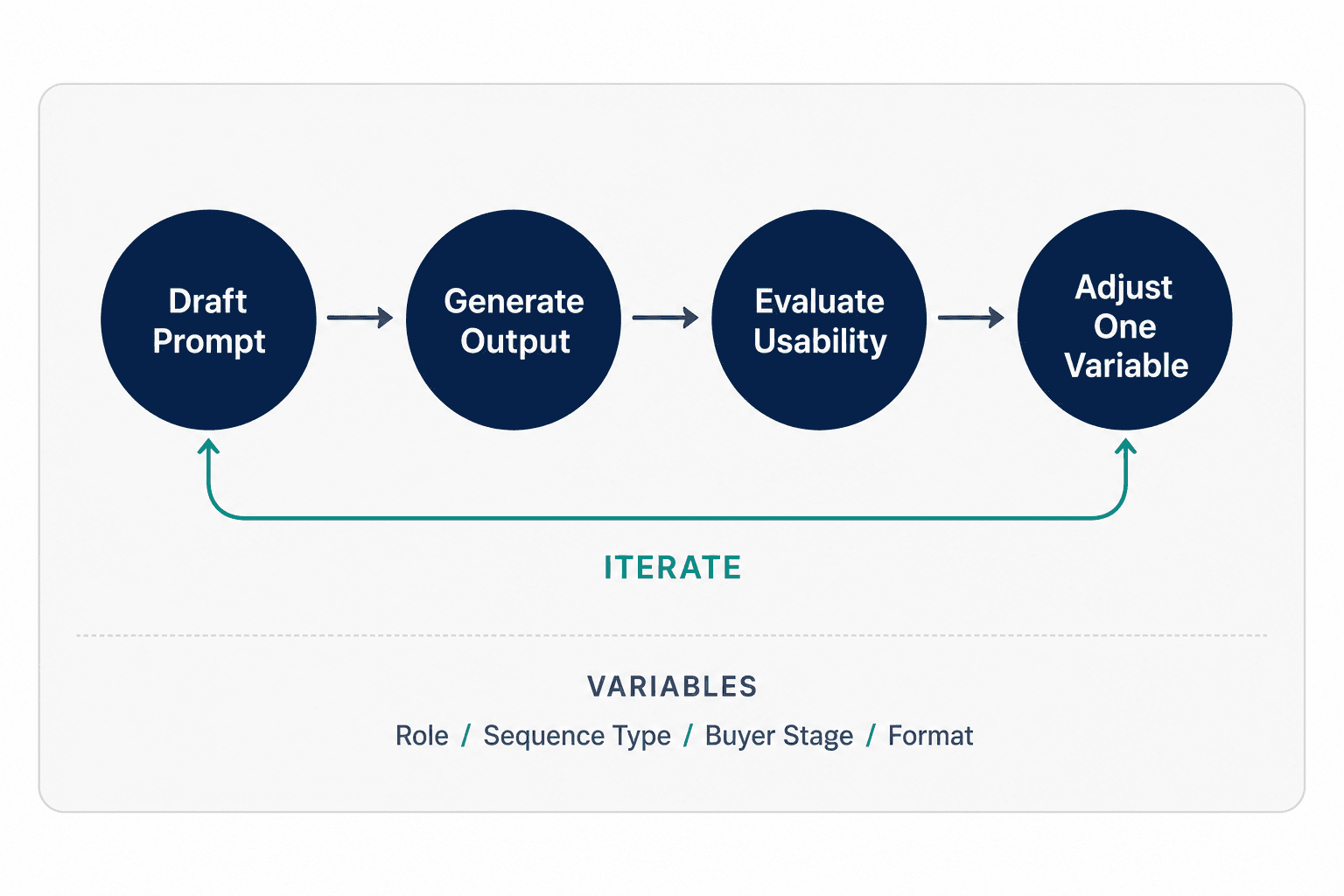
Prompt refinement works like A/B testing: change one variable per iteration, evaluate the output, and adjust based on what you observe. Changing multiple elements simultaneously makes it impossible to know what improved the result.
The four testable variables in any B2B email prompt correspond directly to the four anatomy elements:
- Role framing: Change the seniority, department, or company type of the role assignment. A "demand generation manager" produces different output than a "senior account executive" or a "VP of Marketing." Test which role produces output that matches your actual voice.
- Sequence type declaration: Adjust the specificity of the sequence context. "Email 3 of a 5-email cold outreach sequence" is more constraining than "a follow-up cold email." More specificity usually produces more structurally appropriate output.
- Buyer stage signal: Change the description of the recipient's situation. Add or remove details about their company size, industry, likely pain points, or prior interactions. This variable has the largest impact on output relevance.
- Format constraint: Adjust word count, CTA type, structure instructions, or tone direction. If the AI consistently produces output that's too long, add a hard word count. If the CTA is too aggressive, specify the exact CTA type.
The iteration workflow is straightforward:
- Draft the prompt using all four anatomy elements.
- Generate the output and evaluate it against one criterion: how much rewriting does it require before you'd send it?
- Identify which element of the prompt is most likely responsible for the gap between the output and what you need.
- Adjust that one element only. Keep everything else identical.
- Generate again and compare. Repeat until the output is usable with minimal rewriting.
Quick-Start Checklist and Common Prompt Mistakes
Before running any prompt from this guide, confirm the minimum viable setup for your sequence type:
- Cold outreach: Role defined. Sequence type declared with email position (e.g., "email 3 of 5"). Recipient described as unaware with no prior contact. Format constrained to 80–100 words and one resource-offer CTA.
- MQL nurture: Role defined as consultative, not sales. Content asset named explicitly. Prior email topic referenced for continuity. Format constrained with educational-to-product ratio appropriate to email position.
- Post-demo follow-up: Role defined as supporting the buyer's internal process. One objection only per email (email 3). Timing declared. No urgency or pressure language in format constraint.
- Re-engagement: Specific trigger event supplied (not generic). Three-part structure declared: signal acknowledgment, relevance bridge, low-friction CTA. No meeting request in the CTA.
| Common Mistake | Likely Failure Mode | The Fix |
|---|---|---|
| Omitting sequence type declaration | AI defaults to a generic follow-up email with no structural logic | Declare the sequence type and email position explicitly in every prompt |
| Using B2C framing ("customer," "purchase," "offer") | Output uses transactional language inappropriate for B2B sales cycles | Use B2B terminology: "prospect," "evaluation," "stakeholder," "internal process" |
| Bundling multiple objections in a post-demo email | Output addresses all objections superficially; none are resolved | Constrain each objection-preemption email to one specific objection |
| Generic re-engagement prompt without a trigger event | Output sounds like a mass check-in; easy to ignore | Supply a specific trigger event — job change, funding, competitor signal, or time-based framing |
| No word count or format constraint | AI produces 250-word emails that require cutting before they're usable | Specify word count, CTA type, and structural constraints in every prompt |
| Asking the AI to "sound human" without a role | Output is generically professional but matches no specific voice | Assign a specific role with company context, industry, and seniority level |
| Using the same prompt for emails 2–5 in a nurture sequence | Sequence feels like a drip campaign, not a content series; no continuity | Reference the prior email's topic explicitly in each follow-up prompt |

Comments
Join the discussion with an anonymous comment.