
Programmatic Display AI Targeting in 2026: Contextual vs. Behavioral Decision Guide
A practitioner decision framework for paid media managers and demand generation leads who need to choose between AI-powered contextual targeting, behavioral targeting, and hybrid approaches in a cookieless, privacy-regulated programmatic environment — with honest tradeoffs, a campaign-goal matrix, and platform-agnostic setup guidance.
The 2026 Targeting Inflection Point
US programmatic display is on track to exceed $203 billion in 2026, representing roughly 92% of all US digital display ad spend and a 12.5% year-over-year increase, according to Basis and eMarketer data. The channel is growing. The targeting infrastructure it depends on is not.
Google's April 2025 reversal on Chrome cookie deprecation generated significant industry commentary, but the underlying problem remained. As the Basis 2026 programmatic report frames it plainly, the reversal "did little to resolve the broader challenges associated with signal loss." For most advertisers, declining data quality and shrinking addressable audiences are daily operational realities regardless of browser policy.
The scale of the problem is structural. Over 75% of global internet traffic now flows through environments where third-party cookies are limited or unavailable. Safari, Firefox, and most mobile in-app environments have been effectively cookieless for years. Chrome's partial reversal did not change those environments.
At the same time, AI-powered contextual targeting has matured in ways that change the strategic calculus. It is no longer a fallback when behavioral data is unavailable. For many campaign types, it is now the more defensible primary approach.
But that does not mean contextual always wins. The choice between contextual targeting, behavioral targeting, and hybrid approaches is not a permanent strategic preference — it is a campaign-level decision that depends on what you are trying to accomplish, what data infrastructure you actually have, and what regulatory environment you operate in.
How AI Transformed Contextual Targeting
Legacy contextual targeting worked by matching keywords or IAB content categories to ad placements. A travel advertiser blocked placements containing "accident" and targeted placements containing "vacation." The system was blunt, brittle, and easy to game.
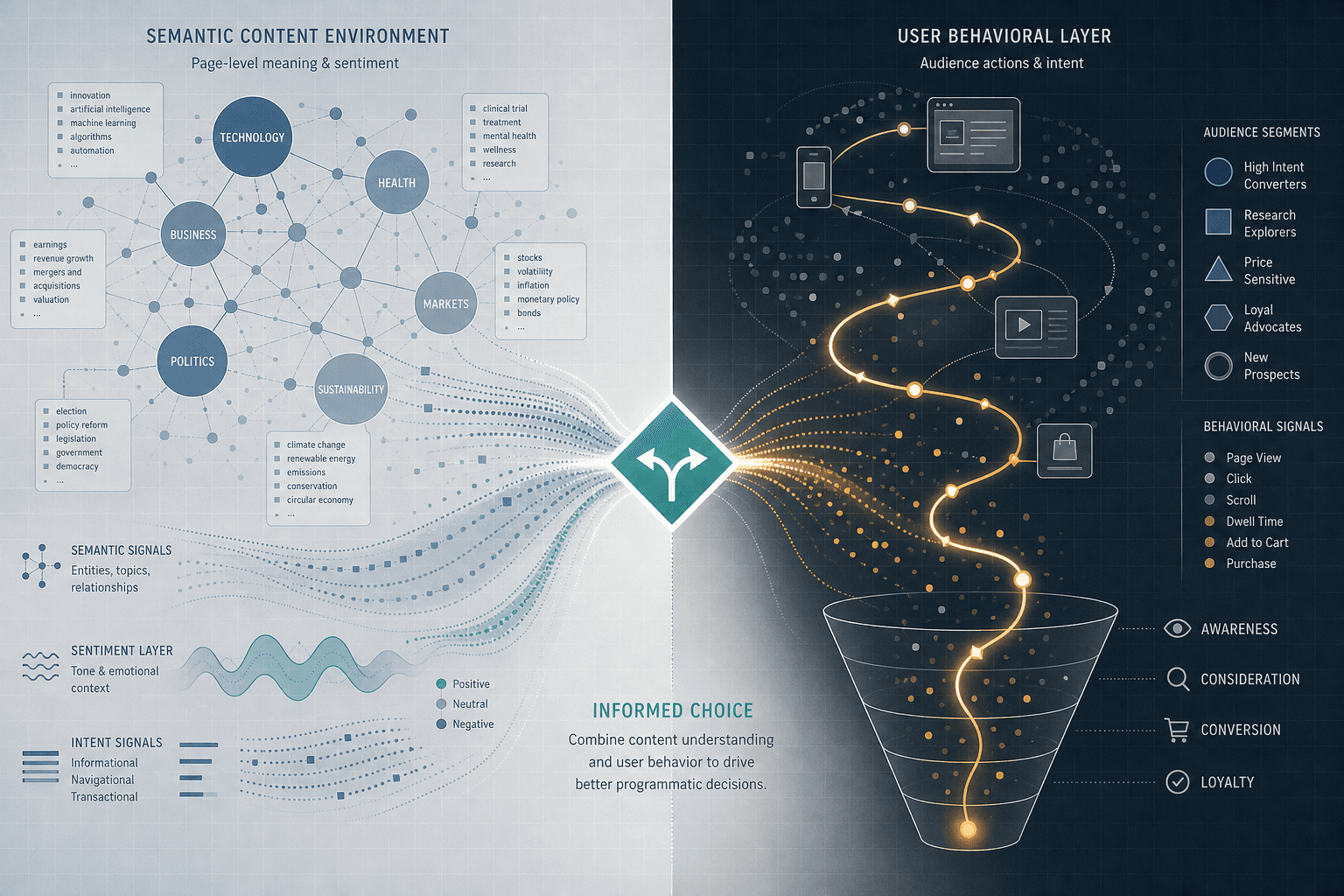
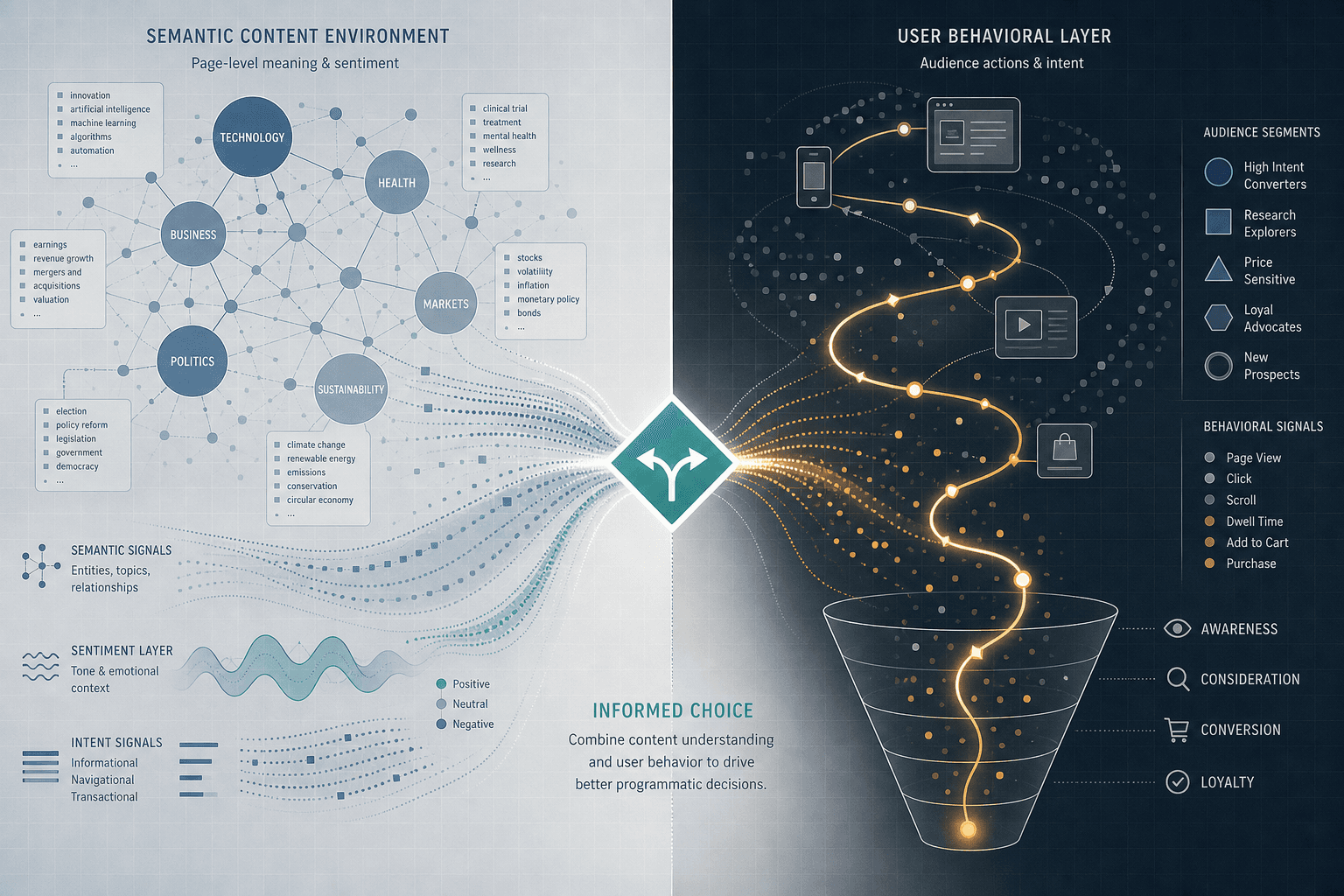
Modern AI-powered contextual targeting operates at a different level entirely. Rather than matching keywords, it analyzes the meaning, tone, structure, and intent of content in real time — evaluating the advertising environment itself, not just surface-level text. Natural language processing models assess semantic relationships between words and phrases. Sentiment detection identifies whether surrounding content is positive, negative, cautionary, or celebratory. Visual and video content analysis extends contextual signals beyond text. And all of this happens in milliseconds at bid time.
The practical implication: the system can distinguish between an article about Apple the brand and an article about apple orchards. It can recognize that a financial news piece framing market volatility as an opportunity reads differently — and delivers a different advertising environment — than one framing the same data as a crisis. These are distinctions that keyword matching cannot make.
- Semantic analysis: NLP models interpret meaning and context, not just word presence — enabling accurate placement even on long-form, mixed-topic content.
- Sentiment detection: AI evaluates the emotional tone of content, allowing advertisers to avoid negative sentiment environments even when the topic itself seems relevant.
- Visual and video understanding: Contextual signals extend to image and video content, not just page text — important for CTV and rich media environments.
- Real-time intent interpretation: AI contextual systems weight signals dynamically in bid decisions rather than relying on pre-classified inventory buckets that may be days or weeks stale.
- Continuous optimization: The system learns which content environments drive the performance signals you care about and shifts budget toward them over time — without needing user-level data to do it.
The consequence for performance stability is significant. Because AI contextual targeting optimizes environments rather than users, it does not degrade as third-party identifiers disappear. The signal it relies on — content itself — remains available regardless of browser policy, privacy regulation, or consent rates.
Behavioral Targeting in 2026: Where It Still Works and Where It Fails
Behavioral targeting is not dead. Framing it that way would be wrong, and experienced practitioners would recognize it immediately as an overclaim.
What is accurate is this: behavioral targeting in 2026 is functionally limited to use cases where the advertiser owns and structures the underlying data. Third-party behavioral pools — the audience segments built from cross-site tracking data that powered a decade of programmatic targeting — are unreliable, shrinking, and increasingly unusable at scale.
The first-party data alternative is real, but the gap between aspiration and operational reality is wide. Fewer than one in five industry professionals describe their first-party data as extensive and well-structured, with 34% characterizing it as limited or disconnected. For most advertisers, high-quality behavioral targeting at scale requires data infrastructure investment that has not yet happened.
Where behavioral targeting remains genuinely strong:
- Cart abandonment retargeting: Users who added items to a cart and did not complete purchase — a high-intent, first-party signal that justifies the retargeting investment.
- CRM-based audience activation: Hashed email lists from owned CRM systems, onboarded to a DSP via identity resolution — strong signal quality because you know exactly who these people are.
- Post-purchase upsell and loyalty targeting: Existing customers with known purchase history and product affinity — behavioral signals that are both accurate and permission-based.
- Account-based marketing with known prospects: B2B campaigns where target accounts are pre-defined and matched against first-party or publisher data — a legitimate behavioral use case that does not depend on third-party pools.
What these use cases share: the advertiser owns the underlying behavioral signal. They are not purchasing audience segments built from someone else's tracking data. That distinction is the operational boundary for behavioral targeting in 2026.
It is worth noting that first-party behavioral signals do not have to originate in your ad tech stack. Email engagement data — open rates, click patterns, product interest signals — can feed into CRM-based retargeting audiences for programmatic display. How AI-powered email personalization builds and activates those first-party signals is a related challenge; B2C AI email personalization case study results from ecommerce and DTC brands illustrates how that first-party signal activation works in an adjacent channel context.
Head-to-Head: Six Dimensions That Actually Matter
The comparison below draws on available research, but a methodological note is required before reading it: most of the performance data in this space is vendor-reported or from single-source commissioned studies. The Dentsu Aegis eCPM and CPC figures were cited in a Peer39 study. The brand recall data comes from a GumGum-commissioned Nielsen study. The audience accuracy comparison comes from Xapads' own campaign data. None of these should be treated as industry consensus. They are directionally useful but not independently validated at scale.
| Dimension | AI Contextual Targeting | First-Party Behavioral Targeting |
|---|---|---|
| Performance stability | Stable and improving — optimizes environments, not users, so performance does not degrade as identifiers disappear | High for well-structured first-party audiences; degrades sharply if relying on third-party pools or stale CRM data |
| Audience scale | High — operates across all cookieless environments including Safari, Firefox, and most mobile in-app inventory | Limited by the size and quality of owned first-party data; third-party behavioral audiences have shrunk significantly since 2023 |
| Privacy compliance | Strong by default — no user-level tracking required; works in GDPR and CPRA environments without consent dependency | Requires explicit consent frameworks, data processing agreements, and clean room infrastructure for cross-platform activation |
| Cost structure | One Dentsu Aegis study cited by Peer39 found contextual eCPM 36% lower and CPC 48% lower than comparable cookie-based targeting — treat as directional, not definitive | Higher infrastructure costs for first-party data onboarding, identity resolution, and CRM integration; lower CPMs possible with tight audience match rates |
| Brand safety control | High — advertiser controls which content environments ads appear alongside; sentiment thresholds and topic exclusions are configurable at the campaign level | Lower direct control — ad placement is determined by where the user goes, not by content environment quality; brand safety relies on DSP-level blocklists |
| Measurement reliability | Requires environment-level signals (content category performance, PMP deal quality, attention metrics); last-click attribution systematically undervalues upper-funnel contextual placements | Better for lower-funnel attribution when conversion events are trackable; still affected by cross-device gaps and consent-based measurement loss |
A separate data point worth noting: one GumGum and Nielsen study cited by AI Digital found 69% higher prompted brand recall when rich media ads were placed in contextually relevant environments. This is a brand recall metric, not a conversion metric, and the study was commissioned by a contextual vendor — weight it accordingly. But the directional finding aligns with the brand safety and environment-quality argument for contextual.
The Decision Framework: Matching Targeting Method to Campaign Reality
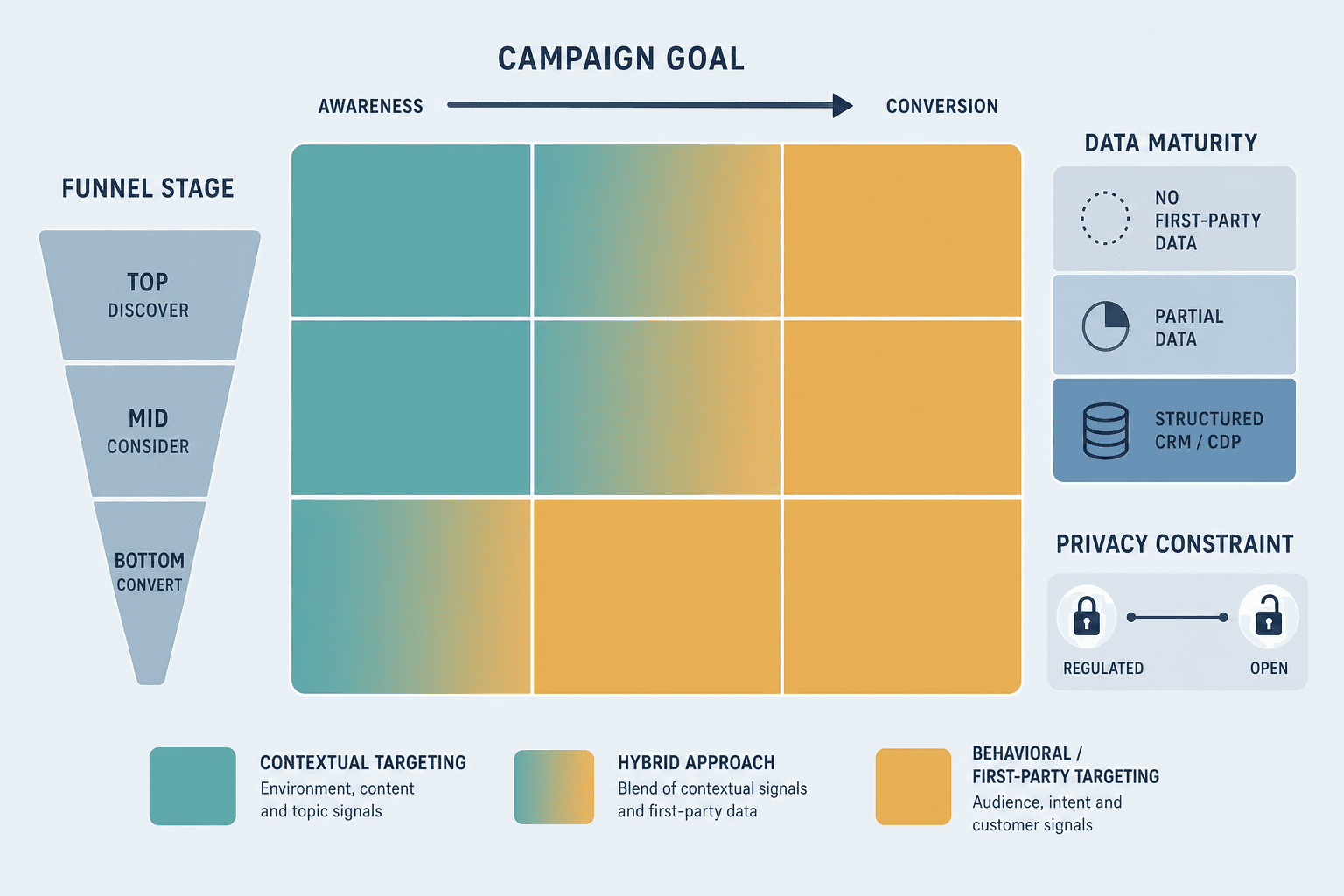
The matrix below is the article's primary practical output. It maps targeting approach to four variables: campaign goal, funnel stage, data maturity, and privacy constraints. Use it as a starting point for structuring campaign decisions — not as a permanent rule. Every cell reflects a default recommendation that should be adjusted based on your specific context, testing results, and data infrastructure.
| Campaign Goal | Funnel Stage | Data Maturity | Privacy Constraints | Recommended Approach |
|---|---|---|---|---|
| Brand awareness | Upper funnel | Any | Any | Contextual — primary layer. No first-party data required. Stable at scale across cookieless inventory. |
| Consideration / engagement | Mid funnel | No or limited first-party data | Any | Contextual — primary layer with topic cluster refinement based on early performance signals. |
| Consideration / engagement | Mid funnel | Partial or structured CRM | Standard | Hybrid — contextual prospecting with first-party behavioral suppression (exclude existing customers) and lookalike modeling where available. |
| Conversion / direct response | Lower funnel | Structured CRM or CDP | Standard | First-party behavioral retargeting — CRM onboarding, hashed identifier activation, tight frequency caps. |
| Conversion / direct response | Lower funnel | No or limited first-party data | Any | Contextual with high-intent topic clusters and PMP deal curation. Do not attempt behavioral retargeting without the data infrastructure to support it. |
| Retargeting (cart abandonment, upsell) | Lower funnel | First-party transaction data | Standard | First-party behavioral — highest signal quality use case for behavioral targeting in 2026. |
| Any goal | Any stage | Any | Regulated industry (healthcare, finance) or GDPR/CPRA market | Contextual — default choice. First-party behavioral only with explicit consent infrastructure and legal review. |
| ABM / known account targeting | Mid to lower funnel | Structured account list | Standard B2B | First-party behavioral — account list matched to publisher or DSP data. Contextual used as a complementary layer for accounts not yet matched. |
The Hybrid Activation Model: How to Combine Both Approaches
For most mid-funnel campaigns with partial first-party data, neither a pure contextual nor a pure behavioral approach is optimal. The hybrid model uses contextual targeting as the primary prospecting layer and reserves first-party behavioral for retargeting and conversion — structuring budget allocation to reflect the relative reliability of each signal type.
A starting budget allocation framework — drawn from Xapads campaign data and described explicitly as illustrative, not empirically validated — is:
- 70% contextual prospecting: Upper-funnel awareness and broad reach across contextually relevant environments. No first-party data dependency.
- 20% contextual mid-funnel consideration: Refined topic clusters and higher-intent content environments based on early performance signals from the prospecting layer.
- 10% first-party behavioral retargeting: CRM-based audiences, cart abandonment segments, or post-visit retargeting — only where first-party data infrastructure exists and is current.
The structural logic of the hybrid model is that contextual targeting builds the prospecting pool — reaching users in relevant environments without requiring identity data — and first-party behavioral handles the conversion layer where you already have a known relationship with the user. The two layers are complementary rather than competing: contextual brings new users into the funnel; behavioral closes the loop with users who have already engaged.
One operational note: the behavioral retargeting layer should include suppression logic. Users who have already converted should be excluded from retargeting audiences. This sounds obvious but is frequently misconfigured, especially when CRM data and DSP audiences are managed by separate teams.
DSP Configuration Principles: Setting Up Each Targeting Approach
The guidance below is platform-agnostic. It covers the configuration principles that apply regardless of which DSP you use. Specific feature names, interface paths, and automation capabilities vary by platform — apply these principles to your actual tooling.
Contextual Targeting Configuration
- Topic cluster construction: Build topic clusters around the semantic themes most relevant to your campaign — not just product keywords. Include adjacent topics that signal the right mindset (e.g., for a B2B software campaign, target content about productivity, workflow management, and team operations — not just software reviews).
- Sentiment thresholds: Set sentiment controls to exclude negative or crisis-framed content within your topic clusters. Most AI contextual systems allow you to define acceptable sentiment ranges. Start conservative and loosen based on reach vs. performance tradeoffs.
- Brand adjacency controls: Define content categories and topics you want to avoid — not just brand safety blocklists, but competitive adjacency. You may not want your ads appearing alongside competitor product reviews or pricing comparison content.
- Content quality indicators: Where your DSP exposes quality signals (domain authority, content depth, engagement rates), use them to filter toward higher-quality inventory. Low-quality contextual placements on MFA (made-for-advertising) sites undermine the brand safety argument for contextual.
- PMP deal curation: For upper-funnel contextual campaigns where brand environment matters, curated private marketplace deals with premium publishers give you contextual targeting with explicit inventory control. This is more expensive but eliminates the brand safety uncertainty of open exchange contextual.
First-Party Behavioral Targeting Configuration
- CRM onboarding and hashed identifier activation: Export audience segments from your CRM as hashed email lists and onboard them to your DSP via its identity resolution partner. Match rates typically range from 30–60% depending on data quality and the DSP's ID graph coverage — set realistic expectations before campaign planning.
- Suppression list hygiene: Maintain current suppression lists for existing customers, recent converters, and opted-out users. Stale suppression lists are one of the most common sources of wasted retargeting spend and brand friction.
- Frequency caps: Set daily and weekly frequency caps for retargeting audiences. Without caps, first-party behavioral campaigns often overserve the same users — driving up costs and damaging brand perception. A common starting point is 3–5 impressions per user per day, adjusted based on conversion window length.
- Audience refresh cadence: Behavioral audiences degrade over time. Define how frequently you will refresh audience lists from your CRM — weekly or bi-weekly for active retargeting campaigns. Stale audiences mean you are serving ads to users whose behavioral signal is no longer current.
| Configuration Area | Contextual | First-Party Behavioral |
|---|---|---|
| Primary input | Topic clusters, sentiment thresholds, content quality filters | CRM export, hashed identifiers, purchase/engagement history |
| Brand safety mechanism | Content environment controls, topic exclusions, PMP curation | DSP blocklists; brand safety depends on where users browse |
| Scale lever | Broaden topic clusters, loosen sentiment thresholds, expand to open exchange | Expand CRM segment criteria, extend audience window, add lookalike modeling |
| Key maintenance task | Monitor topic cluster performance; refine sentiment thresholds quarterly | Refresh audience lists; update suppression lists; audit match rates |
| Failure mode to watch | Over-restriction on sentiment leading to insufficient reach; MFA inventory contamination | Stale audience lists; missing suppression leading to converter retargeting; low match rates misread as performance problem |
Measurement and Optimization in a Cookieless Environment
Measurement is where the honest gaps in contextual programmatic are most visible, and it is worth addressing them directly rather than glossing over them.
Last-click attribution systematically undervalues upper-funnel contextual placements. A user who sees a contextual display ad during a research phase and converts two weeks later via paid search will typically show zero credit to the display impression in a last-click model. This is not a contextual targeting problem specifically — it is a structural limitation of last-click attribution applied to any upper-funnel channel. But it affects how contextual campaigns look in standard reporting dashboards, and it affects budget allocation decisions if you are not accounting for it.
What to use instead of last-click for contextual campaign measurement:
- Incrementality testing: Holdout groups that measure the lift in conversions attributable to the contextual campaign versus a control group that did not see the ads. This is the most direct way to measure true incremental impact, though it requires sufficient campaign scale to generate statistically meaningful results.
- Media mix modeling (MMM): Statistical modeling that attributes business outcomes across all channels including non-trackable touchpoints. Particularly useful for upper-funnel contextual where individual impression tracking is unavailable or unreliable. MMM has seen renewed investment from major advertisers precisely because of the attribution gaps created by signal loss.
- Attention metrics: Signals such as viewability, time-in-view, and active attention measurement give you environment-level quality indicators that correlate with downstream performance even when individual conversion attribution is unavailable. Adtaxi's 2026 programmatic guidance notes that attention signals can help identify which impressions actually matter — a useful complement to environment-level contextual optimization.
- Content category and PMP deal performance: For contextual campaigns, optimize at the environment level — which topic clusters, sentiment bands, and PMP deals are driving the best performance signals — rather than trying to force user-level attribution onto a channel that does not reliably support it.
For first-party behavioral retargeting, measurement is more tractable — you have a known audience, a trackable conversion event, and a shorter attribution window. The gaps here are cross-device (a user who sees a retargeting ad on mobile and converts on desktop) and consent-based (users who opted out of tracking but still converted). These gaps exist but are smaller than the attribution challenges facing upper-funnel contextual.
The honest position on measurement in 2026 is that attribution for cookieless programmatic remains an area of active evolution. Incrementality testing and media mix modeling are the most defensible methodologies available, but both require scale, time, and analytical investment that not every team has. If you are running contextual programmatic without these tools, be explicit with stakeholders that your measurement is directional — and build toward better measurement infrastructure rather than defending imprecise numbers.
Comments
Join the discussion with an anonymous comment.